


- Most beautiful villages
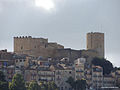
Photo: Giacomocostaphoto, CC BY-SA 3.0 · Wikimedia Commons
Historic village
Italian comune
Salemi is a town and comune in northwestern Sicily, Italy, administratively part of the province of Trapani. It is one of I Borghi più belli d'Italia ("The most beautiful villages of Italy").
Salemi is where Giuseppe Garibaldi announced the annexation of Sicily on May 14, 1860, as part of the Expedition of the Thousand, briefly making the town his headquarters after his landing at Marsala two days earlier.
Located on the slopes of Monte delle Rose Mazzaro between the river and the river Grande, the town is situated on the site of the ancient city Elima of Halyciae.
Theatre of the continuous wars between Selinunte and Segesta, Salemi (or rather: Alicia as it was known in these times), probably due to their common origin, has always been allied with Segesta.
In 272 BC, Salemi (then known as Alicia) was conquered by the Romans and declared a free city and free from taxes for its voluntary submission.
In the fifth century, like the rest of Sicily, Salemi fell under the dominion of the Vandals, and then under that of the Goths.
In 535, it was conquered by the Byzantine Belisarius, the general of Justinian.
In 827, Salemi fell under the control of the Arabs, and the area prospered. It was during this time that the name Salemi seems to have originated. In this regard, there are several theories about the origin of the name: one theory is attributed in honor of "Saleiman", son of the commander who conquered Alicia, that resulting from "rooms" for the presence of the salty river which makes the brackish waters that run through the city; another theory is that Salemi is derived from the meaning of "Salam" and that is a healthy and safe city, and "Salem", which means peace. The urban center was structured then, and remains in the same configuration today. In terms of agriculture, the Arabs introduced many new crops to Salemi and the surrounding areas: oranges, lemons, peaches, apricots, asparagus, artichokes, cotton, eggplant and spices such as saffron, cloves and cinnamon.
In 1077, and then in later Norman times, the town experienced a remarkable development. During this period, the castle was built.
In 1194, it came under the domination of the Swabians.
In 1266, the death of Frederick II, began the Angevin period, which reduced the amount of the population in poverty. …
Between the Jewish Quarter of the Giudecca and Salemi's Islamic Rabato, Salemi's architecture reflects its diverse history, with influences from all three major monotheistic religions: Christianity, Judaism, and Islam.
Legend has it that to cope with the plague that destroyed Salemi in 1270, the people Salemi began asking the Church for a patron saint. For these reasons, in 1290 the people made a formal request to Pope Nicholas IV, and the Church decided that the inhabitants should choose their protector. So they chose to draw names from a can, containing the name of all the saints, in order to choose the patron saint of Salemi. The first extraction was the name of Saint Nicholas of Bari. Not finding any link, they opted for a second extraction after which he was again Saint Nicholas. The extraction was performed again and "miraculously" confirmed for the third time. In his honor, he devoted himself a fair. It is said, also, that through the intercession of the saint together with Our Lady, Saint Francis in San Biagio and the town of Salemi was saved from cholera that God wanted scagliarvi in the course of 1740. In the central Freedom Square a statue was erected to thank the saint for having protected the city from the earthquake of 1794.
In 1987, on the occasion of the ninth centenary of the transfer of the relics of the saint from Myra (Turkey) in Bari, during a pilgrimage of Salemi in Bari, after S. Mass celebrated by the city's assistant pastor Don Giuseppe Maniscalco on the tomb of Saint Nicholas, patron as a gift to the inhabitants offered a scented oil and a few drops on the marble of the tomb was completely absorbed, stirring devout awe among onlookers. Quell'ampolla is kept in the treasury of the Basilica of Bari as a sign of reverence to the saint who continues to exist after seven centuries after its proclamation as Patron of Salemi.
The Feast of Saint Joseph is celebrated on March 19. On this occasion, votive altars are set up so-called "dinner" consisting of a wooden frame, covered with leaves of laurel and myrtle, and decked with oranges and lemons small loaves embroidered called "cuddureddi" and handcrafted by the women of the country representing animals, plants and work tools. On this occasion served are their famous desserts of Saint Joseph, the sfinci. …
The library, named after the philosopher and university professor Salemi Simone Corleo, contains more than 90,000 volumes. It is located in the heart of the historical center, near the church. In 2008 the art critic Philippe Daverio became librarian.
The Liceo Statale Francis of Aguirre is the Institute for the Classical Education, Technical and Vocational located in the district of Salemi. It is named after the illustrious jurist of Salemi. The Institute incorporates the High School and Technical Institute both located in Salemi, the Professional Institute of State for Industry and crafts (the operator of the fashion industry) based in Gibellina and Vocational of State for Industry and crafts (technical sector of the electricity industry) based in Santa Ninfa. Formerly the High School, known as the "Father Maurizio High School", was located in the convent of S. Augustine, now home to some municipal offices.
Museum of Sacred Art (Museo di Arte Sacra) - It houses the works from some of the churches were destroyed or damaged by the earthquake of 1968.
The core consists of sculptures of the '400 and '500 Sicilian, including many examples of the work of Domenico Gagini and a marble Madonna and Child attributed to Francesco Laurana.
The Museum contains the beautiful chapel of the "Santa House" built in 1705, a faithful copy of the Holy House of Loreto.
Museo del Risorgimento - This museum was reopened to the public on the occasion of the celebrations for the 150th anniversary of the unification of Italy. Through the documentary sources of the Municipal Historical Archive, paintings, portraits and collections of weapons of the time, the museum is a testimony to the participation of Salemi in the process of unification and the entrance of Garibaldi and the Thousand in Sicily.
Museum of the Mafia (Museo della Mafia) - The Mafia Museum was created by the Sicilian Caesar Inzerillo, together with the youth of the Sgarbi Laboratory. Dedicated to Leonardo Sciascia, a symbol of the anti-mafia not rhetoric, using the language of art to talk about the Mafia in a provocative and unconventional way, through a multi-sensory, contrived to immerse the visitor. …
Text from Wikipedia, the free encyclopedia, under CC BY-SA 4.0. Full article: «Salemi».
Distances are as the crow flies, not walking or driving.


Salemi is in Salemi, in the province of Trapani (Sicily), Italy. GPS coordinates: 37.81667, 12.80000.
Nearby you’ll find: Norman Castle (200 m away), Mokarta (5 km away), Monte Polizzo (5.4 km away).
Text. Wikipedia, the free encyclopedia (CC BY-SA 4.0).
Data. Wikidata (CC0); opening hours and contacts OpenStreetMap (ODbL).
Photos. Wikimedia Commons, author and licence on every image.
Updated 28 October 2026. All sources and licences