



Photo: Hagai Agmon-Snir حچاي اچمون-سنير חגי אגמון-שניר, CC BY-SA 4.0 · Wikimedia Commons
At a glance
- Type
- Castle
- Area
- 2,000 m²
- Protection
- Italian national heritage
- Coordinates
- 45°46′27″ N, 8°34′16″ E
- Address
- Via Rocca 10
History and description
The Rocca Borromeo di Angera, or Rocca d'Angera, also called Borromeo Castle, is a rocca on a hilltop above the town of Angera in the Province of Varese on the southern shores of Lago Maggiore. It has medieval origins and initially belonged to the Milanese archbishop. It passed then to the Visconti of Milan and later to the Borromeos, who are still the owners.
It is visible across the lake from Arona, where the remains of another castle with the same property history, the Rocca di Arona, stand.
The fortress comprises four parts, built in different periods, that enclose an internal courtyard. On the northeastern side, a wall with corner turrets extends outside the building and bends towards the lake until the edge of the cliff enclosing a garden.
History
The origin of the Rocca traces back to an early medieval watchtower, around which the other parts of the building later developed. The tower belonged to the Milanese church, and in the 13th century, it was the refuge of Archbishop Leone da Perego after being forced to flee Milan by the city faction led by the Della Torre family.
The Della Torre were defeated by the Visconti family, leader of the party of the Milanese nobility, in the battle of Desio in 1277. Ottone Visconti, archbishop and first lord of Milan, expanded the fortress, adding a new wing today called the Ottonian or Visconti wing. After Ottone's death, the Viscontis took possession of the Rocca and other properties belonging to the Milanese church. They paid great attention to Angera because they considered it their legendary place of origin.
Entirely built in squared and smooth local stone, the Ottonian wing is an excellent example of 13th-century residential architecture. It has a front marked by simple narrow windows on the ground floor and mullioned windows on the upper floor. The body of the building was erected against the ancient keep, closing off the original access to the keep.
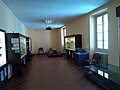
The Ottonian wing contains the Hall of Justice, decorated by an unknown painter with frescoes representing episodes from the life of Archbishop Ottone Visconti, his victory against the Della Torre, and the subsequent pacification of Milan. The frescoes were probably commissioned by Ottone's nephew, Matteo Visconti, to celebrate his memory.
They underline the magnanimity of Ottone Visconti and his will to peacefully obtain the city's government, as shown by the constant presence of the Christian cross above his head. Astrological symbols accompany Ottone's events in the upper part of the wall. The frescoes had to cover the six sides of the Hall of Justice to house all twelve zodiacal signs. A wall, whose frescoes have partly survived, shows the Wheel of Fortune to symbolize the alternation of events that saw the Della Torre pass from dominating the city of Milan to their defeat.
Between 1375 and 1385, for his wife Regina Della Scala, Bernabò Visconti built a third wing known as Ala Scaligera (Della Scala wing). …
Today
Rocca di Angera is today in excellent condition and opens for visitors. The internal courtyard (Corte Nobile) is the castle's first part after the entrance. The nearby former stables house a mighty winepress, considered one of the largest in Europe.
The Rocca is best known for the Hall of Justice with its significant frescos. Two other rooms are the Sala delle Cerimonie (Hall of the Ceremonies), with 15th-century frescoes recovered from the Palazzo Borromeo in Milan after the bombings of the Second World War, and the Sala dei Fasti Borromeo (Hall of the Borromean Splendors), containing paintings glorifying the Borromeo family.
The castle also contains a Museo della Bambola e del Giocattolo (Museum of the Doll and Toy), founded in 1988 by Princess Bona Borromeo Arese, displaying over a thousand dolls from all over the world made between the 18th century and the present day. The keep offers a broad view of the southern Lake Maggiore region.
Externally, toward the lake, a medieval garden stands with medicinal plants, aromatic herbs, and a vineyard.
Text from Wikipedia, the free encyclopedia, under CC BY-SA 4.0. Full article: «Rocca Borromeo di Angera».
Photos
Getting there
AronaTrain, nearest
2.3 km as the crow flies
Rocca Borromeo di AngeraVia Rocca 10
Angera400 m
Aeroporto internazionale Milano Malpensa "Silvio Berlusconi"20.0 km
Distances are as the crow flies, not walking or driving.
Loading map…
Nearby
See on the mapMore castles in Lombardy


Frequently asked questions
Where is Rocca Borromeo di Angera?
Rocca Borromeo di Angera is in Angera, in the province of Varese (Lombardy), Italy. Address: Via Rocca 10. GPS coordinates: 45.77413, 8.57121.
How much does it cost to visit Rocca Borromeo di Angera?
There is an admission charge. Up-to-date prices are on the official website.
What else is there to see near Rocca Borromeo di Angera?
Nearby you’ll find: Civico museo archeologico di Angera (400 m away), Villa Cantoni (1.6 km away), Rocca Borromea (1.6 km away).
Sources and licences
Text. Wikipedia, the free encyclopedia (CC BY-SA 4.0).
Data. Wikidata (CC0); opening hours and contacts OpenStreetMap (ODbL).
Photos. Wikimedia Commons, author and licence on every image.
Credits for the 3 photos
- AngeraJune032026 05 — Hagai Agmon-Snir حچاي اچمون-سنير חגי אגמון-שניר, CC BY-SA 4.0
- Angera - Rocca Borromea 0393 — Phyrexian, CC BY-SA 4.0
- 21021 Angera, Province of Varese, Italy - panoramio (10) — Ben Bender, CC BY-SA 3.0
Updated 28 October 2026. All sources and licences