




- Free 1st Sunday
Photo: Twice25 & Rinina25, CC BY 2.5 · Wikimedia Commons
Museum
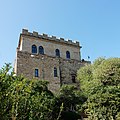
Historical building in Trieste, Italy
Trieste (TS), Friuli Venezia Giulia
Risiera di San Sabba (Slovene: Rižarna) was a Nazi concentration camp operating in Trieste. Officially designated as a police detention camp (Polizeihaftlager), it was the only one on Italian territory with a crematorium. It was primarily used to eliminate members of the resistance in the Operational Zone of the Adriatic Littoral (OZAK), but another important function was as a transit camp for Jews on the way to the extermination camps, primarily Auschwitz. It was a place typical of the Nazi system to help realize the final solution to the Jewish question and to suppress undesirable rebels (which the Nazis labelled as Banditen), while on the other hand systematically exploiting the civilian population.
On top of prisoners killed on the spot or deported, civilians who were captured in raids or destined for forced labour were also confined here. Estimates for the number of victims of San Sabba range from 2000 based on court testimonies up to a maximum of 5000. Victims were usually killed either using exhaust gasses from transport vehicles or they were bludgeoned to death; it is also recorded that some of the victims were shot.
The building complex was built between 1898 and 1913 in the periphery of Trieste in the San Sabba (or San Saba) neighbourhood and was first used for rice-husking, giving it the name Risiera.
Following the Armistice of Cassibile in 1943, large parts of northern Italy became part of the Italian Social Republic, with the provinces of Udine, Trieste, Gorizia, Pola, Fiume and Ljubljana fell under the control of OZAK. The administration of the territory was placed under the command of Friedrich Rainer, the Gauleiter of Carinthia.
Initially the Risiera became a provisional prisoner of war camp for Italian soldiers captured following the armistice, becoming known as Stalag 339.
At the end of October 1943 the complex became a Polizeihaftlager (or police detention camp), used for the collection of prisoners awaiting deportation to Germany and Poland. The facility was used for the detention or elimination of partisans and political prisoners, Jehovah's Witnesses and Jews who were deemed too weak to survive transportation.
After a few months a crematorium was built at the camp by Erwin Lambert.
The Risiera was also used as a storage facility for the items stolen from the prisoners. SS official Odilo Globočnik, previously a close collaborator of Reinhard Heydrich and responsible for the extermination camps in the General Government as part of Operation Reinhard, responsible for the killing of 1.2 million Jews supervised the Risiera. He was assisted by members of the Einsatzkommando Reinhard, under the command of Dietrich Allers while Josef Oberhauser was the commandant. Both had begun their work as part of Aktion T4, which organized the forced euthanasia of the physically and mentally disabled in the camps of Treblinka, Sobibor and Belzec (100,000 victims according to the Nuremberg Trials).
The then Bishop of Trieste, Antonio Santin often intervened with the Nazi authorities, sometimes resulting in the release of prisoners (such as Giani Stuparich and his family), but often with little success. …
Inaugurated in 1975, the museum was re-structured as part of a project by the architect Romano Boico.
There are a number of structures that no longer exist in the camp due to the transformation into a refugee camp for the Italians fleeing from the Socialist Federal Republic of Yugoslavia and its restoration and transformation after it became a national monument. Still visible today are:
The cella della morte where prisoners who were destined to be murdered shortly after arriving at the camp were kept.
Seventeen cells housing up to six prisoners, reserved especially for Slovenes, Croats, partisans, political prisoners and Jews destined to be executed in a few days or weeks. The first two cells were used for torture and to collect materials from prisoners. Thousands of confiscated identity documents were found taken from prisoners, but also forced laborers.
The four storey building where large groups of Jews and civilian or military prisoners were kept awaiting deportation to Germany and the camps at Dachau, Auschwitz, Mauthausen, Bergen-Belsen from which very few would return.
The main building, once used as a barracks, now contains the museum. The area now containing the museum was at the time used as a morgue.
Giovanni Battista Berghinz, Italian military officer and partisan, tortured and murdered in the camp on 12 August 1944
Cecilia Deganutti, Italian partisan, murdered in the camp on 4 April 1945
Vincenzo Gigante, Italian labour organizer, communist and partisan, murdered in the camp in November 1944.
Elio Morpurgo, Jewish-Italian politician, former Mayor of Udine (1889–1894), member of the Chamber of Deputies (1895–1919), including holding a number of cabinet positions. He was nominated to the Senate in 1919, he became a member of the National Fascist Party. He was arrested and briefly detained at the Risiera in 1944 before being transported to Auschwitz, he died en route.
Boris Pahor, Slovene Novelist from Trieste, transported to Dachau and a number of other camps before being liberated from Bergen-Belsen on 15 April 1945.
Giani Stuparich writer and recipient of the Gold Medal of Military Valor for his actions in the First World War, arrested with his family on the night of 25 August 1944, released after seven days following interventions from Antonio Santin and Bruno Coceani.
Text from Wikipedia, the free encyclopedia, under CC BY-SA 4.0. Full article: «Risiera di San Sabba».
Distances are as the crow flies, not walking or driving.


Aquileia (UD)


Risiera di San Sabba is in Trieste, in the province of Trieste (Friuli Venezia Giulia), Italy. Address: Via Giovanni Palatucci 5, 34148 Trieste. GPS coordinates: 45.62083, 13.78917.
Nearby you’ll find: French frigate Danaé (1.8 km away), Museo De Henriquez (2.3 km away), Museo Civico di Storia Naturale di Trieste (2.3 km away).
Text. Wikipedia, the free encyclopedia (CC BY-SA 4.0).
Data. Wikidata (CC0); opening hours and contacts OpenStreetMap (ODbL).
Photos. Wikimedia Commons, author and licence on every image.
Updated 28 October 2026. All sources and licences