


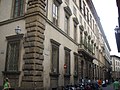


Photo: Gryffindor stitched by Marku1988 This image was created with Hugin., CC BY-SA 3.0 · Wikimedia Commons
Historic villa / palace
Palazzo Panciatichi
Palace in Florence, Via Cavour 2
- Within the UNESCO World Heritage Site “Historic Centre of Florence”
At a glance
- Coordinates
- 43°46′29″ N, 11°15′23″ E
History and description
The Palazzo Panciatichi is a Renaissance palace located on Via Camillo Cavour 2 in the quartiere of San Giovanni, Florence, region of Tuscany, Italy. A different Palazzo Panciatichi-Ximenes or Ximenes-da Sangallo is located at Borgo Pinti 68, corner of via Giusti, in Florence.
History
A large house was built at this site by Agnolo di Ghezzo della Casa at the end of the fourteenth century. Excavations at the site located the remains of an 11th-century bridge over the former river Mugnone. In 1618, the property was bought by Capponi, then in 1621, by the wealthy merchant Bandino Niccolò Panciatichi, who commissioned two terraces and moved the portal.
In 1696, Cardinal Bandino Panciatichi, living in Rome, commissioned Carlo Rainaldi and Francesco Fontana to design a remodeling. The work was forwarded by Antonio Maria Ferri and Paolo Falconieri, who completed the interior in 1697. In 1741 some rooms inside were painted by Giovanni Domenico Ferretti, Vincenzo Meucci and Pietro Anderlini, other rooms were decorated in 1750 by Niccolò Agostino Veracini and Vincenzo Torrigiani. Between 1742-1757, the palace underwent further expansion of the palace directed by Giulio Mannaioni. Around the mid-nineteenth century, the descendants of the Panciatichi moved to a palace in Borgo Pinti, and converted the rooms of the palace into apartments.
In 1910 the property was sold to Cattolica Assicurazioni, then to the National Institute of Insurance (Istituto Nazionale di Assicurazione). Rented in part in 1960 to the Education Authority, the complex was later to house the Regional Council of Tuscany, which still has its headquarters there. To this end, the building was remodeled by Franco Bonaiuti between 1972 and 1973. The palace now is connected to the adjacent Palazzo Capponi Covoni.
At one corner is an aedicule with a Madonna and Child by Desiderio da Settignano (original in the National Museum of the Bargello). At other corners are the coat of arms of the Panciatichi.
Text from Wikipedia, the free encyclopedia, under CC BY-SA 4.0. Full article: «Palazzo Panciatichi».
Photos
Getting there
Firenze Santa Maria NovellaTrain, nearest
800 m as the crow flies
Palazzo Panciatichi
Aeroporto Firenze Amerigo Vespucci5.8 km
Distances are as the crow flies, not walking or driving.
Loading map…
Nearby
See on the mapMore historic villas and palaces in Tuscany

- Free 1st Sunday

- UNESCO
- Free 1st Sunday

- UNESCO
- Free 1st Sunday

- Free 1st Sunday

Frequently asked questions
Where is Palazzo Panciatichi?
Palazzo Panciatichi is in Florence, in the province of Firenze (Tuscany), Italy. GPS coordinates: 43.77472, 11.25639.
What else is there to see near Palazzo Panciatichi?
Nearby you’ll find: Palazzo di Bettino Ricasoli (100 m away), Convent of Scolopi (100 m away), Palazzo Capponi-Covoni (100 m away).
Sources and licences
Text. Wikipedia, the free encyclopedia (CC BY-SA 4.0).
Data. Wikidata (CC0); opening hours and contacts OpenStreetMap (ODbL).
Photos. Wikimedia Commons, author and licence on every image.
Credits for the 9 photos
- Consiglio Toscana Apr 2008 (P) — Gryffindor stitched by Marku1988 This image was created with Hugin., CC BY-SA 3.0
- Palazzo Panciatichi ok — User:sailko, CC BY 2.5
- Palazzo panciatichi, 11 — sailko, CC BY 2.5
- Palazzo panciatichi, retro su via ricasoli — sailko, CC BY 2.5
- Palazzo panciatichi, retro — sailko, CC BY 2.5
- Palazzo panciatichi, stemmaretro — sailko, CC BY 2.5
- Via cavour 2, palazzo panciatichi 01 — Francesco Bini, CC BY-SA 4.0
- Via cavour 2, palazzo panciatichi, tabernacolo con copia di una madonna di desiderio da settignano (al bargello) 01 — Francesco Bini, CC BY-SA 4.0
- Via Ricasoli 11, palazzo panciatichi, 01 — Francesco Bini, CC BY-SA 4.0
Updated 28 October 2026. All sources and licences