


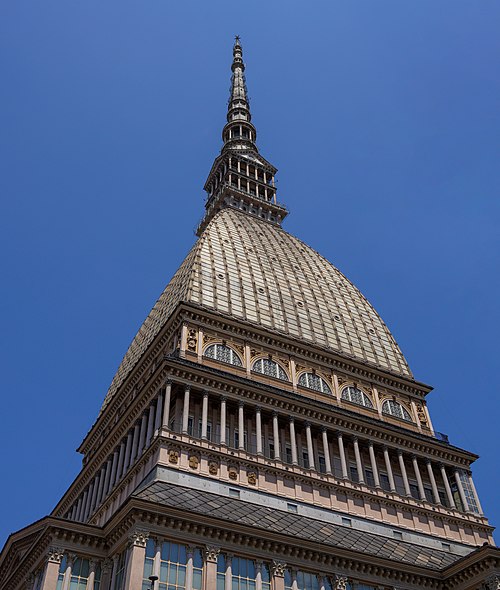
Photo: sailko, CC BY-SA 3.0 · Wikimedia Commons
At a glance
- Type
- Museum
- Period
- Modern era, 1940
- Area
- 5,681 m²
- Protection
- Italian national heritage
- Coordinates
- 45°04′30″ N, 7°41′17″ E
- Address
- via XX Settembre 88c
History and description
Turin (Italian: Torino) is a city and a business and cultural centre in northern Italy. It is the capital and largest city of Piedmont and of the Metropolitan City of Turin. From 1861 to 1865, it was the first capital of the Kingdom of Italy. The city is mainly on the western bank of the River Po, below its Susa Valley, and is surrounded by the western Alpine arch and Superga hill. The population of the city proper is 855,654 as of 2026, while the population of the urban area is estimated by Eurostat to be 1.7 million inhabitants. The Turin metropolitan area is estimated by the OECD to have a population of 2.2 million.
The city was historically a major European political centre. From 1563, it was the capital of the Duchy of Savoy, then of the Kingdom of Sardinia ruled by the House of Savoy, and then the first capital of the Kingdom of Italy from 1861 to 1865. Turin is sometimes called "the cradle of Italian liberty" for having been the political and intellectual centre of the Risorgimento that led to the unification of Italy, as well as the birthplace of notable individuals who contributed to it, such as Camillo Benso, Count of Cavour.
History
The Taurini were an ancient Celto-Ligurian, Alpine people, who occupied the upper valley of the River Po, in the centre of modern Piedmont. In 218 BC, they were attacked by Hannibal as he was allied with their long-standing enemies, the Insubres. The Taurini chief town (Taurasia) was captured by Hannibal's forces after a three-day siege. As a people they are rarely mentioned in history. It is believed that a Roman colony was established after 28 BC under the name of Julia Augusta Taurinorum (modern Turin). Both Livy and Strabo mention the Taurini's country as including one of the passes of the Alps, which points to a wider use of the name in earlier times.
In the 1st century BC, the Romans founded Augusta Taurinorum. Via Garibaldi traces the exact path of the Roman city's decumanus which began at the Porta Decumani, later incorporated into the Castello or Palazzo Madama. The Porta Palatina, on the north side of the current city centre, is still preserved in a park near the cathedral. Remains of the Roman-period theatre are preserved in the area of the Manica Nuova. Turin reached about 5,000 inhabitants at the time, all living inside the high city walls.
After the fall of the Western Roman Empire, the town, along with the rest of the Italian peninsula, was conquered by the Heruli and the Ostrogoths, recaptured by the Romans, but then conquered again by the Lombards whose territory then fell into the hands of the Franks under Charlemagne (773). The Contea di Torino (countship) was founded in the 940s and was held by the Arduinic dynasty until 1050. After the marriage of Adelaide of Susa with Humbert Biancamano's son Otto, the family of the Counts of Savoy gained control. While the title of count was held by the Bishop as count of Turin (1092–1130 and 1136–1191) it was ruled as a prince-bishopric by the Bishops. In 1230–1235, it was a lordship under the Marquess of Montferrat, styled Lord of Turin. At the end of the 13th century, when it was annexed to the Duchy of Savoy, the city already had 20,000 inhabitants. Many of the gardens and palaces were built in the 15th century when the city was redesigned. The University of Turin was also founded during this period. …
Administration
Turin is split up into 8 boroughs, locally called circoscrizioni; these do not necessarily correspond to the historical districts of the city, which are rather called quartieri, rioni, borghi, borgate or zone. The circoscrizioni system originally comprised 10 of them, that were reduced to 8 by merging borough 9 into 8, and 10 into 2.
Circoscrizione 6: Barriera di Milano – Regio Parco – Barca – Bertolla – Falchera – Rebaudengo – Villaretto
Circoscrizione 7: Aurora – Vanchiglia – Sassi – Madonna del Pilone
Circoscrizione 8: San Salvario – Cavoretto – Borgo Po – Nizza Millefonti – Lingotto – Filadelfia
The mayor of Turin is directly elected every five years. The current mayor of the city is Stefano Lo Russo (PD), elected in 2021.
Text from Wikipedia, the free encyclopedia, under CC BY-SA 4.0. Full article: «Museum of antiquities».
Timeline
- 1940Founded and opened
Events and people from Wikidata (CC0).
Photos
Getting there
Torino Porta NuovaTrain, nearest
1.7 km as the crow flies
Museum of antiquitiesvia XX Settembre 88c
Aeroporto di Torino14.3 km
Distances are as the crow flies, not walking or driving.
Loading map…
Nearby
See on the mapMore museums in Piedmont

- UNESCO


Frequently asked questions
Where is Museum of antiquities?
Museum of antiquities is in Turin, in the province of Torino (Piedmont), Italy. Address: via XX Settembre 88c. GPS coordinates: 45.07491, 7.68801.
How old is Museum of antiquities?
Wikidata dates it to 1940.
What else is there to see near Museum of antiquities?
Nearby you’ll find: Galleria Sabauda (200 m away), Roman Theatre of Turin (200 m away), Palatine Towers (300 m away).
Sources and licences
Text. Wikipedia, the free encyclopedia (CC BY-SA 4.0).
Data. Wikidata (CC0); opening hours and contacts OpenStreetMap (ODbL).
Photos. Wikimedia Commons, author and licence on every image.
Credits for the 2 photos
- Museo di antichità, torino, ingresso — sailko, CC BY-SA 3.0
- Torino-MuseoAntichita — Marco Plassio, CC BY-SA 3.0
Updated 28 October 2026. All sources and licences