


- Most beautiful villages
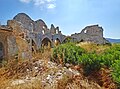
Photo: Kristianpot, CC BY-SA 4.0 · Wikimedia Commons
Gaeta is a seaside resort in the province of Latina in Lazio, Italy. Set on a promontory stretching towards the Gulf of Gaeta, it is 133 km (83 mi) south of Rome and 96.5 km (60 mi) north of Naples.
The city has played a conspicuous part in military history; its walls date to Roman times and were extended and strengthened in the 15th century, especially throughout the history of the Kingdom of Naples (later the Kingdom of the Two Sicilies).
Present-day Gaeta is a fishing port and a seaside resort. NATO has a naval base here. In 2025, it received the blue and green flags from FEE for the twelfth consecutive year. It is one of the I Borghi più belli d'Italia ("The most beautiful villages of Italy").
Ancient Caieta was situated on the slopes of the Torre di Orlando, a promontory overlooking the Mediterranean Sea. It was inhabited by the Oscan-speaking Italic tribe of the Aurunci tribe by the 10th-9th century BC. Only in 345 BC did the territory of Gaeta come under Rome's influence.
Caieta, with its temperate climate like the neighbouring Formia and Sperlonga, became one of the earliest locations of villae maritimae, seaside villas and luxurious retreats for the Roman elite owned, for example, by Scipio Africanus (236–183 BC) and Gaius Laelius. Caieta was also linked to the capital of the Roman Empire by the Appian Way and its extension the Via Flacca.
The remains of the monumental villa of Lucius Marcius Philippus, stepfather of Augustus, are in Hotel Irlanda in the Arcella area. Lucius Munatius Plancus (consul in 42 BC) had a vast villa located on Monte Orlando overlooking the Gulf of Gaeta. His mausoleum, built at the end of the 1st century BC, is still an impressive monument inside a large clearing within the villa.
Lucius Sempronius Atratinus probably lived here as indicated by his mausoleum. Atratinus was suffect Consul in 40 and 34 BC, propraetor in Greece in 39 BC, and first admiral of Mark Antony's fleet from 38–34 BC.
In the Roman imperial age, it continued as a popular seaside resort for many important and rich characters of Rome. Emperor Domitian (r. 81–96 AD) also had a villa in the area.
Emperor Antoninus Pius restored the port, given its strategic relevance.
Remains of an aqueduct that supplied the town from the Conca hill can be seen a few metres from the villa of Hortensius.
At the beginning of the Middle Ages, after the Lombard invasion, Gaeta remained under the suzerainty of the Byzantine Empire. In the following years, like Amalfi, Sorrento and Naples did, it would seem to have established itself as a practically independent port and to have carried on a thriving trade with the Levant. …
The main attractions of the city include:
The Angevine-Aragonese Castle. Its origins are uncertain: most likely it was built in the 6th century, in the course of the Gothic War, or during the 7th century to defend the town from the Lombards' advance. The first documents mentioning it date to the age of Frederick II of Hohenstaufen, who strengthened it in 1233. The current structure is made of two different edifices: the "Angevine" one, in the lower sector, dating to the House of Anjou's rule in the Kingdom of Naples; and the "Aragonese", at the top, built by emperor Charles V, together with the other fortifications that made Gaeta one of the strongest fortresses in southern Italy. The Angevine wing housed a military jail until the 1980s (German war criminal officers Walter Reder and Herbert Kappler were imprisoned here). Now it is a property of Gaeta's municipality, which uses it for conferences and exhibitions. In the dome of the tallest tower is the Royal Chapel, built by King Ferdinand II of the Two Sicilies in 1849.
The Mausoleum of Lucius Munatius Plancus (22 BCE) is a cylindrical travertine monument at the top of Monte Orlando (168 m (551 ft)). It stands at 13.20 m (43.3 ft) and has a diameter of 29.50 m (96.8 ft). Another important Roman public man, Lucius Sempronius Atratinus, Mark Antony's fleet commander, has a mausoleum sited in the more recent district of Gaeta: of similar diameter; it is, however not as well preserved.
The Sanctuary of SS. Trinità was mentioned as early as the 11th century and visited, among others, by St. Francis and Saint Philip Neri. The Crucifix Chapel was built in 1434 over a rock which had fallen from the nearby cliffs. From the sanctuary, the Grotta del Turco can be visited: it is a grotto which ends directly in the sea and where the waves create atmospheric effects of light. …
In 1967, the homeport of the U.S. Sixth Fleet flagship relocated from Villefranche-sur-Mer to Gaeta. Support facilities were established in Mount Orlando. This was done following the transfer of the responsibilities of Lead Nation for NATO Naval Forces in the Mediterranean from the United Kingdom to the United States. The British Mediterranean Fleet was abolished - its former base in Malta was no longer exclusively under British control due to that nation having achieved independence from the UK.
It is currently used as the home port for the flagship of the United States Sixth Fleet. The Sixth Fleet commander, typically a 3-Star US Navy Vice-Admiral, has operational control of Naval task forces, battle groups, amphibious forces, support ships, land-based surveillance aircraft, and submarines in the Mediterranean Sea. Gaeta's role has been important since the early 19th century to the US Navy's commitment to forward presence. Pope Pius IX and King Ferdinand II of the Kingdom of Two Sicilies, paid visits to the USS Constitution while in Gaeta in 1849. Nine ships have been stationed in Gaeta, with the primary mission of serving as the flagship for the Sixth Fleet commander. The first was the USS Little Rock (CG-4). Other Sixth Fleet flagships included USS Springfield (CLG-7), USS Albany (CG-10), USS Puget Sound (AD-38), USS Coronado (AGF-11), USS Belknap (CG-26) and USS La Salle (AGF-3). The current flagship is the USS Mount Whitney (LCC-20).
The town is host to the families of the crews who work on the ship. There was a DOD school for American children and the US Naval Support Activity, Gaeta, which provided health care and other services until it was closed down in 2005. The NATO base itself was located on Monte Orlando, which overlooks the Gulf of Gaeta. It has recently been transferred to a shore-based facility where the Commander Sixth Fleet also operates.
Gaeta has erected a monument to John Cabot, who discovered Canada in 1500. Other people associated with the town include the painters Giovanni da Gaeta and Giovanni Filippo Criscuolo. For a full list, see People from Gaeta.
Gaetani speak a dialect of Italian that, while similar to the nearby Neapolitan, is one of the few Italian dialects to preserve Latin's neuter gender.
Distinctive local cuisine includes the tiella, which resembles both a pizza and a salty crostata. Tiella can be made with several stuffings. Typical stuffings include diced squids, parsley and chilli pepper, octopuses and tomatoes. Other stuffings include escaroles and baccalà (dried and salted cods), courgettes/zucchini, spinaches, rapini and sausages, olives, onions, and sardines. The town is also known for its brand of olives, marketed throughout the world (the main production, however, takes place in neighbouring Itri), and its beaches (Serapo, Fontania, Ariana, Sant'Agostino). Sciuscielle, mostaccioli, susamelli, and roccocò are also local desserts most often made during Christmas time. A Latin text found in Gaeta dating from 997 AD contains the earliest known usage of the word "pizza".
The most famous folklore event of Gaeta is Glie Sciusce of 31 December, in which bands of young Gaetani in traditional costumes head to the city's streets, playing mainly self-built instruments.
Text from Wikipedia, the free encyclopedia, under CC BY-SA 4.0. Full article: «Gaeta».
Distances are as the crow flies, not walking or driving.


Gaeta is in Gaeta, in the province of Latina (Lazio), Italy. GPS coordinates: 41.21667, 13.56667.
Nearby you’ll find: Former convent of Saint Agatha (1.3 km away), Mausoleum of Lucius Munatius Plancus (1.4 km away), Castello di Gaeta (1.8 km away).
Text. Wikipedia, the free encyclopedia (CC BY-SA 4.0).
Data. Wikidata (CC0); opening hours and contacts OpenStreetMap (ODbL).
Photos. Wikimedia Commons, author and licence on every image.
Updated 28 October 2026. All sources and licences