


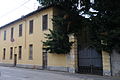

Photo: Aldo Signorelli, CC BY-SA 4.0 · Wikimedia Commons
Castle
Castle of Legnano
Located south of the city on an island in the river Olona
At a glance
- Type
- Castle
- Style
- Medieval architecture
- Protection
- Italian national heritage
- Coordinates
- 45°35′09″ N, 8°55′29″ E
- Address
- Viale Pietro Toselli, 20025 Legnano
History and description
The Visconti Castle is a medieval fortification that stands south of Legnano on a natural island in the Olona River. It has also been known as the castle of San Giorgio (lat. Castrum Sancti Georgi) since the 13th century. The architectural complex is located on Viale Toselli, between Castello Park and Piazza I Maggio.
Strategic function
The presence of a castle in Legnano is linked to the strategic function the city of Carroccio had from the Middle Ages to the 16th century. Legnano was located along an important medieval communication route that ran along the Olona River and connected Mediolanum (modern Milan) with the Verbannus Lacus (Lake Verbano, i.e., Lake Maggiore), the Via Severiana Augusta, which existed since Roman times. The modern Simplon road, built during the Napoleonic era, echoes in its layout the ancient road in use in Roman and medieval times.
The defense of Legnano was important because its eventual conquest could allow Milan's enemies easy access to the northwestern Milanese countryside due to the fact that it was located at the outlet of the Olona Valley, which ends at Castellanza and to aim, through this road, at the Milanese capital. In the Middle Ages Legnano, although formally belonging to Seprio, gravitated around Milan. The link between Milan and the city of the Carroccio was not only military, but also economic: Legnano and the other contadi that gravitated around the capital of Milan also supplied Milan with part of the foodstuffs produced.
When it belonged to the Viscontis, the castle of Legnano was part of a larger defensive system of the belt that enclosed Milan. In particular, fortifications were located in places where the Visconti owned a greater amount of real estate. The castles located around Milan served their function both for military purposes, mainly for external attacks and internal civil wars within the Milanese lordship, and for other purposes. They were also used as summer vacation spots, which allowed the lords to leave the city during the hottest months, during which water was scarce and heat prevailed, aided by the proximity of city buildings: at the time, dwellings in Milan were divided by narrow streets. Another use was the organization of hunting parties in the woods located near the castles, a sport that was very common in the 12th and 13th centuries. …
History
The origins of Legnano Castle are linked to an ancient convent of Augustinians dedicated to Saint George, whose presence is documented as early as 1231. However, this religious building does not appear in the register of churches in Goffredo da Bussero's Liber Notitiae Sanctorum Mediolani, which describes the religious context of the Milan area in the late 13th and early 14th centuries.
This monastery, which included a small church also dedicated to St. George, owned much of the arable land that extended beyond Legnano to Canegrate, San Vittore Olona, Villa Cortese and Dairago. The dedication of the convent and the small church to St. George may have been related to the cult of this saint, which may have been common in the surrounding countryside and which would then have influenced the choice of the monastery's dedication, or the opposite may have happened, that is, the popular cult of St. George would have spread through the dedication of the convent and the small church. It is likely that the presence of this monastery later led to the dedication of not only the castle but also a district of Legnano (the "Costa di San Giorgio") and the neighboring municipality of San Giorgio su Legnano to St. George. Hypotheses discarded by scholars consider instead that the reference to the saint derives from the municipality of San Giorgio su Legnano, which in the early 15th century was known as locus Sancti Georgi Plebis Parabiaghi Duc. Mlni ("locality of San Giorgio, of the parish of Parabiago, Duchy of Milan").
The presence of ecclesiastical properties in Legnano is evidenced by documents dating back several centuries before the mentioned written deed of 1231. The first document that mentions archiepiscopal properties located in the village of Legnano dates back to October 23, 789, thus in Frankish times: it deals with an exchange of land located in Legnanello between Pietro I Oldrati, archbishop of Milan, and the monastery of Sant'Ambrogio of Milan. This document, which is also the first that mentions the village, reads: …
The architectural complex
The lower part of the watchtower, which was presumably built in 1231 and belonged to the ancient convent, can still be seen in the modern structure: this building, which is the oldest part of the Legnano fortification, was in fact incorporated into the castle and corresponds to the central portion of the wing that is immediately to the right of the main keep.
The remains of the tower are square in shape and possess a 7.5 m edge. The windows and doors, which were later bricked up, were single-arched windows and are still recognizable in the modern structure: the arches were made of brick ashlar and white marble. At this tower was the original entrance to the structure, which is still recognizable on the west side although it has been walled up: it features a wide brick arch embellished with white marble inserts. However, the name or family of the builder of the watchtower is uncertain. As already mentioned, according to some studies, the tower may have been built by Uberto Visconti, or by the castle's later owners, the Della Torre family.
The greater antiquity of this part of the castle is also indicated by the appearance of the outer walls, which are rougher and look different from those of the remaining part of the structure, as well as by the level of the original floors, which is 1.5 m lower than the rest of the ground floor. Work performed in the 15th century later restored all the floors to the same level. Originally, this portion of the building, when it served as a tower, was taller and had an additional floor at the top marked by defensive battlements.
As for decorations, those on the ground floor have disappeared, while on the upper floor there are frescoes from the Renaissance period. When the castle was converted into an agricultural estate, wine presses were allocated in the original watchtower: the channels dug on the stone floor that were used to transport the must remain from this use. The scaffolding holes that were used at the time to carry out the work of this conversion have also come down to the 21st century: they are rough hut-shaped niches and can be distinctly seen on the walls of this portion of the castle. …
Text from Wikipedia, the free encyclopedia, under CC BY-SA 4.0. Full article: «Castle of Legnano».
Photos
Getting there
LegnanoTrain, nearest
1.4 km as the crow flies
Castle of LegnanoViale Pietro Toselli, 20025 Legnano
Aeroporto internazionale Milano Malpensa "Silvio Berlusconi"16.3 km
Distances are as the crow flies, not walking or driving.
Loading map…
Nearby
See on the mapMore castles in Lombardy


Frequently asked questions
Where is Castle of Legnano?
Castle of Legnano is in Legnano, in the province of Milano (Lombardy), Italy. Address: Viale Pietro Toselli, 20025 Legnano. GPS coordinates: 45.58581, 8.92468.
What else is there to see near Castle of Legnano?
Nearby you’ll find: Museo Fratelli Cozzi (600 m away), Palace Leone da Perego (1 km away), Palazzo Italia (1.1 km away).
Sources and licences
Text. Wikipedia, the free encyclopedia (CC BY-SA 4.0).
Data. Wikidata (CC0); opening hours and contacts OpenStreetMap (ODbL).
Photos. Wikimedia Commons, author and licence on every image.
Credits for the 8 photos
- Castello di San Giorgio all'imbrunire — Aldo Signorelli, CC BY-SA 4.0
- Caneva - Castello di Legnano — LukeWiller, CC BY-SA 4.0
- Castello di Legnano ora blu — Aldo Signorelli, CC BY-SA 4.0
- Castello Di San Giorgio - Ciclista — Aldosignorelli, CC BY-SA 4.0
- Castello Di San Giorgio - Passeggiata Serale — Aldosignorelli, CC BY-SA 4.0
- Castello Di San Giorgio - Verso Sera — Aldosignorelli, CC BY-SA 4.0
- Castello di San Giorgio 1 — Pattax, CC BY-SA 3.0
- Boom !! — Framor1981, CC BY-SA 4.0
Updated 28 October 2026. All sources and licences