


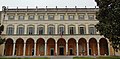


Photo: Parma1983, CC BY-SA 4.0 · Wikimedia Commons
At a glance
- Type
- Castle
- Coordinates
- 45°16′17″ N, 10°05′06″ E
History and description
The Castle of Pontevico is a former fortification built at the height of the early Middle Ages in Pontevico, Province of Brescia, currently used as a neuropsychiatric institute. It has also been remodeled several times over the centuries, due to the continuous sieges suffered over time. It was completely rebuilt in 1844, and the current version dates from the second half of the 20th century.
History
With the Frankish conquest of the territory at the hands of Charlemagne, dating back to the 9th century, feudal struggles began (first between bishoprics and then between communes) and Pontevico found itself placed in an important strategic position along the course of the Oglio River.
The first construction of a castle dates back to the end of the 9th century due to the continuous raids carried out by the Hungarians at that time, being remembered in the chronicles of the time as a colossal stronghold, called munitissimum castrum. A wide moat equipped with drawbridges surrounded the fortress and encircled its forts. It is thought of the ancient presence of an underground road that, starting from the castle, connected Pontevico to nearby Robecco d'Oglio.
On July 26, 1127, Count Goizone Martinengo granted the investiture of Pontevico Castle to Bishop Villano and the consuls of the Commune of Brescia.
In 1191, Pontevico Castle had been, at the hands of Emperor Henry VI, ceded to the people of Cremona. However, it is known for certain that, in January of the following year, it immediately returned to Brescian hands, so much so that along with it came under Pontevico's control not only the waters of the Oglio River, but also the 100 trabucchi (170 meters) starting from the right bank of the Oglio, in Cremonese territory, and with them plantations, pastures and every building located in that area.
Also by the end of the 12th century, the fortress was one of the most important in the Brescian area, so much so that in the same period it was further renovated and enlarged as part of the grandiose military measures of the Commune of Brescia to deal with the growing threat from Cremona. On the occasion of the laying of the foundation stone of the new fortress, a special ceremony was held, in which the three most influential men in the town, after touching the pole of the public banner with their right hand, bowed and kissed the foundation stone, with the bishop's blessing. …
Description
In its present form, the castle possesses its medieval appearance, in Romanesque style and with a quadrangular shape. However, perhaps due to an oversight during the last restoration in the second half of the 20th century, the merlons were made "dovetailed," thus in Ghibelline style, while in the original form they were supposed to be squared, in Guelph style. Positioned toward the Oglio River is a plaque depicting the coat of arms of Pontevico and dating from 1560.
The inner courtyard, surrounded by porticoes around the perimeter, with a loggia, consists of several gardens and contains a small church inside.
It is known that since the time of the Venetian Republic, the castle had a chapel dedicated to St. Mark, the patron saint of the Serenissima; however, since 1815, due to the demolition of the ancient structure, the relics of the shrine have been in a side chapel of the Church of St. Thomas and St. Andrew. The new church dates from 1909, erected at the behest of Monsignor Cremonesini.
The religious structure is placed in the center of the courtyard and is dedicated to the Holy Family; the high altar, on the other hand, is dedicated to Mary of Nazareth, whose simulacrum is placed in the center of the apse.
The small brick church has a gabled facade with a central marble rose window, on which is placed a small bell gable, equipped with two bells. Inside, the main decoration consists of an altarpiece, by Brescian painter Vittorio Trainini, depicting the blessed nun in prostration before Mary holding the child to her.
Next to the small church is a Romanesque-style crypt containing the remains of Bassano Cremonesini, author of the rebirth of the castle, which he transformed into a neuropsychiatric institute.
A trifora provides access to the crypt, whose illumination is made possible by a stained-glass window, on which are two angels bearing a ribbon on which is the inscription Deus caritas est. …
Text from Wikipedia, the free encyclopedia, under CC BY-SA 4.0. Full article: «Castle of Pontevico».
Photos
Getting there
Robecco-PontevicoTrain, nearest
800 m as the crow flies
Castle of Pontevico
Aeroporto Brescia Montichiari25.9 km
Distances are as the crow flies, not walking or driving.
Loading map…
Nearby
See on the mapMore castles in Lombardy


Frequently asked questions
Where is Castle of Pontevico?
Castle of Pontevico is in Pontevico, in the province of Brescia (Lombardy), Italy. GPS coordinates: 45.27139, 10.08500.
What else is there to see near Castle of Pontevico?
Nearby you’ll find: Villa Barni Della Scala (1.2 km away), Castel Merlino (5.9 km away), Palazzo del Fiorino (6.2 km away).
Sources and licences
Text. Wikipedia, the free encyclopedia (CC BY-SA 4.0).
Data. Wikidata (CC0); opening hours and contacts OpenStreetMap (ODbL).
Photos. Wikimedia Commons, author and licence on every image.
Credits for the 8 photos
- Castello (Pontevico) - lato ovest 2 2026-08-11 — Parma1983, CC BY-SA 4.0
- Castello (Pontevico) - lato est 1 2026-08-11 — Parma1983, CC BY-SA 4.0
- Castello (Pontevico) - lato est 2 2026-08-11 — Parma1983, CC BY-SA 4.0
- Castello (Pontevico) - lato ovest 1 2026-08-11 — Parma1983, CC BY-SA 4.0
- Castello (Pontevico) - lato ovest 3 2026-08-11 — Parma1983, CC BY-SA 4.0
- Castello di Pontevico — Rapax2205, CC BY 4.0
- Torre sud Castello di Pontevico — Rapax2205, CC BY 4.0
- Torri Castello di Pontevico — Rapax2205, CC BY 4.0
Updated 28 October 2026. All sources and licences