


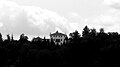


Photo: Castel29, CC BY-SA 4.0 · Wikimedia Commons
At a glance
- Type
- Castle
- Protection
- Italian national heritage
- Coordinates
- 45°58′06″ N, 12°08′08″ E
- Address
- via Brando Brandolini, 29
History and description
CastelBrando, former Castrum Costae, is a medieval castle situated on a dolomite limestone rock at an elevation of 370 m (1,210 ft) above sea level, overlooking the villages of Cison di Valmarino and Valmareno, Northern Italy. The name CastelBrando stems from Brando I of the name Brandolini, an ancient family from Forlì, who were the Lords of the castle.
History
CastelBrando was originally built in the Roman age as a defensive fortress in order to protect the important lines of communication which connected Northern Italy to the countries on the other side of the Alps. Originally there was a garrison here protecting the territory between the Piave and the Livenza rivers in order to facilitate the safe construction of the pre-alpine part of the Via Claudia Augusta, an important Roman road, which linked the valley of the Po River with Rhaetia (modern Austria). The original castrum, dating from 46 AD is still visible today. A recent archaeological excavation has uncovered a 3 m (9.8 ft) diameter bread-oven within the castrum, dating from the same period. The original Roman baths have also been excavated, as have the original pipes of the aqueduct which supplied water from three nearby natural springs. These springs still provide water for the castle today. During the European Migration Period the fortress became an important defensive position against barbarian invasions. Over the centuries the castle has been subject to numerous enlargements and renovations. During the 13th century the castle was substantially enlarged while under the ownership of the Da Camino family, who lived there from 1233 to 1335. Their architectural additions included surrounding the castle with imposing Guelph-Ghibelline style battlements and building a central tower. Gherardo III da Camino, the great Italian feudal lord and military leader was born in the castle in 1240. …
Present day
CastelBrando has now been extensively restored and now houses a 4-star hotel, museum and a theatre. Visitors can get up to the castle by funicular railway from the village.
CastelBrando has several museum exhibits including carriages, weapons, costumes, and musical instruments.
On 18–20 April 2009 CastelBrando hosted the first ever G8 Agriculture Ministers' Meeting organised by the Italian Minister of Agriculture, Luca Zaia.
Text from Wikipedia, the free encyclopedia, under CC BY-SA 4.0. Full article: «CastelBrando».
Photos
Getting there
Vittorio VenetoTrain, nearest
12.4 km as the crow flies
CastelBrandovia Brando Brandolini, 29
Aeroporto di Belluno23.7 km
Distances are as the crow flies, not walking or driving.
Loading map…
Nearby
See on the mapMore castles in Veneto


Frequently asked questions
Where is CastelBrando?
CastelBrando is in Cison di Valmarino, in the province of Treviso (Veneto), Italy. Address: via Brando Brandolini, 29. GPS coordinates: 45.96846, 12.13558.
What else is there to see near CastelBrando?
Nearby you’ll find: Cison di Valmarino (600 m away), Abbey of Santa Maria, Follina (2.1 km away), Follina (2.5 km away).
Sources and licences
Text. Wikipedia, the free encyclopedia (CC BY-SA 4.0).
Data. Wikidata (CC0); opening hours and contacts OpenStreetMap (ODbL).
Photos. Wikimedia Commons, author and licence on every image.
Credits for the 9 photos
- Castelbrando cison di valmarino — Castel29, CC BY-SA 4.0
- Cison di Valmarino - Castello della Costa - 2025-09-01 21-56-50 001 — Fabiofolliero, CC BY-SA 4.0
- Castelbrando Courtyard — Marek. 69 talk, CC BY-SA 3.0
- Castelbrando Funicolare Cison — Simonemb, CC BY-SA 4.0
- Castelbrando — Alessio Milan from Italy, CC BY-SA 2.0
- Castel Brando (6073975994) — Rino Porrovecchio from Palermo, Italy, CC BY-SA 2.0
- Castel Brando-10 (6073460141) — Rino Porrovecchio from Palermo, Italy, CC BY-SA 2.0
- Castel Brando-11 (6073460147) — Rino Porrovecchio from Palermo, Italy, CC BY-SA 2.0
- Castel Brando-12 (6073460159) — Rino Porrovecchio from Palermo, Italy, CC BY-SA 2.0
Updated 28 October 2026. All sources and licences