




Photo: Paolo Monti, CC BY-SA 4.0 · Wikimedia Commons
At a glance
- Type
- Castle
- Protection
- Italian national heritage
- Coordinates
- 45°17′50″ N, 11°47′15″ E
- Address
- Via Catajo, 1, 35041 Battaglia Terme
History and description
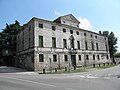
Castello del Catajo is a patrician rural palace near the town of Battaglia Terme, province of Padua, north-eastern Italy built in 1573.
History
It had its origins in a simple villa that was rebuilt and extravagantly enlarged in the manner of a feudal castle from 1570 onwards by Marquess Pio Enea I degli Obizzi, a member of an Italian noble family of French origin. The house contains a vast cycle of historical battle scenes frescoed in 1571–1572 by Giambattista Zelotti, a pupil of Paolo Veronese. He began with events from the Roman age, culminating with the military triumphs of Pio Enea degli Obizzi, which were recreated in the gardens with tourneys and spectacles. His nephew Pio Enea II enlarged the complex with the grand entrance courtyard, announced by sculptures on high drum pedestals, which is dominated by the Baroque "Elephant" fountain.
In the 19th century the estate passed to Francis V, Duke of Modena, who in turn left it to the Archduke Franz Ferdinand of Austria. During the First World War the castle was inherited by Charles I of Austria, the last Emperor of Austria-Hungary, but it was sequestered as war reparations by the Italian State, which sold it in 1926 to the Dalla Francesca family, who currently open it to the public.
Origin of the name
Some historical sources suggest that its name derives from the original name of the place where it was built: in the 12th century it was "Ca' Tajo" (Ca' -> house and tajo -> canal in Venetian language).
The most popular legend, probably created by the founder himself, says that the castle was built thanks to the inspiration of Il Milione, Marco Polo's book where he described the wonders he viewed in ancient China (Cathay).
Text from Wikipedia, the free encyclopedia, under CC BY-SA 4.0. Full article: «Castello del Catajo».
Photos
Getting there
Battaglia TermeTrain, nearest
1.0 km as the crow flies
Castello del CatajoVia Catajo, 1, 35041 Battaglia Terme
Distances are as the crow flies, not walking or driving.
Loading map…
Nearby
See on the mapMore castles in Veneto


Frequently asked questions
Where is Castello del Catajo?
Castello del Catajo is in Battaglia Terme, in the province of Padova (Veneto), Italy. Address: Via Catajo, 1, 35041 Battaglia Terme. GPS coordinates: 45.29734, 11.78750.
What else is there to see near Castello del Catajo?
Nearby you’ll find: Museum of River Navigation (1.1 km away), Villa Emo Selvatico (1.5 km away), Lispida Castle (2.5 km away).
Sources and licences
Text. Wikipedia, the free encyclopedia (CC BY-SA 4.0).
Data. Wikidata (CC0); opening hours and contacts OpenStreetMap (ODbL).
Photos. Wikimedia Commons, author and licence on every image.
Credits for the 9 photos
- Paolo Monti - Servizio fotografico (Battaglia Terme, 1967) - BEIC 6349104 — Paolo Monti, CC BY-SA 4.0
- Castello del Catajo - Marcok 2017 - 1 — Marcok / it.wiki, CC BY-SA 4.0
- Castello del Catajo 01 — SIG SG 510, CC0
- Castello del Catajo con il ponte sul Rialto 1 - Battaglia Terme — Ernesto Sguotti, CC BY-SA 4.0
- Castello del Catajo con il ponte sul Rialto 2 - Battaglia Terme — Ernesto Sguotti, CC BY-SA 4.0
- Castello del Catajo, ingresso alla via interna principale 1 - Battaglia Terme — Ernesto Sguotti, CC BY-SA 4.0
- Castello del Catajo, ingresso alla via interna principale 2 - Battaglia Terme — Ernesto Sguotti, CC BY-SA 4.0
- Castello del Catajo, viale principale - Battaglia Terme — Ernesto Sguotti, CC BY-SA 4.0
- Castello del Catajo, visione panoramica 1 - Battaglia Terme — Ernesto Sguotti, CC BY-SA 4.0
Updated 28 October 2026. All sources and licences