


Photo: AHert, CC BY-SA 3.0 · Wikimedia Commons
Castle, 1356
Castelvecchio
Castle
- Within the UNESCO World Heritage Site “City of Verona”
At a glance
- Type
- Castle
- Period
- Middle Ages, 1356
- Style
- Gothic architecture
- Commissioned by
- Cangrande II della Scala
- Protection
- Italian national heritage
- Coordinates
- 45°26′22″ N, 10°59′17″ E
- Address
- Corso Castelvecchio 1/a
History and description
Castelvecchio ("Old Castle") is a castle in Verona, northern Italy. It is the most important military construction of the Scaliger dynasty that ruled the city in the Middle Ages.
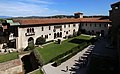
The castle is powerful and compact, with very little decoration — a square compound built of red brick, one of the most prominent examples of Gothic architecture of the age, with imposing M-shaped merlons running along the castle and bridge walls. It has seven towers, a superelevated keep (maschio) with four main buildings inside. The castle is surrounded by a ditch, now dry, which was once filled with water from the nearby Adige.
Castelvecchio is now home to the Castelvecchio Museum and the local officers' club, which can be accessed through the left door on Corso Cavour.
History
The castle stands on the probable location of a Roman fortress outside the Roman city. Lord Cangrande II della Scala had it built along with its bridge across the Adige River as a deterrent to his powerful neighbors, such as Venice, the Gonzaga, and the Sforza families. Construction was carried out between 1354 and 1376 (Cangrande died in 1359). The fortified bridge was intended to allow the seigniors to escape safely northwards to the Tyrol in the event of a rebellion or a coup d'état (the Scaligeri were allies of the Holy Roman Empire), and when they eventually lost their hold on Verona, its surviving members left Italy to found a German branch of the family.
Later, during the Venetian domination, the bridge was further fortified with cannons. The castle was damaged by French troops during the Napoleonic Wars (1796–7), in retaliation for the Pasque Veronesi, when the local population staged a violent anti-French revolt. Napoleon chose to stay in Castelvecchio on his trips to Verona. Still, his widespread and arbitrary requisitions of citizens' and churches' property, and the massive draft of male workers into the French army, prompted the resistance that eventually drove out the invaders.
The bridge was destroyed by the retreating German army in 1945 and rebuilt in 1949.
Under the Austrians, Castelvecchio was turned into barracks.
In 1923, the castle was restored, as well as in 1963–1965.
Text from Wikipedia, the free encyclopedia, under CC BY-SA 4.0. Full article: «Castelvecchio».
Timeline
- 1354Start of construction
- 1356Built
- 1958Reconstruction
Events and people from Wikidata (CC0).
Photos
Getting there
Verona Porta NuovaTrain, nearest
1.2 km as the crow flies
CastelvecchioCorso Castelvecchio 1/a
Aeroporto Valerio Catullo di Verona-Villafranca9.2 km
Distances are as the crow flies, not walking or driving.
Loading map…
Nearby
See on the mapMore castles in Veneto


Frequently asked questions
Where is Castelvecchio?
Castelvecchio is in Verona, in the province of Verona (Veneto), Italy. Address: Corso Castelvecchio 1/a. GPS coordinates: 45.43957, 10.98810.
Is Castelvecchio wheelchair accessible?
According to OpenStreetMap data, the site is partly wheelchair accessible.
How old is Castelvecchio?
Wikidata dates it to 1356.
What else is there to see near Castelvecchio?
Nearby you’ll find: Castelvecchio Museum (100 m away), Carli Palace of Verona (100 m away), Arco dei Gavi (100 m away).
Sources and licences
Text. Wikipedia, the free encyclopedia (CC BY-SA 4.0).
Data. Wikidata (CC0); opening hours and contacts OpenStreetMap (ODbL).
Photos. Wikimedia Commons, author and licence on every image.
Credits for the 9 photos
- Castelvecchio Verona-01 — AHert, CC BY-SA 3.0
- 17dic2013 Verona night christmas photo Paolo Villa IMGP1531 (Arco Gavi, fiume or river Adige, Castelvecchio) — Paolo Villa, CC BY-SA 3.0
- 17dic2013 Verona night christmas photo Paolo Villa IMGP1542 (Torre tower e ponte bridge Castelvecchio) — Paolo Villa, CC BY-SA 3.0
- 17dic2013 Verona night christmas photo Paolo Villa IMGP1653 (Castelvecchio ponte levatoio, Torre, Corso Cavour) — Paolo Villa, CC BY-SA 3.0
- Adige a Castelvecchio — Syrio, CC BY-SA 4.0
- Castelvecchio (111325695) — Arnaud Malon, CC BY 3.0
- Castelvecchio (Verona) 2 — Adert, CC BY-SA 4.0
- 06 Verona (9) — Ljuba brank at Slovenian Wikipedia, CC BY-SA 3.0
- 2005-05-09 - 13-49 Verona 015 — Wolf Meusel, Public domain
Updated 28 October 2026. All sources and licences