




Photo: Segretariato regionale del Ministero per i beni e le attività culturali per l'Emilia-Romagna, CC BY 4.0 · Wikimedia Commons
At a glance
- Type
- Castle
- Period
- Middle Ages, 1102
- Protection
- Italian national heritage
- Coordinates
- 44°53′21″ N, 11°03′56″ E
- Address
- Piazza della Costituente
History and description
The Castle of the Pico (in Italian Castello dei Pico) is a castle in the city center of Mirandola, in the province of Modena, Italy.
Famous in Europe for being impregnable, it belonged to the House of Pico della Mirandola, who ruled over the city for four centuries (1311-1711) and which also contributed important pieces of art in the Renaissance period.
The castle, which dominates the long Costituente square and Circonvallazione boulevard (built in place of the ancient walls, demolished during the 19th century), was restored in 2006 after many years of neglect, but was then severely damaged by the 2012 Northern Italy earthquakes, which made it unusable again.
History
The first evidence of the castle's existence dates back to the year 1102, although probably a primitive settlement existed during the Lombards era, around the year 1000.
The castle was located in a strategic position along the Imperial Romea route (which connected Germany to Rome), and it was later expanded to form a large quadrilateral surrounded by a moat.
In 1500 Giovanni Francesco II Pico della Mirandola built the massive keep called il Torrione (the Big Tower), known to be unconquerable; the city was under sieges several times, including the most famous, the siege of 1510-1511 winter by Pope Julius II and the siege of 1551 by Pope Julius III.
The Pico family obtained the title of dukes in 1617 and enriched their castle, until it became one of the most important and sumptuous palaces in the Po Valley: among the most important works of art collected in the wing called la Galleria Nuova (the New Gallery), there were several paintings by the Venetians Jacopo Palma il Giovane e Sante Peranda.
The castle hosted Pope Julius II, Emperor Leopold I, Aldus Manutius, Borso d'Este and Ercole d'Este, Rodolfo Gonzaga, and Emperor Francis I.
After the House of Este took over in 1711, the city of Mirandola began to decay. In 1714, the burning of artillery and gunpowder in the keep (due to lightning) destroyed much of the castle and seriously damaged all the buildings and churches in the city center. Towards the end of the 18th century, the Dukes of Modena destroyed many other parts of the castle.
On 24 February 1867 the Italian government established that the urban belt of the city of Mirandola ceased to be considered as a fortified work, thus ceasing to be subject to military servitude the land adjacent to the works themselves.
At the beginning of the 20th century, around the 1930s, the city council attempted to rebuild the ancient keep of the castle (destroyed by fire in 1714), creating a massive neo-Gothic tower overlooking on the main square. The modern tower is characterized by dovetail merlons, typical of the pro-Imperial faction of the Ghibellines. …
Description
The largest surviving original structure of the castle of the Pico family is made up of the remains of the Duke's Palace, which overlooks the southern side of the castle, in front of the Teatro Nuovo. In the past, in this widening of the Costituente square, was organized the market of the horses. The facade is characterized by a noble portico resting on ten columns of pink marble, made on behalf of Alexander I Pico. From the portico, through an arched door profiled in ashlar, is the entrance to the inner courtyard and the "Galleria Nuova". On the western part the building there are the remains of the sixteenth-century "bastion of the castle", reinforced in 1576 by Fulvia da Correggio and connected to the mighty walls with a starry plan with 8 points that defended the city.
The Carabini Hall, located on the first floor of the ducal palace and decorated in a 17th-century style, hosted the Civic Museum.
From the ground floor, descending a few steps, there are the prisons, made of thick masonry with a barrel vault, on whose thick walls are visible graffiti and drawings made by prisoners. Next to the prisons, another exhibition space was created for temporary exhibitions.
The central body of the castle consists of the "Galleria Nuova" (New Gallery), whose northern façade was erected by the duke Alessandro II Pico della Mirandola in 1668. The New Gallery, which dominates from above the Circonvallazione boulevard, consists of a loggia, closed at the sides by two buildings, profiled in ashlar and with large serlian windows tripartite.
The New Gallery was frescoed by Biagio Falcieri and arranged to house a precious picture gallery composed of over 300 works of art by notable artists such Leonardo da Vinci, Raphael, Caravaggio, Titian, Paolo Veronese, and many others) purchased in November 1688 by duke Alessandro II Pico from the lawyer Giovan Pietro Curtoni of Verona (1600-1656) at the price of 15,000 Venetian ducats. …
Exhibitions
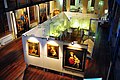
In 2006, following the reopening of the Pico castle to the public, the Civic Museum of Mirandola (before housed at the municipal library "Eugenio Garin", located first in Giuseppe Garibaldi square and then in the former Jesuit convent in Francesco Montanari street) was rebuilt and divided into 12 rooms, dedicated to archaeological items found in Mirandola, religious commissions, antique furniture and paintings (including a fine Madonna and Child attributed to Guercino), numismatics (coins of the mint of Mirandola and medals of Pisanello and Niccolò Fiorentino).
Other sections of the museum were dedicated to the Pico family and to the princes of the House of Este, with ancient portraits including a precious portrait of Alfonso IV d'Este by Justus Sustermans and a portrait of Alessandro I Pico by Sante Peranda.
A specific room was dedicated to the famous Giovanni Pico della Mirandola, important humanist philosopher from the Rennassance, and to his nephew Giovanni Francesco II Pico, man of letters.
In the last part of the museum were exhibited numerous portraits of politicians and writers of the 19th century, as well as a section dedicated to music and the local municipal orchestra.
The museum was also enriched by prints from the sixteenth to the twentieth century, various goods from the ancient Mount of Piety of the Franciscan monks and a collection of military relics (weapons, shields and armor of the fifteenth and sixteenth centuries).
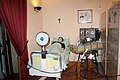
Since 2010, the castle permanently hosted the traveling exhibition "Mobilmed", which shows the history of the Mirandola Biomedical District, a great source of income in the Mirandola area. However, following the serious damage caused by the earthquake of 2012, the exhibition was moved to Odoardo Focherini street.
On the top floor of the castle was the headquarters of the Fondazione Cassa di Risparmio di Mirandola, whose premises housed a rich collection of prints and historical maps of the city of Mirandola (part of the Giulio Cesare Costantini fund) and ancient weapons of the Duchy of Mirandola.
Also on the top floor was the Leica Hall, where the Mirandola Photographic Society set up frequent exhibitions of artistic photographs, taken by professionals and fan of photography and Leica cameras.
Text from Wikipedia, the free encyclopedia, under CC BY-SA 4.0. Full article: «Castle of Pico».
Timeline
- 1102Built
Events and people from Wikidata (CC0).
Photos
Getting there
MirandolaTrain, nearest
3.7 km as the crow flies
Castle of PicoPiazza della Costituente
Distances are as the crow flies, not walking or driving.
Loading map…
Nearby
See on the mapMore castles in Emilia-Romagna

- Free 1st Sunday


Frequently asked questions
Where is Castle of Pico?
Castle of Pico is in Mirandola, in the province of Modena (Emilia-Romagna), Italy. Address: Piazza della Costituente. GPS coordinates: 44.88907, 11.06545.
How old is Castle of Pico?
Wikidata dates it to 1102.
What else is there to see near Castle of Pico?
Nearby you’ll find: Museo civico di Mirandola (100 m away), Casa della Gioventù Italiana del Littorio (100 m away), Palazzo della Ragione (200 m away).
Sources and licences
Text. Wikipedia, the free encyclopedia (CC BY-SA 4.0).
Data. Wikidata (CC0); opening hours and contacts OpenStreetMap (ODbL).
Photos. Wikimedia Commons, author and licence on every image.
Credits for the 7 photos
- Castello dei Pico a Mirandola - 1 — Segretariato regionale del Ministero per i beni e le attività culturali per l'Emilia-Romagna, CC BY 4.0
- Castello Pico, Mirandola — G. Bellei, Public domain
- Mirandola - Castello Pico - Motivo — G. Pini - Modena, Public domain
- Mirandola - Castello Pico — Unknown author Unknown author, Public domain
- Castello di Mirandola - panoramio — Gilles Guillamot, CC BY-SA 3.0
- Hrad rodu Pico, Mirandola (Piazza Guglielmo Marconi, 23) — Alexbrocko, CC BY-SA 4.0
- 3° Reggimento di Fanteria Nationale "della Mirandola" (1740) — Quinto Cenni, Public domain
Updated 28 October 2026. All sources and licences