


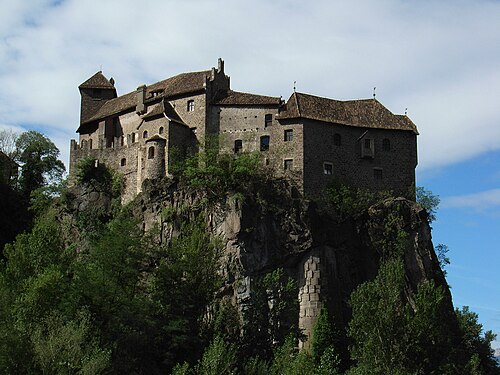
Photo: Terribile62, CC0 · Wikimedia Commons
At a glance
- Type
- Castle
- Protection
- Italian national heritage
- Coordinates
- 46°14′56″ N, 11°02′23″ E
History and description
Castel Belasi is a contemporary art centre dedicated to ecological thought and practice, located in Segonzone, a hamlet of Campodenno in Trentino, northern Italy. It is housed in a medieval castle at the foot of the Brenta Dolomites, probably built in the 13th century, which gave its name to the noble family of the Khuen-Belasi counts. The centre has been open to the public since 2021 and has been directed artistically by Stefano Cagol since 2023. It operates as an institution of the Municipality of Campodenno in collaboration with the MUSE – Science Museum of Trento.
Contemporary art centre
A project inspired by the frescoes of Castel Belasi is the Contemporary Art Center for Eco Thought, directed by Stefano Cagol. The centre uses the castle's historic frescoes, including the Judgement of Paris, as a starting point for international contemporary art exhibitions focusing on sustainability, the human-nature relationship, and current environmental challenges. These exhibitions create a dialogue between past and present through art and science.
Notable exhibitions, such as Fragile and As Ice, have featured works by internationally renowned artists, including Ai Weiwei, Tony Cragg and AES+F integrated with the castle's historic and artistic context to raise awareness of ecological issues.
Ethical message: The castle's Renaissance frescoes, including the Judgement of Paris, are interpreted as reminders of the consequences of human choices, a central theme of the art centre.
Dialogue across eras: Castel Belasi combines its medieval structure and frescoes with contemporary art installations, establishing a connection between historical lessons and present and future environmental challenges.
The institution's mission is to foster dialogue between contemporary art and ecological issues, including environmental change, sustainability, and political ecology, linking the specific and the global. The curatorial project draws inspiration from the manor's historic frescoes, addressing themes of responsibility and the consequences of human choices. The exhibition programme reflects on present challenges through international contemporary art exhibitions and interdisciplinary projects, developed in partnership with scientific institutions, cultural organisations, and research bodies.
Castel Belasi realizes a range of exhibitions that explore ecological, scientific, and social topics, often produced in collaboration with the MUSE – Science Museum and other partners:
Castel Belasi maintains a long‑term partnership with MUSE – Science Museum of Trento and the Municipality of Campodenno for joint projects that bridge contemporary art and scientific research on sustainability and ecological issues. …
History of the castle
For a long time, based on a theory proposed by the historian Carl Ausserer, it was believed that the castle already existed in the 12th century and was held by an ancient Belasi family, vassals of the Counts of Appiano. According to this interpretation, an Adelpreto de Bellago, mentioned in a document dated 1189, was considered a member of this family. Following the extinction of the Belasi lineage in 1291, the castle was thought to have been enfeoffed to Ulrich of Ragogna.
This reconstruction was also reported, though with reservations, by Aldo Gorfer, who suggested that the name Belasi derived from the personal name Belasio (Blasius), possibly referring to a castellan in the service of the Counts of Appiano or the Flavon family.
More recent research has shown that the castle is later in date than previously assumed and that the Adelpreto mentioned in 1189 was unrelated to Belasi, being instead connected with Plag, near Eppan an der Weinstraße. Consequently, no Belasi family existed in the 12th century. The construction of Castel Belasi has therefore been reassessed and dated to the second half of the 13th century, coinciding with the arrival of the Rubein-Ragogna family from the Burgraviate of Merano, loyal supporters of the Counts of Tyrol.
According to this interpretation, the castle was founded at the initiative of the Counts of Tyrol to control access to the Val di Non, which they had occupied during their conflict with the Prince-Bishops of Trento. Castel Belasi was subsequently entrusted to Ulrich of Ragogna, a Tyrolean captain.
In 1368, Conrad known as Khuen, son of Egenone of Tramin an der Weinstraße (documented in 1311), acquired Castel Belasi from Simon Rubein, Ulrich's nephew. The deed of transfer does not mention any payment, suggesting that the acquisition may have been linked to an outstanding debt. An alternative hypothesis, proposed in the 19th century by Stephan von Mayrhofen, holds that Conrad's eldest son Arnold married Elizabeth of Belasi, the last descendant of the Rubein family; however, no documentary evidence confirms this claim.
The name Belasi therefore does not derive from an early castellan, but rather from the name of the hill on which the castle was built. …
Architecture and historical heritage
The castle stands on a gentle hill, surrounded by woods and orchards. Its structure is largely intact, although it no longer contains the original furnishings. The building features a pentagonal keep and high defensive walls, to which structures from different periods are attached. Two bartizans are positioned along the walls near the main entrances. On the southern side, two minor walls are connected by a ravelin that overlooks the approach to the main entrance.
Overall, Castel Belasi illustrates the architectural evolution of a medieval fortress transformed into a noble residence, combining fortifications, residential spaces, and artistic heritage in a single complex.
The most significant frescoes date to the 16th century, although earlier decorative work, discovered during restoration on a first-floor corridor, depicts late medieval castle motifs such as tournaments, coats of arms, crests and musicians. Later decorations include the Music and Fruits Room, showing draped parapets with musical instruments, fruit and vegetables, and a room with a fresco of the Judgement of Paris, attributed to the German painter Bartlmä Dill Riemenschneider, son of Tilman Riemenschneider. Another room, the Metamorphoses Room, presents scenes from Ovid's Metamorphoses. A large family coat of arms on the central palace façade is surmounted by the arms of Ferdinand II, Archduke of Austria, dated to the 1560s.
In the western courtyard, attached to the central palace, is the family chapel dedicated to Martin of Tours. The chapel, decorated with frescoes from the 15th and 16th centuries, is connected to a first-floor room of the palace via a window, allowing the counts to attend services from inside the castle.
Text from Wikipedia, the free encyclopedia, under CC BY-SA 4.0. Full article: «Castel Belasi».
Photos
Getting there
CrescinoTrain, nearest
1.6 km as the crow flies
Castel Belasi
Aeroporto di Bolzano-Dolomiti - Flughafen Bozen-Dolomiten32.0 km
Distances are as the crow flies, not walking or driving.
Loading map…
Nearby
See on the mapMore castles in Trentino-South Tyrol



Frequently asked questions
Where is Castel Belasi?
Castel Belasi is in Campodenno, in the province of Trento (Trentino-South Tyrol), Italy. GPS coordinates: 46.24890, 11.03967.
What else is there to see near Castel Belasi?
Nearby you’ll find: Castel Sporo (2.5 km away), Torre di Visione (2.5 km away), Fort Rocchetta (2.7 km away).
Sources and licences
Text. Wikipedia, the free encyclopedia (CC BY-SA 4.0).
Data. Wikidata (CC0); opening hours and contacts OpenStreetMap (ODbL).
Photos. Wikimedia Commons, author and licence on every image.
Credits for the 9 photos
- Castel Belasi — Terribile62, CC0
- Castel Belasi -Segonzone di Campodenno TN- — Terribile62, CC BY-SA 4.0
- Castel Belasi 01 — Syrio, CC BY-SA 4.0
- Castel Belasi agosto 2019 — Terribile62, CC BY-SA 4.0
- Castel Belasi by drone 01 — Syrio, CC BY-SA 4.0
- Castel Belasi Segonzone di Campodenno TN — Terribile62, CC BY-SA 4.0
- Castel Belasi. PH Stefano Cagol. 2023 — Leila Mai Mai, CC BY 4.0
- Castel Belasi. Pieke Bergmans. ph Mariella Rossi — Leila Mai Mai, CC BY 4.0
- Cortile Castel Belasi — Terribile62, CC BY-SA 4.0
Updated 28 October 2026. All sources and licences