



- Free 1st Sunday
Photo: User:Oursana, Public domain · Wikimedia Commons
Museum, 1424
Chapel in the Church of Santa Maria del Carmine in Florence, Italy
The Brancacci Chapel (in Italian, "Cappella dei Brancacci") is a chapel in the Church of Santa Maria del Carmine in Florence, central Italy. It is sometimes called the "Sistine Chapel of the early Renaissance" for its painting cycle, among the most famous and influential of the period. Construction of the chapel was commissioned by Felice Brancacci and began in 1422. The paintings were executed over the years 1425 to 1427. Public access is currently gained via the neighbouring convent, designed by Brunelleschi.
The patron of the pictorial decoration was Felice Brancacci, descendant of Pietro, who had served as the Florentine ambassador to Cairo until 1423. Upon his return to Florence, he hired Masolino da Panicale to paint his chapel. Masolino's associate, 21-year-old Masaccio, 18 years younger than Masolino, assisted, but during painting Masolino left to Hungary, where he was painter to the king, and the commission was given to Masaccio. By the time Masolino returned he was learning from his talented former student. However, Masaccio was called to Rome before he could finish the chapel, and died in Rome at the age of 27.
In his frescos, Masaccio carries out a radical break from the medieval pictorial tradition, by adhering to the new Renaissance perspectival conception of space. Thus, perspective and light create deep spaces where volumetrically constructed figures move in a strongly individualised human dimension. Masaccio therefore continues on Giotto's path, detaching himself from a symbolic vision of man and propounding a greater realistic painting. The cycle from the life of Saint Peter was commissioned as patron saint from Pietro Brancacci, the original owner of the chapel.
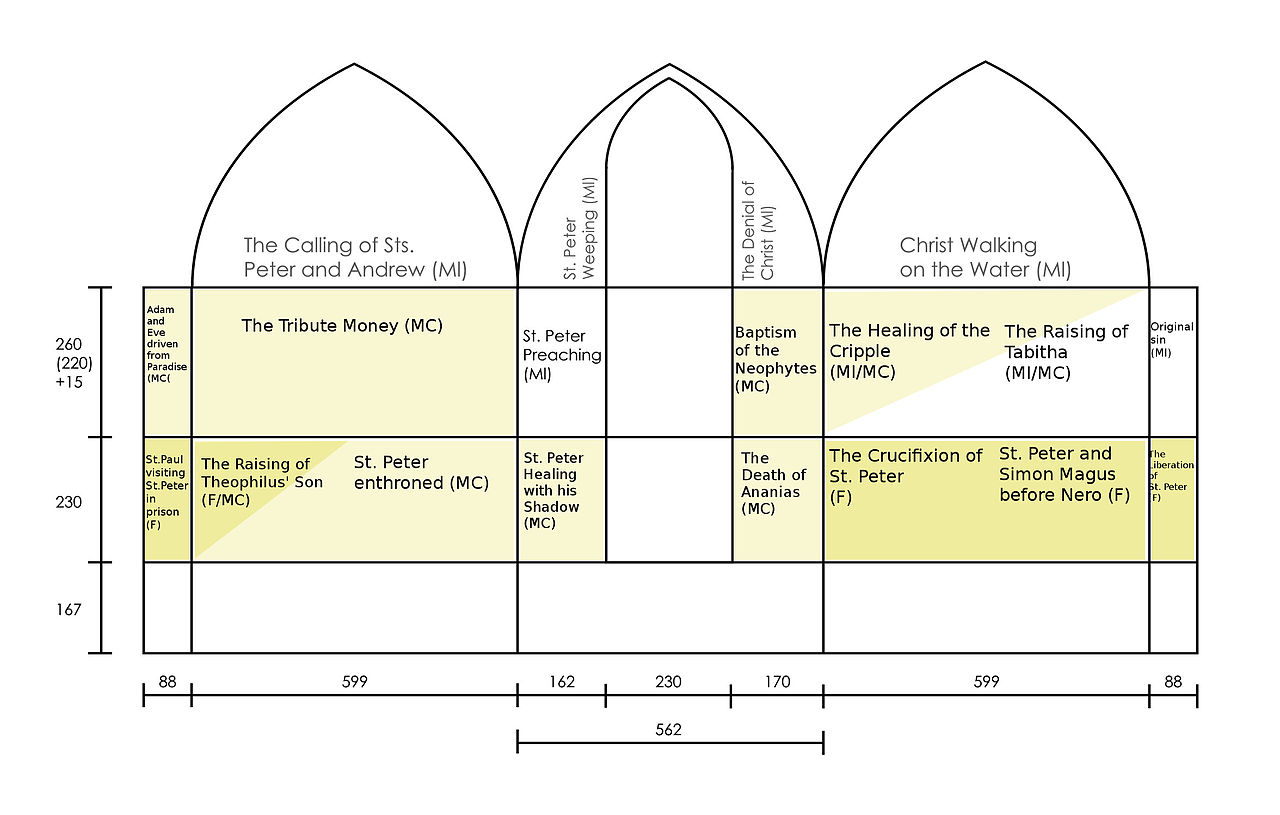
The paintings are explained below in their narrative order.
By Masolino da Panicale.
In contrast with Masaccio's Expulsion, this is a serene and innocent raffiguration.
The cycle begins with this painting by Masolino, placed on the higher rectangle of the arch delimiting the Chapel, within the pillar thickness. This scene and the opposite one (the Expulsion) are the premises to the story narrated in the frescos, showing the moment in which humans severed their union with God, later reconciled by Christ with Peter's mediation.
The painting shows Adam standing near Eve: they look at each other with measured postures, as she prepares to bite on the apple, just offered to her by the serpent near her arm around the tree. The snake has a head with thick blond hair, much idealised. The scene is aulic in its presentation, with gestures and style conveying tones of late International Gothic. Light, which models the figures without sharp angles, is soft and embracing; the dark background makes the body stand out in their sensual plasticity, almost suspended in space. …
Masaccio's application of scientific perspective, unified lighting, use of chiaroscuro and skill in rendering the figures naturalistically established new traditions in Renaissance Florence that some scholars credit with helping to found the new Renaissance style.
The young Michelangelo was one of the many artists who received his artistic training by copying Masaccio's work in the chapel. The chapel was also the site of an assault on Michelangelo by rival sculptor Pietro Torrigiano, who resented Michelangelo's critical remarks about his draughtsmanship. He punched the artist so severely that he "crushed his nose like a biscuit" (according to Benvenuto Cellini) which deformed Michelangelo's face into that of a boxer's.
The first restoration of the chapel frescoes was in 1481-1482, by Filippino Lippi, who was also responsible for completing the cycle. Due to the lamps used for lighting the dark chapel, the frescoes were relatively quickly coated in dust and dirt from the smoke. Another restoration was conducted at the end of the 16th century. Around 1670, sculptures were added, and the fresco-secco additions were made to the frescoes, to hide the various cases of nudity. Late 20th century restoration removed the overpainting and collected dust and dirt. Some critics, including professor and art historian James H. Beck, have criticised these efforts, while others, including professors, historians and restorers, have praised the work done on the chapel.
Text from Wikipedia, the free encyclopedia, under CC BY-SA 4.0. Full article: «Brancacci Chapel».
Events and people from Wikidata (CC0).
Distances are as the crow flies, not walking or driving.


Brancacci Chapel is in Florence, in the province of Firenze (Tuscany), Italy. Address: Via del Carmine - Firenze. GPS coordinates: 43.76845, 11.24403.
Wikidata dates it to 1424.
Nearby you’ll find: Palazzo Rospigliosi Pallavicini (100 m away), Palazzo Mazzei (100 m away), Palazzo Magnani Feroni (200 m away).
Text. Wikipedia, the free encyclopedia (CC BY-SA 4.0).
Data. Wikidata (CC0); opening hours and contacts OpenStreetMap (ODbL).
Photos. Wikimedia Commons, author and licence on every image.
Updated 28 October 2026. All sources and licences