

Photo Ввласенко, CC BY-SA 3.0
Bologna · Emilia-Romagna
Things to see in Bologna
In Bologna the atlas lists 301 historic places: 111 historic villas and palaces, 77 museums, 45 abbeys and monasteries, 45 fortresses and towers, 17 historic theatres, 5 archaeological sites and 1 castle.
Of these, 14 list opening hours, 8 have free entry and 2 are part of a UNESCO World Heritage Site.
Don’t miss: Casa Carducci (16th century), historic building in Bologna, Italy, former residence of Giosuè Carducci, now house museum.
By date of construction, the most common period is the Middle Ages (35% of dated places) and the Modern era (24% of dated places).
The Porticoes of Bologna
- 301historic places
- 387,971inhabitants
- 54 maltitude
The town
Bologna (Emilian: Bulåggna) is a beautiful and historic city in the Emilia-Romagna region of Northeast Italy. It has the oldest university in the Western world, a lively student population, excellent food, a striking brick terracotta-roofed cityscape, and lots to see and do. The city had a population just under 395,000 in 2020. Until 2015 it was part of a "Province of Bologna" but this was absorbed into a metropolitan area, population 1,017,000. This page therefore covers the entire metropolis, with the exception of Imola, described separately.
Text from Wikivoyage, CC BY-SA, abridged · Wikivoyage
301 places
Villas and palaces 111


Show all 34 places
 Palazzo Re Enzo
 Villa Baruzziana
 Palazzo Albergati
 Palazzo dei Banchi
 Palazzo Poggi
 Palazzo della Mercanzia
 Palazzo Fava
 Palazzo Malvezzi De' Medici
 Palazzo Malvezzi Campeggi, Bologna
 Palazzo Pallavicini
 Palazzo Legnani Pizzardo, Bologna
 Porticoes of Bologna
 Palazzo Boncompagni
 Palazzo Rossi Poggi Marsili
 Casa Saraceni
 Palazzo Davia Bargellini
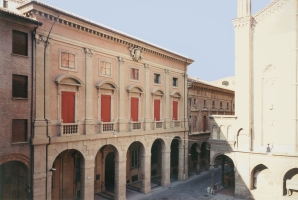 Palazzo Magnani
 Villa Aldrovandi Mazzacorati
 Palazzo Bentivoglio
 Palazzo Martinetti-Rossi
 Palazzo dei Notai
 Palazzo Fantuzzi, Bologna
 Palazzo Ghislardi Fava
 Palazzo Hercolani
 Palazzo Bolognini Amorini Salina
 Palazzo del Podestà
 Palazzo della Banca d'Italia
 Palazzo Isolani
Museums 77


- Free 1st Sunday


Show all 39 places
 Ducati Museum
 Industrial Heritage Museum (Bologna)
 Museo per la memoria di Ustica
 Fondazione MAST CIAO
 Mineralogical Collection "Luigi Bombicci Museum"
 Museo di palazzo Poggi
 Diocesan Museum of San Petronio in Bologna
 Galleria d'arte moderna "Raccolta Lercaro"
 Cineteca di Bologna
 Davia Bargellini Museum Museo del soldatino "Mario Massacesi"
 Museum of the Risorgimento, Bologna
 Medieval Civic Museum
 Museo della Specola (Bologna)
 Museo tattile - Bologna
 Museo europeo degli studenti
 Museo della sanità e dell'assistenza
 Museum of the History of Bologna
 Church of San Mattia, Bologna
 Tapestry and Upholstery Museum (Bologna)
 Museo Ottocento Bologna
 Bologna City Art Collections
 Museo della Resistenza di Bologna
 Luigi Fantini Museum
 Quadreria di Palazzo Rossi Poggi Marsili
 Comunication museum of Bologna
 Opificio delle Acque
 Sanctuary of Santa Maria della Vita
 Biblioteca di San Giorgio in Poggiale
 Museo della Beata Vergine di San Luca
 Luigi Cattaneo Anatomical Wax Museum
 Jewish Museum of Bologna
 Lapidarium of the Medieval Civic Museum
Abbeys and monasteries 45


Fortresses and towers 45


Historic theatres 17


Castles 1


Getting there
By plane: Bologna's airport is approximately 6 km NW from the centre of the city
Guglielmo Marconi International Airport (BLQ IATA), Via Triumvirato, 84, ☏ +39 051 6479615. The airport has international connections available, including nonstop flights from Amsterdam Schiphol, Brussels (National), Charleroi ("Brussels" South), Copenhagen Airport, Dublin, Edinburgh, Frankfurt, Iași, Istanbul, Lisbon, London, Madrid Barajas, Manchester Airport, Moscow, Paris, Prague, Vienna Airport, and Zagreb (seasonal).
Services
WiFI – free, registration required.
Left luggage (1st floor of the main terminal). 24/7. €6 per item.
Bologna Welcome - Airport (Tourist Information Office) (ground floor at the Arrivals Area), ☏ +39 051 6472201. Mon-Sat 09:00-19:00, Sun 10:00-17:00.
Connections to the city
Marconi Express monorail service connects the airport with the Bologna Centrale railway station in 7 minutes. Single fares €12.80. Waiting time for the train can be quite long (sometimes over half an hour), as there are not enough carriages for the amount of people. Contactless card payments accepted at the gate, no need to buy a ticket, but each passenger will require a separate card. Does not accept Google/Apple Pay cards, physical cards only. It's highly recommended that you pay by contactless at the ticket gate if you are able, as the ticket vending machines are right at the start of a long tunnel where you can't see the queue.
Text from Wikivoyage, CC BY-SA, abridged · Wikivoyage
What to see, according to Wikivoyage
Layout of the city: The iconic leaning towers (Due Torri) provide a useful central landmark. They are marked in the centre of the free map available from the Tourist Information Centre in the main square, Piazza Maggiore. The central area around Piazza Maggiore (including the Due Torri and Piazza Santo Stefano can be thought of as the hub of a wheel, with other roads leading out like spokes to the old city gates (Porte) that stud the Viali—a heavily trafficked beltway that surrounds the historical centre of the town. The northeast quadrant of the map is the university district (an integral part of the town rather than a separate campus). The two southern quadrants of your map are residential sections of the city, and not common tourist areas. However, Bologna's main park, the Giardini Margherita, is just outside the center (across the Viali from Porta Santo Stefano or Porta Castiglione), beneath the surrounding hills. Also to the south, an extended portico (with 666 arches and almost 4 km long) leads out from the Viali (at Porta Saragozza) up to the baroque Sanctuary of San Luca, which provides another iconic landmark.
Text from Wikivoyage, CC BY-SA, abridged · Wikivoyage · Underlined names link to our own pages.