


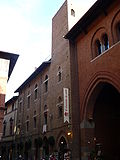


Photo: Ugeorge, CC BY-SA 3.0 · Wikimedia Commons
Museum, 1881
Archeological Civic Museum of Bologna
Archaeological museum in Bologna, Italy
Bologna (BO), Emilia-Romagna
At a glance
- Type
- Museum
- Period
- Modern era, 1881
- Protection
- Italian national heritage
- Coordinates
- 44°29′35″ N, 11°20′37″ E
- Address
- Via Dell'archiginnasio 2, 40124 Bologna
History and description
The Archaeological Civic Museum of Bologna (Italian: Museo Civico Archeologico di Bologna) is located in the fifteenth-century Palazzo Galvani building at Via dell'Archiginnasio 2 postal code 40124 Bologna, once known as the Hospital of Death. Founded in September 1881 by the merging of two separate museums: the one belonging to the University of Bologna – heir of the Room of Antiquity belonging to the Academy of Sciences founded by Luigi Ferdinando Marsili in (1714) – and that belonging to the City of Bologna (enriched by the antique collection of Artist Pelagio Palagi (1860) and the large amount of finds from excavations conducted in and around Bologna during these times.
This museum is among the most important in archeological finds in Italy and is highly representative of the local history from prehistoric period to Roman Age. Additionally, its ancient Egyptian collection is among the most important in Europe. Between 1972 and 2012 the Museum has housed over 150 exhibitions with focus on archeology but also on arts.
Collections
Out on exposition are materials from the Lower Paleolithic Age (almost 700,000 years ago) until the Late Bronze Age (10th century B.C.). The Paleolithic times are documented by items made of flint and chert: bi-facial choppers, points, scrapers, and cores. However, items representing the Mesolithic Age (11,000 years ago) and Neolithic Age (4,500 to 3,000 years ago), are more scarce. With the Bronze Age, finds became more frequent as testified by the numerous ceramic containers, tools made of bone, horn and metal, discovered, together with the casting moulds, in the big villages on the plain during the early half of the second millennium BC. The section is completed by prehistoric materials coming from Italy, Europe, and beyond.
This section of the museum displays material from diggings from the 19th and mid 20th centuries done within the Bolognese area and deals with the reconstruction of the development of the ancient settlement of the Etruscan civilization from its origins (9th century B.C.) to the founding of the city of Felsina (the settlement of Bologna during Etruscan times) between the middle of the 6th and 5th centuries B.C.
The oldest phases of the Etruscan Bologna (Villanovan and Orientalising, from the 9th to the middle of the 6th century B.C.) are illustrated by the vast selection from the approximately 4,000 tomb kits discovered: vases characterised by a bi-conical form (for the deposition of the ashes of the dead), objects for personal use and bronze tools, pottery and bronze vases. Among the many pieces on display one may find: the Benacci askos, a very rare vase typology used to contain the oil for the lanterns and the "closet of Saint Frances" i.e. the deposit of a foundry made of a big vase (dolium) containing more than 14,000 bronze pieces. …
Services
The Museum is endowed with the following: an educational department, a specialized library with a reading lounge, a historic archive (available for consultation with an appointment), a photographic archive (also available for consultation with appointment or by written request), a restoration lab, special access for disabled visitors, rooms for temporary expositions, a conference room, and a bookshop.
Text from Wikipedia, the free encyclopedia, under CC BY-SA 4.0. Full article: «Archeological Civic Museum of Bologna».
Timeline
- 1881Founded and opened
Events and people from Wikidata (CC0).
Photos
Getting there
Bologna ZanoliniTrain, nearest
1.4 km as the crow flies
Archeological Civic Museum of BolognaVia Dell'archiginnasio 2, 40124 Bologna
Aeroporto di Bologna "Guglielmo Marconi"6.4 km
Distances are as the crow flies, not walking or driving.
Loading map…
Nearby
See on the mapMore museums in Emilia-Romagna


- Free 1st Sunday


Frequently asked questions
Where is Archeological Civic Museum of Bologna?
Archeological Civic Museum of Bologna is in Bologna, in the province of Bologna (Emilia-Romagna), Italy. Address: Via Dell'archiginnasio 2, 40124 Bologna. GPS coordinates: 44.49295, 11.34357.
How much does it cost to visit Archeological Civic Museum of Bologna?
There is an admission charge. Up-to-date prices are on the official website.
How old is Archeological Civic Museum of Bologna?
Wikidata dates it to 1881.
What else is there to see near Archeological Civic Museum of Bologna?
Nearby you’ll find: Museo della sanità e dell'assistenza (100 m away), Palazzo dei Banchi (100 m away), Sanctuary of Santa Maria della Vita (100 m away).
Sources and licences
Text. Wikipedia, the free encyclopedia (CC BY-SA 4.0).
Data. Wikidata (CC0); opening hours and contacts OpenStreetMap (ODbL).
Photos. Wikimedia Commons, author and licence on every image.
Credits for the 4 photos
- Museo civico archeologico di Bologna — Ugeorge, CC BY-SA 3.0
- Block statue of the scribe Ahautinefer, 19th Dynasty, circa 1213-1204 BCE, Herakleopolis Magna, Museo Civico Archeologico, Bologna — SpeakingArch, CC BY-SA 4.0
- Fragmented statue of Sekhmet, 18th Dynasty, reign of Amenhotep III (1390-1353 BCE), Thebes, Museo Civico Archeologico, Bologna — SpeakingArch, CC BY-SA 4.0
- Relief of Horemheb with Nubian Prisoners, 18th Dynasty, 1333-1332 BCE, from the Saqqara Tomb of Horemheb, Museo Civico Archeologico, Bologna — SpeakingArch, CC BY-SA 4.0
Updated 28 October 2026. All sources and licences