





Photo: Peter Stewart, CC BY-SA 2.0 · Wikimedia Commons
Archaeological site
Thurii
City of Magna Graecia, situated on the Tarentine gulf
Cassano allo Ionio (CS), Calabria
At a glance
- Type
- Archaeological site
- Coordinates
- 39°45′02″ N, 16°27′01″ E
History and description
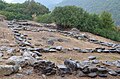
Thurii (Latin: Thūriī; Ancient Greek: Θούρῐοι, romanized: Thoúrioi), called also by some Latin writers Thūrium (compare Ancient Greek: Θούρῐον, romanized: Thoúrion, in Ptolemy), and later in Roman times also Cōpia and Cōpiae, was an ancient Greek city situated on the Gulf of Taranto, near or on the site of the great renowned city of Sybaris, whose place it may be considered as having taken. The ruins of the city can be found in the Sybaris archaeological park near Sibari in the Province of Cosenza, Calabria, Italy.
History
Thurii was founded as a colony of Athens along with exiles from Sybaris in 443 BC. Justin writes that people say that the city of Thurii was built by Philoctetes and his monument is seen there even to his days, as well as the arrows of Hercules which laid up in the temple of Apollo. The site of that city had remained desolate for a period of 58 years after its destruction by the Crotoniats; when at length, in 452 BC, a number of the Sybarite exiles and their descendants made an attempt to establish themselves again on the spot, under the guidance of some leaders of Thessalian origin; and the new colony rose so rapidly to prosperity that it excited the jealousy of the Crotoniats, who, in consequence, expelled the new settlers a little more than 5 years after the establishment of the colony. The fugitive Sybarites first appealed for support to Sparta, but without success: their application to the Athenians was more successful, and that people determined to send out a fresh colony, at the same time that they reinstated the settlers who had been lately expelled from thence. A body of Athenian colonists was accordingly sent out by Pericles, under the command of Lampon and Xenocritus. Pericles' expressed intent was for it to be a Panhellenic colony, and the number of Athenian citizens was small, the greater part of those who took part in the colony being collected from various parts of Greece. Among them were two celebrated names: Herodotus the historian, and the orator Lysias, both of whom appear to have formed part of the original colony. Hippodamus also went out with the colonists and became the architect of the new city. The term "Thurii-seers" (Thouriomanteis; Θουριομάντεις) referred not to seers from Thurii itself, but to seers such as Lampon who were sent by Athens to assist in founding the colony.
The laws of the new colony were established by the sophist Protagoras at the request of Pericles, adopting the laws of Zaleucus of Locri. …
The site
One house stands out by size and decoration: the large domus located behind the Theatre, undoubtedly one of the most sumptuous private buildings in the Roman city. It was built in the late Republican era (1st century BC) and survived until the 5th century AD through a series of expansions and transformations that gradually modified the layout. The monumentality and the splendour of the house reached their peak between the 1st and 3rd centuries AD while from the 4th are tangible signs of a decline.
Coinage
Thurii had an active mint in antiquity. The coins of Thurii are of great beauty; their number and variety indeed gives us a higher idea of the opulence and prosperity of the city than we should gather from the statements of ancient writers.
Text from Wikipedia, the free encyclopedia, under CC BY-SA 4.0. Full article: «Thurii».
Photos
Getting there
SibariTrain, nearest
600 m as the crow flies
Thurii
Distances are as the crow flies, not walking or driving.
Loading map…
Nearby
See on the mapMore archaeological sites in Calabria


Frequently asked questions
Where is Thurii?
Thurii is in Cassano allo Ionio, in the province of Cosenza (Calabria), Italy. GPS coordinates: 39.75069, 16.45022.
What else is there to see near Thurii?
Nearby you’ll find: National Archaeological Museum of Sibaritide (4.7 km away), Timpone della Motta (9.4 km away), Castello San Mauro (10.9 km away).
Sources and licences
Text. Wikipedia, the free encyclopedia (CC BY-SA 4.0).
Data. Wikidata (CC0); opening hours and contacts OpenStreetMap (ODbL).
Photos. Wikimedia Commons, author and licence on every image.
Credits for the 2 photos
- Sybaris archeological park 1 — Peter Stewart, CC BY-SA 2.0
- Sybaris archeological park 2 — Peter Stewart, CC BY-SA 2.0
Updated 28 October 2026. All sources and licences