


Photo: Michelvincenzo, CC BY-SA 4.0 · Wikimedia Commons
Archaeological site
Scylletium
Human settlement in Borgia, Calabria, Province of Catanzaro, Calabria, Italy
At a glance
- Type
- Archaeological site
- Protection
- Italian national heritage
- Coordinates
- 38°49′02″ N, 16°35′49″ E
History and description
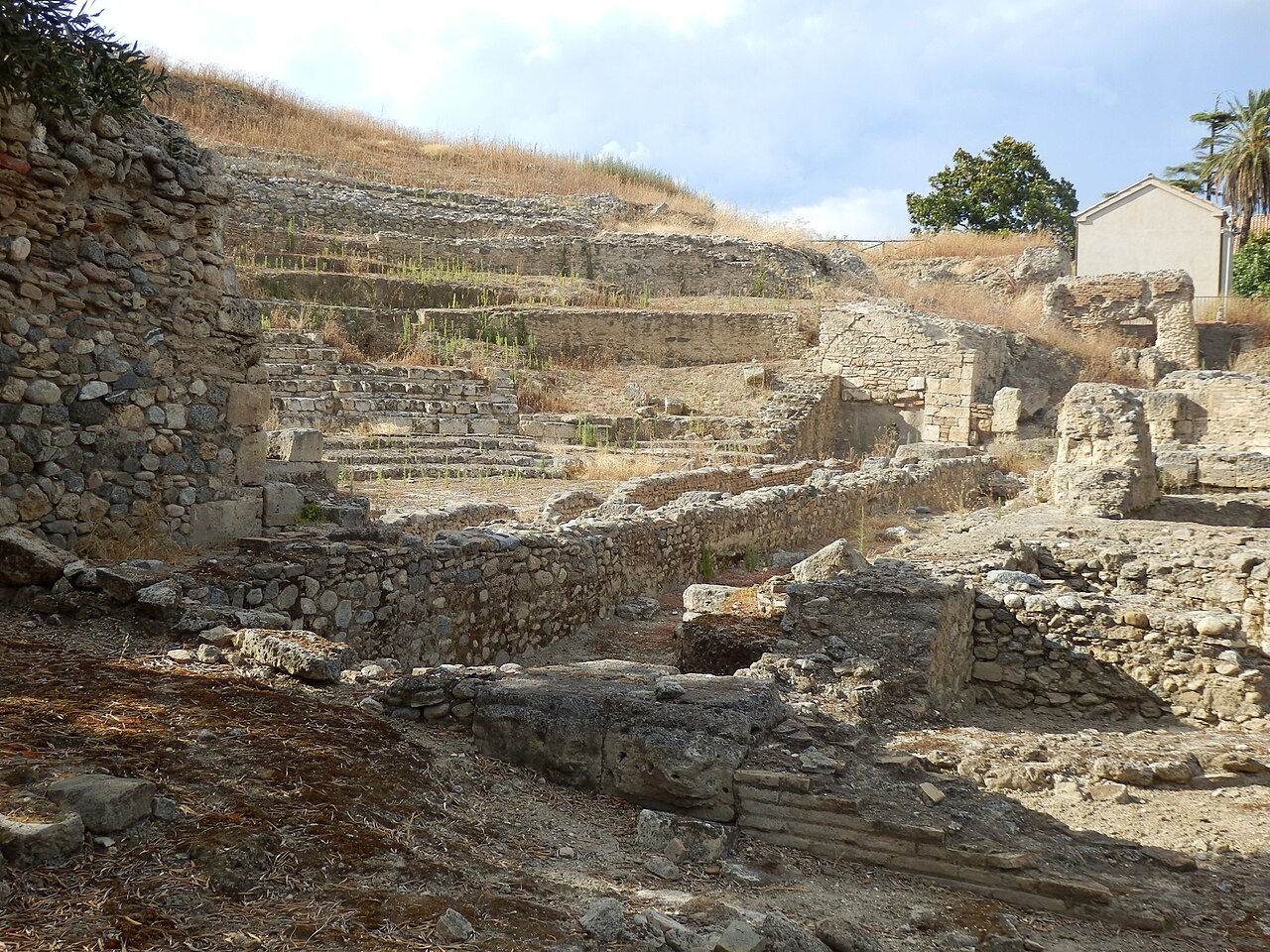
Scylletium, later Minervium and Colonia Minervia, was an ancient seaside city in present-day Calabria, southern Italy. Its ruins can be found at the frazione (borough) of Roccelletta in Borgia, near Catanzaro, facing the Gulf of Squillace.
History
Skylletion may originally have been founded in the 7th c. BC on the Punta di Staletti promontory.
In any case Scylletium was situated from the 6th c. BC on the east coast of Calabria (ancient Bruttium), on the shores of an extensive bay, to which it gave the name of Scylleticus Sinus.
According to a tradition generally received in ancient times, Scylletium (Σκυλλήτιον) was founded by an Athenian colony of Magna Graecia, a part of the followers who had accompanied Menestheus to the Trojan War. Solinus also mention that the Scylaceum was established by Athenians.
Another tradition was, however, extant, which ascribed its foundation to Ulysses. However, it did not display any friendship towards the Athenians.
It appears during this period to have been a minor place and a mere dependency of Crotona until it was wrested from its power by the elder Dionysius, who assigned it with its territory to the Locrians.
It was still a small and unimportant place at the time of the Second Punic War, as no mention is found of its name during the operations of Hannibal in Bruttium, though he appears to have had his headquarters for some time at Castra Hannibalis very near Scylletium.
In 124 BC the Romans, at the instigation of C. Gracchus, sent a colony to Scylletium, which appears to have assumed the name of Minervium or Colonia Minervia. The name is written by Velleius Scolatium; and the form Scolacium is found also in an inscription of the reign of Antoninus Pius, from which it appears that the place must have received a fresh colony under Nerva. Scylletium appears to have become a considerable town after it received the Roman colony, and continued such throughout the Roman Empire.
Towards the close of this period it was distinguished as the birthplace of the Roman statesman Cassiodorus, founder of the Vivarium, a monastery dedicated to the coexistence of coenobitic monks and hermits, who has left us a detailed but rhetorical description of the beauty of its situation dated to around 530 AD, and fertility of its territory. Cassiodorus also mentioned production of highly priced terra cotta. His villa was located at Punta di Staletti.
Text from Wikipedia, the free encyclopedia, under CC BY-SA 4.0. Full article: «Scylletium».
Photos
Getting there
Catanzaro LidoTrain, nearest
1.5 km as the crow flies
Scylletium
Aeroporto Internazionale di Lamezia Terme32.0 km
Distances are as the crow flies, not walking or driving.
Loading map…
Nearby
See on the mapMore archaeological sites in Calabria


Frequently asked questions
Where is Scylletium?
Scylletium is in Borgia, in the province of Catanzaro (Calabria), Italy. GPS coordinates: 38.81721, 16.59704.
What else is there to see near Scylletium?
Nearby you’ll find: Museum and archaeological park of Scolacium (1 km away), Borgia Castle (7.9 km away), Palazzo Fazzari (9.8 km away).
Sources and licences
Text. Wikipedia, the free encyclopedia (CC BY-SA 4.0).
Data. Wikidata (CC0); opening hours and contacts OpenStreetMap (ODbL).
Photos. Wikimedia Commons, author and licence on every image.
Credits for the 6 photos
- Scolacium Théâtre2 — Michelvincenzo, CC BY-SA 4.0
- Scolacium Entrée1 — Michelvincenzo, CC BY-SA 4.0
- Scolacium Foro1 — Michelvincenzo, CC BY-SA 4.0
- Scolacium Nécropole1 — Michelvincenzo, CC BY-SA 4.0
- Scolacium Théâtre1 — Michelvincenzo, CC BY-SA 4.0
- Voyage pittoresque ou description des royaumes de Naples et de Sicile Vol. 3. 1783 (8378633) — Jean-Claude Richard de Saint-Non, Public domain
Updated 28 October 2026. All sources and licences