
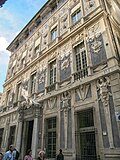


Photo: Unknown author Unknown author, Public domain · Wikimedia Commons
At a glance
- Type
- Historic theatre
- Architect
- Tommaso Carpineti
- Protection
- Italian national heritage
- Coordinates
- 44°24′48″ N, 8°56′05″ E
History and description
The Paganini Theater was an Italian theater, located in Genova. Inaugurated in 1855, it was situated on the central Via Caffaro. After less than a century of activity, on 23-24 October 1942, it was destroyed during the bombardments on Genova in World War II.
History
During the golden age of Italian drama, even before the unification of Italy, the growing Genoese upper-middle class demanded the construction of new theaters to serve the city's entertainment needs. Theater managers, sometimes dealing only with entrepreneurial aspects and sometimes also with cultural organization, met this demand.
Although significant national theaters were already present in the capital city (such as the Teatro Carlo Felice, the Teatro Colombo, the Teatro del Falcone, the Teatro di Sant'Agostino, the Teatro Apollo, and others), the demand was particularly intense and was seized upon by Francesco Sanguinetti (or Sanguineti), already the manager of the Teatro Carlo Felice. The construction of the new theater was chosen for the area of Via Caffaro, an important artery that connected the city center uphill with the upscale neighborhood of Castelletto, recently developed through the projects of Carlo Barabino and Giovanni Battista Resasco.
Inaugurated on 9 April 1855, Paganini Theater was designed by Tommaso Carpineti. Although sometimes attributed to G. B. Carpaneto, the oldest sources agree on Tommaso Carpineti as the architect (despite another G.B. Carpineti being listed in the contemporary registry as well). The theater construction plans are preserved in the State Archive of Genova. Sanguinetti decided to name it after the renowned Genoese violinist Niccolò Paganini.
The building was located in front of the Collegio-Convitto Commerciale d'Ippolito d'Aste, at the intersection with Via Bruzza. The inauguration took place with a performance of Rigoletto. The Annuario dei teatri di Genova from 1845/1855 summarized the steps that led to the birth of the theater:
In the new street between the destroyed gates of Portello and the hill of St. Anna, not far from the famous Contrada Nuova, in 1853, according to a plan devised by Engineer Tommaso Carpineti, the construction of a new theater was approved. On 28 June that year, the foundation stone of the theater was laid, and within a mere twenty months, it was completed. Meanwhile, the Civic Council, in its resolution on 1 February, assigned the name Via Cafaro to the new street. [...] …
Description
The hall was horseshoe-shaped, finely furnished, and had 5 orders of boxes and the gods; each order had 29 boxes. The stage curtain was the work of painter Giuseppe Isola and depicted Il trionfo del Petrarca in Campidoglio (The Triumph of Petrarch on the Capitol). The auditorium measured 17x18 meters with a height of 16 meters. The stage, 30x22 meters, had a height of 24 meters.
The lighting, innovative for the period, was gas-powered, with a sumptuous chandelier with 76 flames illuminating the auditorium.
Two marble staircases led to the boxes. On the second-order floor, there were three "gracefully painted" rooms for coffee and billiards. Another coffee room was located on the right corner of the theater, accessible both from the street in front and internally from the lobby for the public. On the fourth-order floor, there were additional three rooms where the first rehearsals of the works took place and were converted into a foyer for dance parties or as an outlet in case of excess spectators.
Above, there was an apartment intended as a residence for the manager, as well as other rooms for the caretaker's accommodation and offices. Going up more stairs, there was the dressing room for artists, the choir, the band, the choristers, and the extras. Finally, it was abundantly supplied with running water for cleaning, an uncommon feature at that time and therefore mentioned in the period descriptions.
Text from Wikipedia, the free encyclopedia, under CC BY-SA 4.0. Full article: «Teatro Paganini».
Timeline
- 1855Opened
- 1942Conflagration
Events and people from Wikidata (CC0).
Getting there
CarbonaraTrain, nearest
400 m as the crow flies
Teatro Paganini
Porto Antico700 m
Aeroporto Internazionale di Genova - Cristoforo Colombo7.3 km
Distances are as the crow flies, not walking or driving.
Loading map…
Nearby
See on the mapMore historic theatres in Liguria


Frequently asked questions
Where is Teatro Paganini?
Teatro Paganini is in Genoa, in the province of Genova (Liguria), Italy. GPS coordinates: 44.41332, 8.93461.
What else is there to see near Teatro Paganini?
Nearby you’ll find: Palazzo Podestà (300 m away), Palazzo Doria Tursi (300 m away), Palazzo Lercari-Parodi (300 m away).
Sources and licences
Text. Wikipedia, the free encyclopedia (CC BY-SA 4.0).
Data. Wikidata (CC0); opening hours and contacts OpenStreetMap (ODbL).
Photos. Wikimedia Commons, author and licence on every image.
Credits for the 1 photos
- Teatro Paganini, Genova, late 1800s, 3 — Unknown author Unknown author, Public domain
Updated 28 October 2026. All sources and licences