


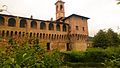


Photo: JMek, CC BY-SA 3.0 · Wikimedia Commons
Historic theatre, 1836
Teatro Dante
Theatre and cinema in Sansepolcro, Italy
Sansepolcro (AR), Tuscany
At a glance
- Type
- Historic theatre
- Period
- Modern era, 1836
- Style
- Italian theater
- Architect
- Francesco Leoni
- Coordinates
- 43°34′10″ N, 12°08′39″ E
History and description
Teatro Dante (also called Cinema Teatro Dante) is an Italian theatre in Sansepolcro, a town in Tuscany, Italy, in the province of Arezzo.
The theatre was inaugurated on 1 September, 1836, and was originally known as the Royal Theatre Dante (Regio Teatro Dante). Its inaugural performance was Vincenzo Bellini's opera La sonnambula (The Sleepwalker). The building has historically been associated with the Accademia dei Risorti ("Academy of the Resurrected" ), which owns the theatre.
In addition to operating as a movie theater, Teatro Dante hosts theatrical productions, concerts, operettas, and other live performances.
History
According to accounts of the theatre's history, the project was commissioned in September 1674 during the reign of Cosimo III de' Medici, Grand Duke of Tuscany, as part of an effort to promote cultural activities in the towns of the Grand Duchy of Tuscany.
The institution was initially known as '''Teatro della Fortuna''' ("Theatre of Fortune") and was managed by the local ''Accademia degli Sbalzati'', led by the poet Pietro Gherardi.
The ''Accademia degli Sbalzati'' ceased to exist in 1727. It was succeeded by another local association, known as the '''Accademia dei Nobili''', which continued to support theatrical activities and the use of the building.
The theatre operated regularly until 1832, when two local academies, The Nobles and The Resurrected, formed the Academy of the Nobles Resurrected. To witness this union, an olive tree became the new blazon of the association, cut at the lower end with new branches growing back on the sides, symbolizing the definitive rebirth of the association. The academy was not to be the only one to be renewed. The old theater, now dilapidated and in poor condition, was demolished in favor of a new building, built in stone in front of the old theater. Work began in 1833, a year after the birth of the new academy, led by the florentine Francesco Leoni and continued until August 1836. On September 1, the new theater called royal Dante theatre was inaugurated with La Sonnambula by Vincenzo Bellini. The name of the theater was chosen to pay tribute to one of the most important poets of Italy, the florentine Dante Alighieri. …
Description
Thanks to assiduous care, the theater space, even of medium size, has come to this day still intact with its neo-classical style, which makes it one of the most beautiful historic theaters in Tuscany. The theater is built according to the specifications of the nineteenth century Italian theaters, the main architectural features are the construction of the hall with a plant horseshoe, the elimination of the bleachers in favor of in favor of more box tiers, and the enlargement of the stage in favor of the new perspective wings. In the theater there are a total of 400 seats, divided in 190 seats in the stalls and in four tiers of boxes. There is also a small orchestra pit. Both the stalls that the stage has a little slope that is vanished in the area of pit.
The Academy
The academy of resurrected, as we know it nowadays, was established in 1953, with the aim of making management activities of theaters, cinemas, and other opportunities for entertainment and education. The component of the academy are formed mostly by the old nobles family present in Sansepolcro. Over the years, academics have changed several times, acquiring or disposing their shareholdings in the company. A famous member of the academy was the family Buitoni.
The statute of the academy expressed clearly that the company was created with the same intent of its ancient founders, and that any proceeds obtained will be invested to support the running costs and adapt the structures to the times. No academic earns money from the theater and its activities.
The theater Dante underwent natural transformation of small theaters Italian born largely in the Renaissance, which have been transformed from theater to multi-purpose halls. During the renaissance, the nobles of Sansepolcro manage this theater for personal prestige and to be able to present artistic and cultural performances to the entire population. It followed, as usual, that every noble had his reserved seat, away from ordinary people, according to his shareholding in association. The most prominent members were sitting in the most central seats, the others, hand in hand in the more laterals. The nobles didn't sat in the stalls, but they were on the upper floors, in the boxes. Originally it seems were not present even the chairs in the stalls, and that some performances were paid exclusively by the nobility to exercise more prestige in town. Ordinary people, in the early years it seems that should bring home a chair, if they wanted to sit. To remember the tradition of the boxes, still it reserves the "academic box" the number 8 box on the first floor that however isn't the royal box (called also the central box, the number 9 in second tier of boxes).
Trivia
the theater was used by Italian director Mario Monicelli for the shooting of the movie Rossini! Rossini! After much research, it was the only theater in the center Italy who was willing to remove the bulbs and put candles and candlesticks during filming.
Text from Wikipedia, the free encyclopedia, under CC BY-SA 4.0. Full article: «Teatro Dante».
Timeline
- 1836Built and opened
Events and people from Wikidata (CC0).
Photos
Getting there
Santa FioraTrain, nearest
3.3 km as the crow flies
Teatro Dante
Distances are as the crow flies, not walking or driving.
Loading map…
Nearby
See on the mapMore historic theatres in Tuscany


Frequently asked questions
Where is Teatro Dante?
Teatro Dante is in Sansepolcro, in the province of Arezzo (Tuscany), Italy. GPS coordinates: 43.56954, 12.14412.
How old is Teatro Dante?
Wikidata dates it to 1836.
What else is there to see near Teatro Dante?
Nearby you’ll find: Castello Mediceo (100 m away), Museo della vetrata (200 m away), Museo della Resistenza di Sansepolcro (300 m away).
Sources and licences
Text. Wikipedia, the free encyclopedia (CC BY-SA 4.0).
Data. Wikidata (CC0); opening hours and contacts OpenStreetMap (ODbL).
Photos. Wikimedia Commons, author and licence on every image.
Credits for the 2 photos
- Sansepolcro, Cinema Teatro Dante Fronte — JMek, CC BY-SA 3.0
- Sansepolcro, Cinema Teatro Dante - lampadario sala — Ajmad217, CC BY-SA 4.0
Updated 28 October 2026. All sources and licences