

- UNESCO
Photo: Pellegrinospagnuolo, CC BY-SA 4.0 · Wikimedia Commons
Abbey / Monastery
Marian church in Mercogliano, Italy
Mercogliano (AV), Campania
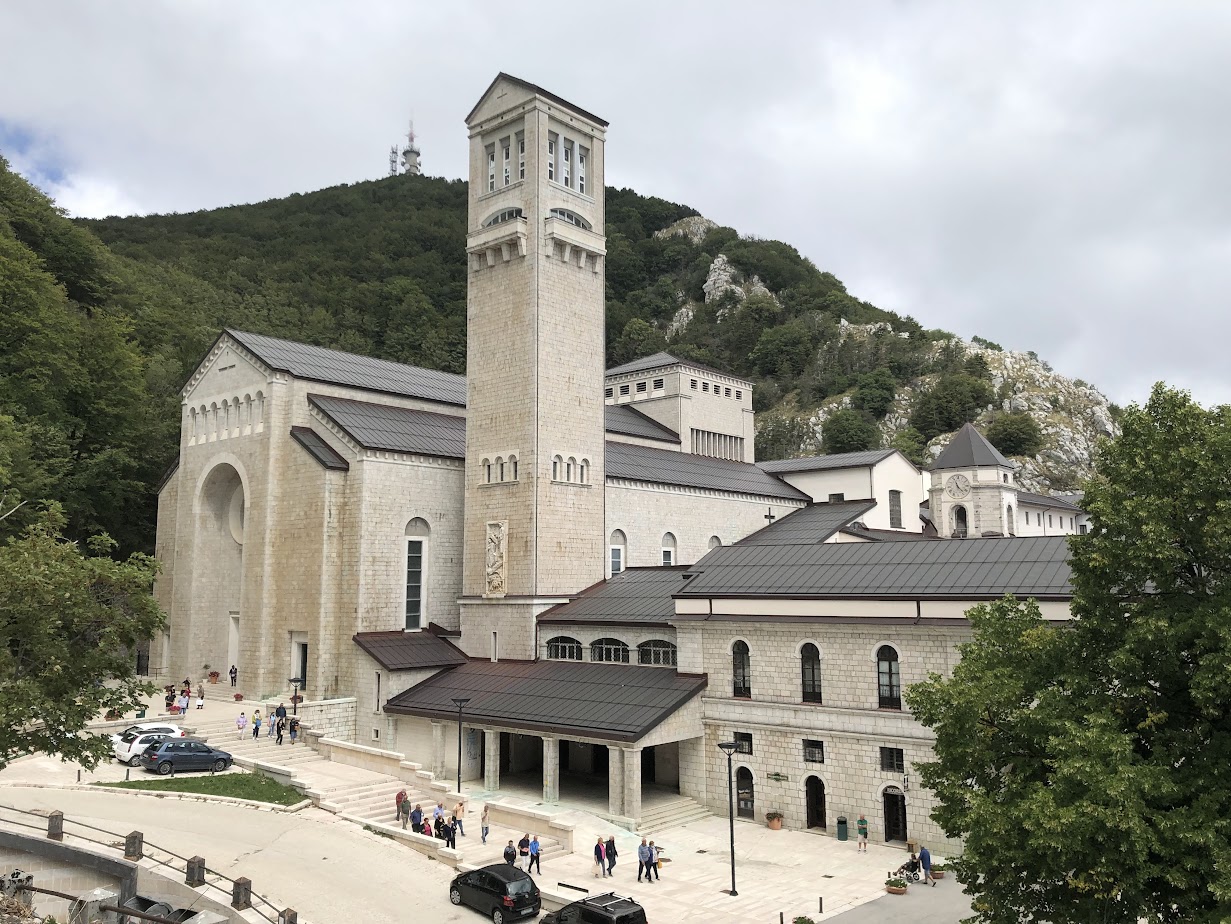
Sanctuary of Montevergine is a Marian church in Mercogliano, located in the hamlet of Montevergine. It's a part of the Territorial Abbey of Montevergine, one of the six Italian territorial abbeys. Inside, the painting of the Madonna di Montevergine is venerated and it is estimated that about one and a half million pilgrims visit it every year.
The history of the sanctuary of Montevergine is closely linked to the figure of William of Montevergine, a hermit monk who lived between the 11th and 12th centuries, who took pilgrimages to places of Christianity. Returning to Italy after a long journey to Santiago de Compostela, he decided to undertake a new pilgrimage to Jerusalem and to prepare himself spiritually he took refuge at Mount Serico, in Atella, where he is the protagonist of the healing of a blind man. Resuming the journey towards the holy land, he arrives in Ginosa, meeting with John of Matera, who advises him to give up the pilgrimage and to work for the divine service in the lands of the West: William refuses the advice of the saint and continues with his walk until he is beaten up by a group of brigands. Remembering John's words and after a long spiritual reflection, he understands the new path to follow, that is to retire in solitude and devote himself to meditation. Arriving in Irpinia, he feels that God's will is to make him reside on a mountain, known today as Partenio, at an altitude of over a thousand meters.
Over time, William's reputation for holiness increased more and more, so much so that men eager to embrace a lifestyle dedicated to prayer and solitude began to arrive spontaneously on the mountain. In a short time numerous cells, mostly made with mud and mortar, housed numerous monks. At the same time it was also decided to build a church, consecrated in 1126, dedicated to the Madonna, but, contrary to what is often told, no apparitions occurred: William only followed his deep devotion to the Virgin Mary. Soon the monks of Montevergine gathered in a congregation called Verginiana, officially recognized on 8 August 1879 by Pope Leo XIII: over the centuries the congregation has carried out both evangelization service, even using the local dialect to reach the lowest classes of society, and care for the sick, with the construction of numerous hospitals in Campania and in the rest of southern Italy. After the death of St. William in 1142, the sanctuary reached its heyday between the 12th and 14th centuries, when it was enriched with numerous works of art and expanded considerably thanks to the offerings of feudal lords, popes and kings: it was in this period that the painting of the Madonna was donated, now venerated in the cathedral basilica, but also numerous relics, including the bones of San Gennaro, which were then transferred to the cathedral of Naples in 1497. …
The construction works of the cathedral basilica began in 1952, ending in 1961 with the solemn consecration on Ascension Day: the basilica is the work of the architect Florestano Di Fausto. The facade, divided into three compartments where the same number of entrances open, is covered in white stone and in the center there is a rose window decorated with polychrome glass depicting the coronation of the Virgin.
Inside there are no particular notable elements, it has a neo-Romanesque style and is made up of three naves, one central and two lateral ones divided by five arches on both sides: at the bottom of the two lateral naves there are two matronea which host the organ. The main altar is enclosed by a wooden choir made of walnut and olive briar, while at the back there is a marble throne where the painting of the Madonna di Montevergine was placed, later replaced by a crucifix without nails: the frame that previously housed the painting it is surrounded by two marble angels who seem to support it; the altar is completed with polychrome marble, bronze bas-reliefs and a mosaic, the work of Hainal.
The ceiling is coffered with pure gold coffering, while the flooring is semi-polished granite. The windows of the dome are adorned with stained glass windows representing Angels created by Amalia Panigati, who was also responsible for the crosses in the matronea symbolizing the Evangelists. From the left nave there is access to a sort of side chapel called the Penitentiary, while at the bottom of the right nave there is access to the old basilica via a Gothic style portal, dating back to the 13th century, whose tympanum is decorated with the descent of the Holy Spirit on the Apostles and Holy Mary during the first Christian Pentecost. …
Pilgrimages to Montevergine are a deeply rooted tradition not only in Campania, but also throughout the rest of southern Italy: the first evidence of ascents to Mount Partenio already dates back to the time of William of Montevergine when small communities of people came to the church especially to get to know the virtuous saint; A document from 1139 says of pilgrimages that they invoke divine grace and on 12 September 1263, Pope Urban IV, affirmed how the area of Montevergine had become an important center of prayer. The constant flow of pilgrims over the years led to benefits trickling down to local communities, so much so that numerous hostels were built in the area: today this place takes the name of Ospedaletto d'Alpinolo, deriving precisely from the high number of reception centers.
The pilgrimages in the past were carried out both in a carriage and with a cart, on horseback or on foot, they were characterized by fasting or abstinence from meat, eggs and cheese; another tradition had it that unmarried women or girls who went on pilgrimage intertwined broom branches during the climb towards the mountain, promising the Madonna to return the following year and to untie the knot in the company of the groom or even that very young girls went barefoot to the sanctuary on behalf of third parties to thank the Virgin for the grace received. During the descent, the men used to perform a chariot race, called recanata, while the women sang popular songs. …
Text from Wikipedia, the free encyclopedia, under CC BY-SA 4.0. Full article: «Sanctuary of Montevergine».
Distances are as the crow flies, not walking or driving.


Sanctuary of Montevergine is in Mercogliano, in the province of Avellino (Campania), Italy. GPS coordinates: 40.93592, 14.72839.
Nearby you’ll find: Santuario Montevergine (0 m away), Palazzo abbaziale di Loreto (1.9 km away), Summonte (2.4 km away).
Text. Wikipedia, the free encyclopedia (CC BY-SA 4.0).
Data. Wikidata (CC0); opening hours and contacts OpenStreetMap (ODbL).
Photos. Wikimedia Commons, author and licence on every image.
Updated 28 October 2026. All sources and licences