

- UNESCO
- Free 1st Sunday
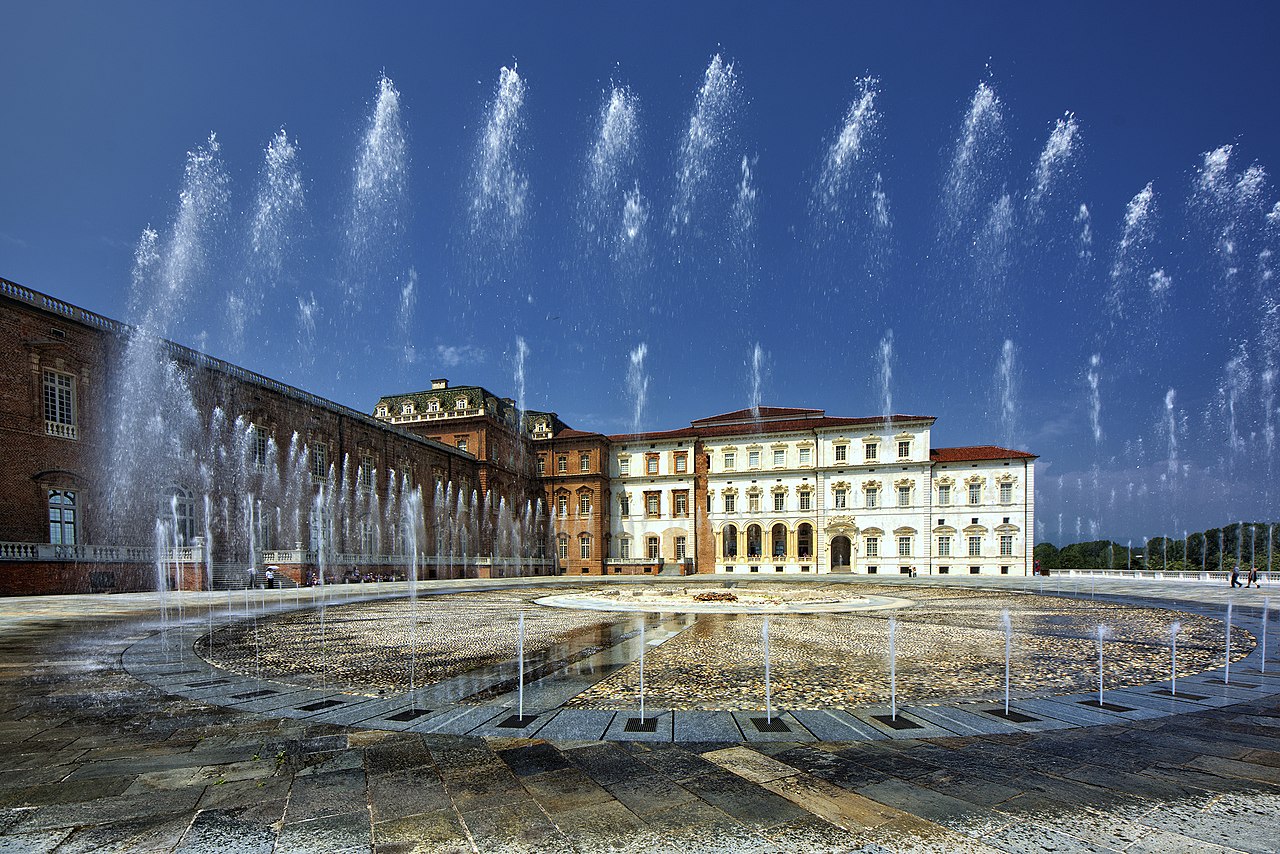
Photo: Tiziano Photography, CC BY-SA 3.0 · Wikimedia Commons
The Palace of Venaria (Italian: Reggia di Venaria Reale) is a former royal residence and gardens located in Venaria Reale, near the city of Turin in the Piedmont region in northern Italy. It is one of the 14 Residences of the Royal House of Savoy built in the area between the 16th and 18th centuries which were collectively designated a UNESCO World Heritage Site in 1997.
The palace was designed and built from 1675 by Amedeo di Castellamonte, commissioned by Duke Charles Emmanuel II, who needed a base for his hunting expeditions in the heathy hill country north of Turin. The name itself derives from the Latin phrase Venatio Regia meaning "Royal Hunt". It was later enlarged to become a luxurious residence for the House of Savoy. During that time, the palace complex became a masterpiece of Baroque architecture and was filled with decoration and artwork. It fell into disuse at the end of the 18th century. After the Napoleonic Wars, it was used for military purposes until 1978, when its renovation began, leading to the largest restoration project in European history.
Charles Emmanuel II, Duke of Savoy (1634–1675) was inspired by the earlier Castle of Mirafiori (Italian: Castello di Mirafiori), built by Duke Charles Emmanuel I (1562–1630) for his wife Catalina Micaela of Spain (1567–1597) in what is today the southern suburb of Turin.
Keen to leave a memorial dedicated to himself and his wife, Marie Jeanne Baptiste of Savoy-Nemours (1644–1724), Charles Emmanuel II bought two small villages just north of the city, Altessano Superiore and Altessano Inferiore, from the landowner family Birago of Milanese origin, who had used the land for farming. The place was renamed Venaria for its future function as a hunting lodge (Venatio in Latin). The construction of this residence was part of the larger plan of building the so-called "Garland of Delights" (Corona di Delizie), a chain of palaces and leisure residences around Turin, which also included the hunting lodge of Stupinigi, the Castle of Rivoli, the Queen's Villa, and others.
In 1658 Charles Emmanuel II commissioned the project to build the palace and a small town around it to the architect Amedeo di Castellamonte, whose father Carlo was the chief architect of Charles Emmanuel I and whose work had popularized Piedmontese Baroque.
The ambitious plan envisioned a grandiose complex including the palace, gardens, hunting woods, and also a new town, with scenic vistas. The new town's plan had a circular layout, imitating the round shape of the collar of the Supreme Order of the Most Holy Annunciation, a dynastic order created by the House of Savoy. Construction began in 1659, and under the direction of Castellamonte work proceeded steadily, starting with the horse stable and the clock tower built in 1660. …
The palace is made up of two distinct wings: the original 17th century Palace of Diana, covered in white plaster, and the later 18th-century addition, with exposed brickwork. The entrance of the palace leads into the Cour d'honneur ("Honour Court"), which once housed a fountain with a deer.
The Palace of Diana is the core of the complex and the oldest section of the palace. It was built between 1658 and 1663 under the direction of Amedeo di Castellamonte. The main façade, covered with plaster and featuring cornucopias, shells and fruits, is connected on the right by section with the 18th-century wing. The façade facing the Honor Court presents a loggia flanked by an arched entryway on its right. Originally, there was a twin archway on the left of the loggia, but it was removed during Garove's reworking.
The Cour d'honneur leads into the Sala di Diana (Hall of Diana), situated in the Palace of Diana, which functions as the heart of the palace. It is a rectangular room, decorated with stuccoes and paintings centered on the theme of hunting. These include the frescoed vault representing Olympus (work of Jan Miel) which pictures Jupiter offering a gift to Diana, huge equestrian portraits of the dukes and the court (works by various painters in the ducal service), and hunting-themed canvases by Jan Miel, including the Hunt for the Deer, the Hare, the Bear, the Fox, the Boar, the Death of the Deer, the Going to the Woods, the Assembly, the Curea.
The two pavilion date to the Michelangelo Garove period (1669–1713) and are covered with multicolor pentagonal tiles in ceramics, which are united by a large gallery, known as Grand Gallery (Galleria Grande). The centerpiece of the 18th-century wing is the Galleria Grande (Grand Gallery), which is stucco decorations, 44 arched windows, and black and white tiled floor. The interiors originally housed a large collection of stuccos, statues, paintings (according to Amedeo di Castellamonte, up to 8,000) from some of the court artists of the times, such as Vittorio Amedeo Cignaroli, Pietro Domenico Olivero and Bernardino Quadri. …
Text from Wikipedia, the free encyclopedia, under CC BY-SA 4.0. Full article: «Palace of Venaria».
Events and people from Wikidata (CC0).
Distances are as the crow flies, not walking or driving.


Palace of Venaria is in Venaria Reale, in the province of Torino (Piedmont), Italy. Address: Piazza della Repubblica, 4 - Venaria Reale. GPS coordinates: 45.13583, 7.62352.
According to OpenStreetMap the opening hours are: Monday: Closed; Tuesday to Sunday: 10:00–17:00. Always check the official website before your visit.
Nearby you’ll find: TIM Historical Archive (4.6 km away), Castle of the lakes (4.8 km away), Teatro Cardinal Massaia (5.1 km away).
Text. Wikipedia, the free encyclopedia (CC BY-SA 4.0).
Data. Wikidata (CC0); opening hours and contacts OpenStreetMap (ODbL).
Photos. Wikimedia Commons, author and licence on every image.
Updated 28 October 2026. All sources and licences