

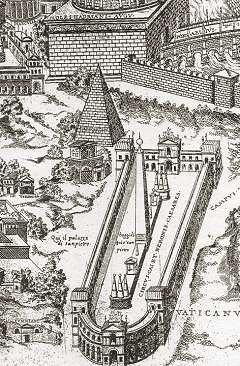


Photo: Carrasco at English Wikipedia, CC BY-SA 3.0 · Wikimedia Commons
Fortress / Tower
St. Pellegrino Gate
Gate in Vatican City
- Within the UNESCO World Heritage Site “Historic Centre of Rome, the Properties of the Holy See in that City Enjoying Extraterritorial Rights and San Paolo Fuori le Mura”
At a glance
- Type
- Fortress / Tower
- Coordinates
- 41°54′12″ N, 12°27′26″ E
History and description
Porta San Pellegrino is a gate in the outer wall of Vatican City. It is located beside Bernini's Colonnade and the small Vatican post; it is also known as Porta Viridaria. Rebuilt by Pope Alexander VI in 1492, the gate is surmounted by his papal coat of arms. The gate is little used. Originally part of the ninth-century Leonine Walls commissioned by Pope Leo IV to defend St. Peter's Basilica from Saracen raids, it once marked the principal northern entrance for pilgrims. Although its military purpose has long passed, the gate's austere ashlar masonry and heraldic reliefs still evoke its defensive and ceremonial significance.
History
Porta San Pellegrino originally formed one of the three principal entrances in the Leonine Walls, consecrated by Pope Leo IV on 27 June 852 to defend St. Peter's Basilica and the surrounding Borgo district from Saracen raids. The ancient Via Trionfale led directly under this gate, guiding pilgrims from the centre of the future piazza towards Monte Mario. In 1411 the antipapal John XXIII demolished the gate's original towers, leaving the medieval wall weakened. Mid-century, Pope Nicholas V extended the Vatican’s northern enclosure, and Porta San Pellegrino thereafter marked the junction between the Passetto di Borgo and the new fortifications. Pope Alexander VI undertook a full reconstruction in 1492, adding two square crenellated towers and affixing his family's arms and a Latin dedicatory inscription above the interior arch. After Pope Pius IV's mid-16th-century enlargement of Borgo, the gate lay beyond the new defensive line and was closed in 1563; it remained sealed until Pope Leo XII reopened it in 1823 to give the Pontifical Swiss Guard direct access to their barracks.
Architecture
The surviving fabric of Porta San Pellegrino consists of a single semicircular stone arch flanked by low, square towers topped with machicolated parapets. The inner face bears the Borgia coat of arms—a bull and an eagle—in high relief, set beneath a weathered inscription commemorating Alexander VI's restorations. The ashlar masonry and minimal decorative carving reflect the gate's strictly military function, while the scale of its towers hints at its role as a key access point to the papal city.
Modern use
Today the gate stands almost hidden beneath the buildings of the Apostolic Palace and sees little pedestrian traffic. On 6 February 2015, however, the Vatican announced completion of a small welfare facility immediately adjacent to Bernini's Colonnade, providing three daily showers and a barber's chair for homeless pilgrims (closed on Wednesdays and during large events), along with hygiene kits.
Text from Wikipedia, the free encyclopedia, under CC BY-SA 4.0. Full article: «St. Pellegrino Gate».
Photos
Getting there
Città del VaticanoTrain, nearest
600 m as the crow flies
St. Pellegrino Gate
Aeroporto di Roma-Ciampino16.1 km
Distances are as the crow flies, not walking or driving.
Loading map…
Nearby
See on the mapMore fortresses and towers in Lazio


- UNESCO


Frequently asked questions
Where is St. Pellegrino Gate?
St. Pellegrino Gate is in Rome, in the province of Roma (Lazio), Italy. GPS coordinates: 41.90337, 12.45711.
What else is there to see near St. Pellegrino Gate?
Nearby you’ll find: Palazzo detto dei Propilei (200 m away), Circus of Nero (200 m away), Palazzo Cesi Armellini (300 m away).
Sources and licences
Text. Wikipedia, the free encyclopedia (CC BY-SA 4.0).
Data. Wikidata (CC0); opening hours and contacts OpenStreetMap (ODbL).
Photos. Wikimedia Commons, author and licence on every image.
Credits for the 4 photos
- Porta San Pellegrino — Carrasco at English Wikipedia, CC BY-SA 3.0
- Porta San Pellegrino 1 — Mx. Granger, CC0
- Porta San Pellegrino 20141004 134129 — Gugganij, CC BY-SA 3.0
- Porta SanPellegrino 3028-31 — user:Lalupa, Public domain
Updated 28 October 2026. All sources and licences