
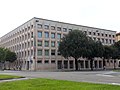


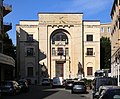

Photo: Zairon, CC BY-SA 4.0 · Wikimedia Commons
Fortress / Tower, 1532
Porta Nuova
City gate in Verona, Italy
- Within the UNESCO World Heritage Site “City of Verona”
At a glance
- Type
- Fortress / Tower
- Period
- Renaissance, 1532
- Protection
- Italian national heritage
- Coordinates
- 45°25′53″ N, 10°59′17″ E
- Address
- Corso Porta Nuova
History and description
Porta Nuova is a gateway to the historic center of Verona, built between 1532 and 1540. It was designed by architect Michele Sanmicheli. Giorgio Vasari remarked on the gateway in his work Le vite de' più eccellenti pittori, scultori e architettori, stating that "never before [had there been] any other work of more grandeur or better design."
History
Two resolutions of the Venetian Senate, the first dated 15 December 1530, the second on 5 January 1531, mandated the demolition of the long side of the wall that separated the Visconti Citadel from the rest of Verona, "for the convenience and ornament of our city." Concurrently, it was decided to renovate the countryside wall, which had suffered significant damage during the War of the League of Cambrai in 1516. This project was expected to include the replacement of the medieval gate that stood near the future site of Porta Nuova.
Michele Sanmicheli was appointed as the engineer in charge of the fortifications of Verona ("inzener sopra le fabriche"), with the appointment occurring in October 1530 but becoming effective in May 1531. Following this, work on the military structures progressed more rapidly. Sanmicheli's first intervention was the design of the bastion of the Holy Trinity, which began in the year after his appointment. This was followed by work on the bastions of Riformati, San Bernardino, San Zeno, Spagna, and San Francesco, along with a series of intermediate artillery emplacements, including that of the cavalier of San Giuseppe. His efforts also led to the creation of three city gates: Porta Nuova, was completed in 1532, followed by Porta San Zeno in 1541 and Porta Palio in 1547.
Porta Nuova, situated between the bastion of the Holy Trinity and the bastion of Riformati, was constructed alongside the realignment of the city walls between these two bastions and the dismantling of the wall that separated the fortified Citadel from the rest of the city. In this context, Sanmicheli had the opportunity to refine a new urban planning approach for this significant portion of the Venetian city, establishing Porta Nuova as a focal point. Unlike earlier gates, it provided access to a long straight street (the street of Porta Nuova, built in 1535) that led directly to the gates of Bra and the Arena, near which Sanmicheli later constructed the Honorij Palace. …
Description
Francesco Maria I Della Rovere, Captain General, specified that the gates should be situated "in an open place and straight between two bastions", avoiding the "entangled and twisted" configuration found in Ferrara. He also requested that a cavalier suitable for the placement of artillery be positioned at the center of the curtain wall between the two bastions.
The structure of the gate appears to be an integral part of the city walls, as it does not project beyond the curtain wall. Its height is intentionally limited to reduce vulnerability to enemy artillery. The block has two circular towers on either side, used by sentries and originally covered by a wooden roof with a tiled covering, the shape of which allowed an excellent view of the surrounding area. The open top of the gate served as a platform for fortress artillery, making it, as noted by Scipione Maffei, "the first example of making a gate to be used also as a Cavalier." This necessitated the gate's considerable width for maneuvering artillery, as well as thick walls, pillars, and roof structures to support the weight and absorb vibrations from cannon fire.
The plan, rectangular in shape, is laid out as an elaborate three-lane design, defined by four large pillars with dividing Doric pilasters. The side aisles provided access to guard posts, complete with fireplaces, and to small rooms that could be used as cells. The interior is almost entirely covered by ashlar. The gate was accessible from the countryside by wooden drawbridges lowered over the fixed masonry bridge, which ran across the deep magisterial moat. …
Text from Wikipedia, the free encyclopedia, under CC BY-SA 4.0. Full article: «Porta Nuova».
Timeline
- 1532Built
Events and people from Wikidata (CC0).
Photos
Getting there
Verona Porta NuovaTrain, nearest
500 m as the crow flies
Porta NuovaCorso Porta Nuova
Aeroporto Valerio Catullo di Verona-Villafranca8.8 km
Distances are as the crow flies, not walking or driving.
Loading map…
Nearby
See on the mapMore fortresses and towers in Veneto


Frequently asked questions
Where is Porta Nuova?
Porta Nuova is in Verona, in the province of Verona (Veneto), Italy. Address: Corso Porta Nuova. GPS coordinates: 45.43147, 10.98817.
Is Porta Nuova wheelchair accessible?
According to OpenStreetMap data, the site is partly wheelchair accessible.
How old is Porta Nuova?
Wikidata dates it to 1532.
What else is there to see near Porta Nuova?
Nearby you’ll find: Camera di commercio industria artigianato e agricoltura (100 m away), Verona defensive system (200 m away), Palazzo Verità Montanari (500 m away).
Sources and licences
Text. Wikipedia, the free encyclopedia (CC BY-SA 4.0).
Data. Wikidata (CC0); opening hours and contacts OpenStreetMap (ODbL).
Photos. Wikimedia Commons, author and licence on every image.
Credits for the 9 photos
- Verona Porta Nuova Stadtseite 3 — Zairon, CC BY-SA 4.0
- Decorazione facciata sud Porta Nuova (Verona) — Ppigna, CC BY-SA 4.0
- Decorazione interno Porta Nuova (Verona) — Ppigna, CC BY-SA 4.0
- Dettaglio facciata nord Porta Nuova (Verona) — Ppigna, CC BY-SA 4.0
- Facciata nord Porta Nuova (Verona) — Ppigna, CC BY-SA 4.0
- Facciata sud Porta Nuova (Verona) — Ppigna, CC BY-SA 4.0
- L04 097 Verona, Porta Nuova — Falk2, CC BY-SA 4.0
- L04 098 Verona, Porta Nuova — Falk2, CC BY-SA 4.0
- L04 116 Verona, Porta Nuova — Falk2, CC BY-SA 4.0
Updated 28 October 2026. All sources and licences