


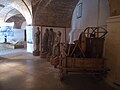
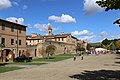


Photo: Pax:Vobiscum, CC BY-SA 3.0 · Wikimedia Commons
Archaeological site
Poggio Civitate
Etruscan archaeological site in Murlo, near Siena, Tuscany, Italy
At a glance
- Type
- Archaeological site
- Coordinates
- 43°09′20″ N, 11°23′58″ E
History and description
Poggio Civitate is a hill in the commune of Murlo, Siena, Italy and the location of an ancient settlement of the Etruscan civilization. It was discovered in 1920, and excavations began in 1966 and have uncovered substantial traces of activity in the Orientalizing and Archaic periods as well as some material from both earlier and later periods.
Iron Age
Limited Iron Age (Villanovan) architectural and artifactual evidence suggests that there was Iron Age activity and possibly Iron Age occupation at Poggio Civitate during the mid-8th to early 7th centuries BCE.
On an area of the site known as Civitate C, a trench labeled Civitate C 7 (CC7) uncovered the post holes and countersunk floor of a curvilinear, ovoid hut of approximately five by seven meters. After its period of use, this structure appears to have been reused as a midden, including a deposit of over one thousand murex shells (Bolinus brandaris), possibly used for small scale dye production.
Artifacts, such as fragments of coil-made pottery, an Iron Age technology, suggest a presence of Iron Age Etruscans on Poggio Civitate. An impasto handle fragment has a typology and decorations reminiscent of Iron Age (Villanovan) cover bowls for biconical urns. There are also fragments of bronze fibulae of an Iron Age design. These artifacts have been recovered from an area of the site known as Civitate A as well as from a trench labeled Tesoro 27, which sounded below the ground level of the Intermediate Orientalizing Complex 2(OC2)/Workshop.
Orientalizing period
The Orientalizing period lasted roughly from the early or mid 7th century BCE to the early 6th century BCE. The Orientalizing period at Poggio Civitate is often further divided into the Early Orientalizing Period and Intermediate Orientalizing Period, which last from roughly 630-580 BCE. This period marked the first large scale architectural works being constructed on the site and new technology was used to support new features like the terracotta roofs. Excavations of artifacts and architecture indicate clear class structures with evidence of rich aristocratic homes (the Intermediate Phase Orientalizing Complex) and items along with the more simple homes (non-elite domestic architecture) found throughout Poggio Civitate. The Orientalizing period as a whole was one of renewed Italian and Mediterranean trade as exhibited by the influx of new goods and materials during this time. Products such as Greek pottery and murex shell show this increase in trade.
Five surviving buildings from the Orientalizing period have been uncovered. Early Phase Orientalizing Complex 4(EPOC4) and Early Phase Orientalizing Complex 5(EPOC5) are two buildings from the Early Orientalizing Period. EPOC4 is thought to be a residence and EPOC5 is poorly preserved and thus harder to judge its function. Intermediate Phase Orientalizing Complex 1 (OC1) is a residence, Intermediate Phase Orientalizing Complex 2 (OC2) is a workshop, and Intermediate Phase Orientalizing Complex 3 (OC3) is a tripartite building, with possible religious functions. They were large complexes with decorative tile roofs and were built in the second quarter of the seventh century. All three buildings are thought to have been destroyed by the same fire sometime between 590 and 580 BCE. …
Archaic period
The Archaic period, lasting from the 7th century BCE to the mid 6th century BCE, saw an enhanced revitalization of the previously destroyed building complex of the Orientalizing period. Prior to the creation of the new Archaic building, survivors salvaged any debris that remained and flattened the plateau, known as Piano del Tesoro, or the "Plateau of the Treasure", to begin construction. The monumental building included elaborate decorations, including frieze plaques with motifs such as a banquet and horse race, gutters, and terracotta statues such as the “Cowboy” akroterion and sphinx akroterion. In the mid-6th century BCE, the building was destroyed and abandoned.
In the early 6th century BCE, Poggio Civitate produced what is known as the Archaic Building, a monumental complex. The construction was a large four-winged building with a courtyard in the middle of the structure. The roof and the walls of the structure were elaborately decorated with 30,000 feet of non-decorative and decorative terracottas.
It is unknown what the building was used for. There have been several disputes, but the first excavator of Poggio Civitate believed the monumental building was used as a meeting-hall for political and religious events. Others argued that it could have been used as the residence of the ruler, a palazzo, or an Etruscan version of an agora.
Use of akroteria at Poggioe Civitate can be first seen in the Intermediate Orientalizing Phase. In earlier periods, elements of what became Archaic akroteria, were seen, but in the Archaic period statues were developed in the round with highly artistic design on these corners and peaks of the Archaic Building. Humanoid elements such as fragments of ears made of terracotta are found among the Archaic akroteria. The famous "Murlo Cowboy" is an example of Archaic acroterion. It has also been argued that these Akroteria created an aura of power and wealth that would impact both those living within and around the buildings they adorned. …
Text from Wikipedia, the free encyclopedia, under CC BY-SA 4.0. Full article: «Poggio Civitate».
Getting there
MurloTrain, nearest
4.6 km as the crow flies
Poggio Civitate
Distances are as the crow flies, not walking or driving.
Loading map…
Nearby
See on the mapMore archaeological sites in Tuscany


- Free 1st Sunday
Frequently asked questions
Where is Poggio Civitate?
Poggio Civitate is in Murlo, in the province of Siena (Tuscany), Italy. GPS coordinates: 43.15560, 11.39940.
What else is there to see near Poggio Civitate?
Nearby you’ll find: Castello di Bibbiano (5.2 km away), Villa di Curiano (5.6 km away), Castello di Castelrosi (6.3 km away).
Sources and licences
Text. Wikipedia, the free encyclopedia (CC BY-SA 4.0).
Data. Wikidata (CC0); opening hours and contacts OpenStreetMap (ODbL).
Photos. Wikimedia Commons, author and licence on every image.
Credits for the 1 photos
- Poggio Civitate and Murlo — Pax:Vobiscum, CC BY-SA 3.0
Updated 28 October 2026. All sources and licences