

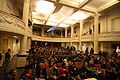

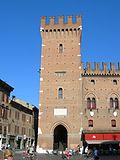


Photo: Lungoleno, CC BY-SA 4.0 · Wikimedia Commons
Historic villa / palace, 18th century
Palazzo Arcivescovile
Palazzo in Ferrara, Italy
Ferrara (FE), Emilia-Romagna
- Within the UNESCO World Heritage Site “Ferrara, City of the Renaissance, and its Po Delta”
At a glance
- Period
- Early modern period, 18th century
- Architect
- Tommaso Mattei
- Protection
- Italian national heritage
- Coordinates
- 44°50′11″ N, 11°37′11″ E
- Address
- corso Martiri della Libertà
History and description
The Archiepiscopal palace of Ferrara, commissioned by the cardinal legates Tommaso Ruffo, was built in its recent form starting from 1717. It is located in Corso Martiri della Libertà next to the Cathedral of San Giorgio.
History
At least until 1172, the bishops had at their disposal, within the primitive Ferrarese city walls laid out exclusively near the ancient course of the Po di Primaro, a building at the church of Santo Stefano, and this was before the city's religious and political centre moved further north than before, during the period of the city's expansion. With the construction of the new cathedral to replace the basilica of San Giorgio fuori le mura, a new bishop's palace was built from the end of the 12th century, smaller in size than the modern building. Subsequently, at the behest of bishop Giovanni Tavelli da Tossignano, starting in 1441, the primitive bishop's residence was enlarged with a new wing that reached as far as the cathedral square, making its façade more important and, at the same time, the interiors were enriched with decorations that have partly survived.
The reconstruction in modern forms was commissioned by Cardinal Tommaso Ruffo, who considered the palace as the bishop's seat used up to that time to be too modest in size and insufficiently prestigious. The project for its reconstruction was initially entrusted to Tommaso Mattei, a Roman architect. In the meantime, the cardinal acquired several adjacent buildings, had parts of the primitive palace demolished and had the new bishop’s see joined into a single monumental block. Work continued until at least 1724 and was entrusted to Vincenzo Santini, an architect from Veneto, who also worked on the Church of San Domenico (Ferrara).
After its reconstruction, it hosted illustrious personalities. In 1796 Napoleon Bonaparte met Cardinal Alessandro Mattei there and in 1857, as a guest of the Metropolitan Archbishop of Ferrara Luigi Vannicelli Casoni, he stayed there Pope Pius IX. …
Description
The palace is of considerable size and is characterised by a large portal that occupies two floors and supports, on its columns, the balcony on the second floor placed at the centre of the façade, facing the palazzo comunale.
The interior is refined and decorated with stuccoes and frescoes.
The monumental internal staircase, past the main entrance and before entering the building’s courtyard, is architecturally and artistically significant in the eighteenth-century Ferrara period. Vincenzo Santini’s son, Angelo, was inspired by this work for the ceremonial staircase of the palace of Renata di Francia.
The ceiling is decorated with frescoes by Vittorio Bigari. There are statues and decorations attributed to Filippo Suzzi and Andrea Ferreri and, on the walls, a painting of the Madonna by Ippolito Scarsella.
The archbishop’s residence is joined directly to the cathedral by a raised passageway that forms a characteristic face. Through this passage from the cathedral square one reaches the historic via Guglielmo degli Adelardi (the ancient via Gorgadello).
University headquarters
Before the seat of the Studium in 1567 was moved to the Palazzo Paradiso, and thus before its 18th-century reconstruction ordered by Cardinal Ruffo, in 1503 Nicolaus Copernicus obtained a degree in canon law there.
Text from Wikipedia, the free encyclopedia, under CC BY-SA 4.0. Full article: «Palazzo Arcivescovile».
Timeline
- 18th centuryBuilt
People
Events and people from Wikidata (CC0).
Photos
Getting there
FerraraTrain, nearest
1.5 km as the crow flies
Palazzo Arcivescovilecorso Martiri della Libertà
Distances are as the crow flies, not walking or driving.
Loading map…
Nearby
See on the mapMore historic villas and palaces in Emilia-Romagna


- Free 1st Sunday
Frequently asked questions
Where is Palazzo Arcivescovile?
Palazzo Arcivescovile is in Ferrara, in the province of Ferrara (Emilia-Romagna), Italy. Address: corso Martiri della Libertà. GPS coordinates: 44.83632, 11.61986.
How old is Palazzo Arcivescovile?
Wikidata dates it to the 18th century.
What else is there to see near Palazzo Arcivescovile?
Nearby you’ll find: Town hall of Ferrara (100 m away), Sala Estense (100 m away), Palazzo del Seminario (100 m away).
Sources and licences
Text. Wikipedia, the free encyclopedia (CC BY-SA 4.0).
Data. Wikidata (CC0); opening hours and contacts OpenStreetMap (ODbL).
Photos. Wikimedia Commons, author and licence on every image.
Credits for the 9 photos
- 00 Palazzo Arcivescovile di Ferrara — Lungoleno, CC BY-SA 4.0
- 01 Palazzo Arcivescovile di Ferrara — Lungoleno, CC BY-SA 4.0
- 02 Palazzo Arcivescovile di Ferrara — Lungoleno, CC BY-SA 4.0
- 03 Palazzo Arcivescovile di Ferrara — Lungoleno, CC BY-SA 4.0
- 04 Palazzo Arcivescovile di Ferrara — Lungoleno, CC BY-SA 4.0
- 10 Palazzo Arcivescovile di Ferrara — Lungoleno, CC BY-SA 4.0
- 11 Palazzo Arcivescovile di Ferrara — Lungoleno, CC BY-SA 4.0
- 12 Palazzo Arcivescovile di Ferrara — Lungoleno, CC BY-SA 4.0
- 20 Palazzo Arcivescovile di Ferrara — Lungoleno, CC BY-SA 4.0
Updated 28 October 2026. All sources and licences