


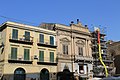

Photo: Antoine Pitrou, FAL · Wikimedia Commons
Historic villa / palace
Palazzo Alliata di Villafranca
Building in Palermo, Italy
At a glance
- Protection
- Italian national heritage
- Coordinates
- 38°06′53″ N, 13°21′36″ E
History and description
The Palazzo Alliata di Villafranca is former aristocratic palace, now converted into a museum, located just off Via Vittorio Emanuele (ancient Via Cassaro) facing the Piazza Bologni which opens two blocks west of the Quattro Canti intersection, in the ancient quarter of the Albergaria of the city of Palermo, region of Sicily, Italy.
History
By 1567, this area was part of a large garden or orchard, known as Piano d'Aragona with a large house owned by Aloisio da Bologna, baron of Montefranco. Vannino Beccadelli had arrived from in Palermo at the beginning of the XIV century. The family was later called "di Bologna", and gave the name to the piazza in front of the palace. One prominent member of this family was Il Panormita, a poet of the Aragonese court on the island. Another member was the archbishop Simone di Bologna, who is linked to the enlargement of the Cathedral of Palermo, and erection of the Archbishop's Palace. However, the son of Aloisi did not have male heirs, and by 1640, the palace was sold to the Alliata di Villafranca family, wealthy bankers from Pisa that had arrived to Palermo around the 14th century, and by 1609 had acquired the title of prince of Paruta.
The palace suffered damage during the 1751 earthquake, prompting a major reconstruction that joined the palace to adjacent houses. The work was commissioned from the architect Giovanni Battista Vaccarini, assisted by the Cascione and Ferrigno. The interior decoration included frescoes by Gaspare Serenario, Vaccarini's brother-in-law, who depicted large frescoes to the Glory of Prince Alliata and the Princess admires the Temple of Glory. The frescoes were lost after the bombardments of World War II. The fresco depicting San Dazio before the Virgin remains. During the revolution of 1820, the Palace was heavily damaged by the insurgents. The palace was owned and the main residence of the Alliata di Villafranca until the late 20th century. In the following century the palace was rebuilt to its current late 17th century appearance to designs by the architect Giovanni Battista Vaccarini. …
Interior
Kitchens
Scuderie.
Rooms of the royal postal service, the 'Corrieri maggiori ereditari del Regno di Sicilia'.
Scalone d'onore or main staircase.
Vestibolo or vestibule, with a 1929 mosaic window by Pietro Bevilacqua showing Saint Dacius Alliata and San Leo Alliata (respectively Archbishop of Milan from 530 and a martyr in 1274), both from the Alliata family.
Salotto Verde or Salottino Barocco, recorded as housing the Van Dyck in 1625 and thus probably the building's original private chapel, with the only surviving fresco by Gaspare Serenari, showing St Dacius Presented to the Virgin Mary, surrounded by Serpotti-style stuccowork.
Salottino Giallo or Sala del Té.
Salone Rosa or Sala del baccarà.
Salone del Principe Fabrizio Alliata Colonna., with a Serpotti-style stucco ceiling of allegorical subjects and previously housing Serenari's 1756 fresco Princess Admiring the Temple of Glory, the room now houses the two works by Stom, previously in the original Quadreria or Sala dei Musici.
Fumoir or Stanza di Cuoio.
Sala dello Stemma., previously housing Serenari's 1756 fresco Fame Showing the Princes' Glory, with the four seasons in stucco (workshop of Serpotta) at the corners of the room. The paintings were damaged by earthquakes and finally destroyed in bombing during the Second World War. It now houses two 1613-1618 works attributed to Pietro D'Asaro, Orpheus Singing to the Animals and Shipwreck or the Miraculous Haul of Fish
Text from Wikipedia, the free encyclopedia, under CC BY-SA 4.0. Full article: «Palazzo Alliata di Villafranca».
Photos
Getting there
Palazzo Reale-OrleansTrain, nearest
800 m as the crow flies
Palazzo Alliata di Villafranca
Palermo (Siremar)1.4 km
Aeroporto di Palermo Falcone e Borsellino23.7 km
Distances are as the crow flies, not walking or driving.
Loading map…
Nearby
See on the mapMore historic villas and palaces in Sicily


Frequently asked questions
Where is Palazzo Alliata di Villafranca?
Palazzo Alliata di Villafranca is in Palermo, in the province of Palermo (Sicily), Italy. GPS coordinates: 38.11482, 13.35997.
What else is there to see near Palazzo Alliata di Villafranca?
Nearby you’ll find: Palazzo Damiani (0 m away), Palazzo Drago Ajroldi (100 m away), Natoli Palace (100 m away).
Sources and licences
Text. Wikipedia, the free encyclopedia (CC BY-SA 4.0).
Data. Wikidata (CC0); opening hours and contacts OpenStreetMap (ODbL).
Photos. Wikimedia Commons, author and licence on every image.
Credits for the 4 photos
- Palermo-AP-p1070469 — Antoine Pitrou, FAL
- Palermo - Palazzo Alliata di Villafranca - 2026-09-03 09-57-45 001 — Effems, CC BY-SA 4.0
- Palermo - Palazzo Alliata di Villafranca - 2026-09-21 19-14-56 001 — Risa_G_WiCo18, CC BY-SA 4.0
- Palermo - Palazzo Alliata di Villafranca - 2026-09-21 19-17-00 001 — Risa_G_WiCo18, CC BY-SA 4.0
Updated 28 October 2026. All sources and licences