



- UNESCO
Photo: This illustration was made by ( User:Royonx ) and released under the license(s) stated above. You are free to use it for any purpose as long as you credit me and follow the terms of the license.…, CC BY-SA 3.0 · Wikimedia Commons
Archaeological site
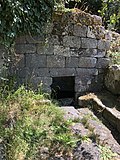
Nuraghe in Torralba, Sardinia, Italy
Santu Antine ("Saint Constantine"), also known as Sa domo de su re ("The house of the king" in the Sardinian language) is a nuraghe (ancient megalithic edifice built by the Nuragic Civilization) in Torralba, one of the largest in Sardinia. It is located in the centre of the Cabu Abbas plain.
Santu Antine is constructed of huge basalt blocks. The main tower originally reached a height of 23–24 metres (75–80 ft) and contains three tholoi chambers on top of each other. The central tower with diameter of 15 metres (50 ft) is 17 metres (55 ft) high. It has three floors. The top floor is now gone. Multiple 27 metres (90 ft) long corridors built with the corbel arch technique can be observed inside of the Nuraghe, superimposed on two floors. In addition to the towers, the nuraghe featured three wells.
The main structure was built around the 19-18th century BC, and the other parts of the nuraghe date back to the 17th–15th century BC. The remains of a Nuragic village lie nearby.
The nuraghe has been studied several times from an archaeoastronomic point of view, and these studies have shown how its structure is oriented following the solstices. These claims were supported, among others, by the archaeologist Ercole Contu and archaeostronomists Mauro Peppino Zedda, Juan Antonio Belmonte and Michael Hoskin. In particular, Hoskin, science historian and emeritus professor at Churchill College in Cambridge, called Santu Antine "the most sophisticated dry stone monument on earth's surface".
Text from Wikipedia, the free encyclopedia, under CC BY-SA 4.0. Full article: «Santu Antine».
Distances are as the crow flies, not walking or driving.


Santu Antine is in Torralba, in the province of Sassari (Sardinia), Italy. Address: Nuraghe Santu Antine, 07048 Torralba SS. GPS coordinates: 40.48654, 8.76987.
According to OpenStreetMap the opening hours are: April to September: 9:00–20:00; October to March: 9:00–17:00. Always check the official website before your visit.
Nearby you’ll find: Nuraghe Oes (800 m away), Dolmen of Prunaiola (1.5 km away), Necropolis of Moseddu (3.3 km away).
Text. Wikipedia, the free encyclopedia (CC BY-SA 4.0).
Data. Wikidata (CC0); opening hours and contacts OpenStreetMap (ODbL).
Photos. Wikimedia Commons, author and licence on every image.
Updated 28 October 2026. All sources and licences