

- UNESCO
Photo: Francesco Cubeddu, CC BY-SA 4.0 · Wikimedia Commons
Archaeological site
Nuraghe in Villanovaforru, Italy
Villanovaforru (VS), Sardinia
Nuraghe Genna Maria is a Nuragic complex located in Villanovaforru, South Sardinia, dating back to the Final Bronze Age. The Nuragic civilization, which lasted in Sardinia from approximately 1800 BCE to 238 BCE, is known for its stone towers called "nuraghi". These structures served various functions, including defensive, residential, and ritual purposes. Genna Maria, like many nuraghi, was strategically built on a hilltop, providing a vantage point over the surrounding landscape.
Nuragic settlement is roughly 5000 square metres in size. Built around a central tower (mastio) that dates to between 1700 and 1350 B.C., the Nuraghe is thought to be roughly 10 m high. It is surrounded by a three-lobed (originally four-lobed) bastion and preceded by a courtyard with a well or cistern. From the east tower to the north-west one, it has undergone partial renovation. A hexagonal ante-mural with towers at the apexes and a southern entrance encircles the Nuraghe.
The Nuragic societies are known for their megalithic architecture — the "nuraghi" (singular "nuraghe"). These stone tower structures represent the core characteristic of their shared material culture. Genna Maria serves as one of the better-preserved examples of the nuraghi.
Beyond their architectural uniformity, Nuragic societies also showed similarities in pottery styles, tomb structures, ritual sites, agricultural and food-processing tools, and domestic utensils. These commonalities indicate a high degree of interaction among the island's communities.
Nuraghe Genna Maria consists of a central tower and a trilobate bastion, with later additions including an outer defensive wall and towers, forming a hexagonal layout.
It is built using large, unworked basalt or limestone blocks without mortar, following the typical Nuragic dry-stone masonry technique.
The site evolved over time, showing the architectural development of the Nuragic civilization, particularly the transition from simple nuraghi (single towers) to complex nuraghi (multi-towered fortresses) during the Middle to Late Bronze Age. With over 7,000 nuraghi in Sardinia, Genna Maria is an example of Nuragic architectural and social evolution during the Bronze Age.
The surrounding village provides insights into Nuragic social structure. The settlement was organized around a central layout of the central nuraghe, suggesting a hierarchical society where the tower may have served as a political or military center. The presence of huts, storage pits, and workshops indicates a community structure including an agricultural and craft-based economy.
The site was abandoned after being destroyed by fire in the 8th century BCE but was later repurposed in the 5th–4th centuries BCE as a small religious sanctuary.
It resembles Su Nuraxi in Barumini, a UNESCO-listed complex nuraghe, similar in design but better preserved (Ialongo, 2017).
The Nuraghe Genna Maria is situated atop a cone-shaped hill near Villanovaforru, at an elevation of 409 meters above sea level. Its name derives from the Latin Janua Maris ("Door of the Sea"), as both the Gulf of Cagliari and the Bay of Oristano are visible from the summit on clear days.
There was an early settlement predating the nuraghe.
The construction of a three-towered nuraghe, later enclosed by an outer defensive wall with additional towers, took place.
A reinforcement with a support wall, similar to contemporary nuraghi like Su Nuraxi (Barumini), was added.
A partial collapse happened, of which the cause is unknown; complex multi-room houses were built over the ruins of the outer wall.
The surrounding village was a pastoral-agricultural community, which engaged in grain cultivation, viticulture and livestock farming.
The central tower and courtyard were repurposed for agrarian rituals dedicated to Demeter.
The cult transformed into worship of Sarda Ceres (Romanized Sardinian harvest goddess).
Pagan rituals persisted despite Christianization, prompting Pope Gregory the Great to urge local bishops to suppress them.
Text from Wikipedia, the free encyclopedia, under CC BY-SA 4.0. Full article: «Nuraghe Genna Maria».
Distances are as the crow flies, not walking or driving.
 Museo archeologico Genna Maria1.3 km
 Museo Naturalistico del Territorio “Giovanni Puscheddu”2.6 km
 Tomba dei giganti di Su cuaddu 'e Nixias2.8 km
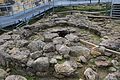 Area archeologica di Sant'Anastasia3.5 km
 Nuraghe Arrubiu4.7 km
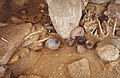 Tomb of Bingia 'e Monti5.1 km
 Tomba dei giganti di Sa Domu 'e S'Orcu5.8 km
 Castello di Monreale6.8 km


Nuraghe Genna Maria is in Villanovaforru, in the province of Medio Campidano (Sardinia), Italy. Address: piazza Costituzione, Villanovaforru (SU), Italia. GPS coordinates: 39.63544, 8.85326.
Nearby you’ll find: Museo archeologico Genna Maria (1.3 km away), Museo Naturalistico del Territorio “Giovanni Puscheddu” (2.6 km away), Tomba dei giganti di Su cuaddu 'e Nixias (2.8 km away).
Text. Wikipedia, the free encyclopedia (CC BY-SA 4.0).
Data. Wikidata (CC0); opening hours and contacts OpenStreetMap (ODbL).
Photos. Wikimedia Commons, author and licence on every image.
Updated 28 October 2026. All sources and licences