


- Free 1st Sunday
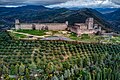
Photo: Eumolpa, Public domain · Wikimedia Commons
Museum, 1941
Diocesan museum, Archeology, Sacred art, Architecture in Palazzo dei Canonici - Piazza San Rufino, Assisi
The Assisi Diocesan Museum, in the city of Assisi, Italy, was founded in 1941 by bishop Giuseppe Placido Niccolini to preserve the most important works of art of the Assisi Cathedral and of several oratories of Assisi's confraternities. The museum is located underneath the piazza of the cathedral and has a collection consisting of about 300 works of which 100 are on display, exhibited in the museum's nine sections.
The museum was founded in 1941, by bishop Giuseppe Placido Nicolini. Its original location was on the ground floor of the parish office, and consisted of four rooms and an annex of historical archives. Entrance was through the cathedral itself and the museum could be visited only by appointment. In the 1990s bishop Sergio Goretti, in addition to encouraging the regular daily opening of the old exhibition spaces, began to consider a reorganization that would be more appropriate for the museum's objects. This gave rise to the project of expanding and refurbishing the museum's space to make it more suitable to the collection.
Following the reconstruction of the earthquake of 1997 and the Jubilee year the spaces underneath the palazzo dei canonici, the cloister, and the crypt were restored. The final exhibition space, now on two floors, was finished and opened to the public on 15 April 2006. The museum now has two entrances, one still found in the cathedral itself (near the chapel of the Holy Eucharist) and a second in the piazza (at the entrance of the palazzo of the canons).
In the corridor are archeological displays of items found in the immediate area, including capitals sculpted in limestone, rediscovered in the crypt but originally from the cathedral, and datable to between the 8th and the 12th centuries. Among the items from the Roman era is the front of the sarcophagus with Nikai Clipeofore and the libation rite dated to the 2nd century.
In the St. Clare room are detached frescoes attributed to the Master of Santa Chiara, an anonymous artist of the 13th century that takes his name from an icon found in the Basilica of St. Clare in Assisi. Originally these frescoes decorated an area above today's chapel of the Madonna del Pianto which corresponds to the old left apse of the cathedral that was separated from the rest of the church with the modifications of Galeazzo Alessi in the 16th century.
This room has the polyptych of San Rufino (1462) by Foligno artist Nicolò di Liberatore (also known as l'Alunno).
In the predella are scenes of the martyrdom of San Rufino, the patron of the city of Assisi, including the miraculous finding of his body and its transfer into the walls of the city. Also in this area are two predellas by Dono Doni (1563) as well as sacred vessels and liturgical vestments from the 17th through the 19th centuries.
The Romanesque crypt of San Rufino (11th century) is divided into three naves with an apse and has vaulted arches supported by columns resting on arches. The symbols of the four evangelists are carved into the vaults and are dated to the middle of the 11th century. Inside the crypt is a Roman sarcophagus from the beginning of the third century depicting the myth of Selene and Endimone in which the body of San Rufino was originally placed. Also visible in the crypt is part of a Roman wall in opus quadratum, that was rediscovered underneath the cathedral. The crypt is one of the places that Francis of Assisi went to pray when preaching in the cathedral.
The cloister (11th century) is surrounded by old portico with arches and capitals, and has at its center a well from the Roman era, known as the pozzo della Mensa.
This room houses objects from the churches and monuments of the diocesan territory. Of special interest is the work of Matteo da Gualdo. …
Text from Wikipedia, the free encyclopedia, under CC BY-SA 4.0. Full article: «Assisi Diocesan Museum».
Events and people from Wikidata (CC0).
Distances are as the crow flies, not walking or driving.


Assisi Diocesan Museum is in Assisi, in the province of Perugia (Umbria), Italy. Address: Piazza San Rufino, 3, 06081 Assisi (PG). GPS coordinates: 43.07060, 12.61720.
According to OpenStreetMap the opening hours are: Monday to Friday: 10:00–13:00, 15:00–18:00; Saturday: 10:00–18:00; Sunday: 11:00–18:00. Always check the official website before your visit.
There is an admission charge. Up-to-date prices are on the official website.
Wikidata dates it to 1941.
Nearby you’ll find: Rocca Maggiore (100 m away), Basilica di Santa Chiara (200 m away), Temple of Minerva (200 m away).
Text. Wikipedia, the free encyclopedia (CC BY-SA 4.0).
Data. Wikidata (CC0); opening hours and contacts OpenStreetMap (ODbL).
Photos. Wikimedia Commons, author and licence on every image.
Updated 28 October 2026. All sources and licences