



- Free 1st Sunday
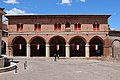
Photo: Alessandro Vecchi, CC BY-SA 3.0 · Wikimedia Commons
Museum
Museum of traditional paper production in Fabriano, Ancona
The Paper and Watermark Museum is a museum of Fabriano, Italy. Based on the paper-making tradition of Fabriano, which is documented since the 12th Century, the museum focuses on handmade paper and watermark techniques in Medieval Italy. The museum was opened in 1984. It is housed in a former Dominican convent.
The Fabrianese papermakers probably learned the techniques from the Arabs, and were able to sufficiently refine and perfect the process for their paper to successfully compete with parchment. The Fabrianese papermakers also developed different types of multiple hammer mills used to grind the rag cloth, and a method of sizing paper by means of animal glue.
Watermarks were a technique introduced by Fabriano in the 13th century. There are a number of methods for creating a watermark, however early watermarks involved laying wire into the paper mould. Later techniques became more sophisticated, using punches which had been carved out in wood, or cast in metal.
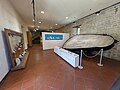
The museum collections document the history of papermaking in Fabriano over the last 800 years. They hold examples of paper and watermarks from across this period, as well as examples of tools used in the manufacturing of paper. They give a background into the significance of paper and watermarks, especially in the Renaissance period. In addition to this, the museum runs a medieval style Fulling mill, to show how this would have been used in paper production. Further to this, the museum touches on the invention of the printing press, and the significance this had in the development of the paper industry.
In addition to the permanent collections, the museum gives practical demonstrations, as well as educational courses and workshops.
Text from Wikipedia, the free encyclopedia, under CC BY-SA 4.0. Full article: «Paper and Watermark Museum Fabriano».
Distances are as the crow flies, not walking or driving.


Paper and Watermark Museum Fabriano is in Fabriano, in the province of Ancona (Marche), Italy. Address: largo Fratelli Spacca, 2 ‒ 60044 Fabriano (AN). GPS coordinates: 43.33330, 12.90268.
According to OpenStreetMap the opening hours are: Tuesday to Sunday, public holidays: 10:00–18:00. Always check the official website before your visit.
There is an admission charge. Up-to-date prices are on the official website.
Nearby you’ll find: Pinacoteca civica Bruno Molajoli (300 m away), Diocesan museum of Fabriano (300 m away), Palazzo del Podestà (300 m away).
Text. Wikipedia, the free encyclopedia (CC BY-SA 4.0).
Data. Wikidata (CC0); opening hours and contacts OpenStreetMap (ODbL).
Photos. Wikimedia Commons, author and licence on every image.
Updated 28 October 2026. All sources and licences