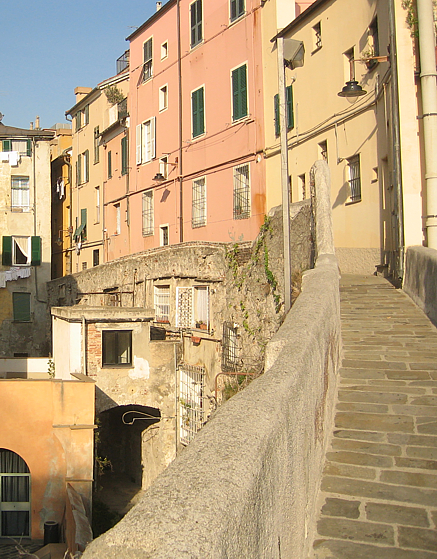


Photo: User:F.noceti, CC BY 2.5 · Wikimedia Commons
Fortress / Tower
Walls of Genoa
Series of walls surrounding the city of Genoa, Italy
At a glance
- Type
- Fortress / Tower
- Protection
- Italian national heritage
- Coordinates
- 44°24′47″ N, 8°55′38″ E
History and description
The walls of Genoa (mura di Genova in Italian, miage de Zena in Ligurian) constitute in their whole the several circles of walls that protected and defended the city of Genoa, former capital of the republic of the same name. To this day, large portions of these walls remain, and Genoa has more and longer walls than any other city in Italy.
Ancient walls
In Roman times the original centre of Genoa, on the Sarzano hill, may have been defended by a wall, but there is no archaeological or documentary evidence of its existence.
The first known city walls were built in the 9th century, when thanks to Berengar II of Italy, the city gained wide autonomy, with subsequent economic development and a population increase.
The first walls, which included Sarzano hill, had three gates: the Serravalle gate, at the north side of the church of San Lorenzo, another on the hill of Saint Andrew, near the site of the future Porta Soprana, and another one at the end of “Via Canneto il curto”, near the church of San Peter.
The settlement enclosed by the walls and the coastline occupied about twenty-two hectares.
Some small settlements (housing mainly workmen and artisans), which had grown around churches, monasteries, and feudal palaces, remained outside the walls.
In 1155, this defensive wall was extended to the northwest to include the new settlements outside the walls. The walls culminated on the top of St. Andrew hill, with Porta Soprana.
The new walls greatly expanded the area contained within, compared to the previous one, including an area of 55 hectares.
The construction of the walls dragged until 1163; in that year, the international political situation and particularly relations with emperor Frederick Barbarossa led to an acceleration of work, as attested to by Caffaro, and the work was completed in 53 days thanks to the effort of the entire population.
The three main gates had a monumental look, with high semicircular towers. Two of them survive to this day: “Porta Soprana” and “Porta dei Vacca”; the third one, Porta Aurea ("Golden Gate"), already partially demolished in the 18th century, was completely demolished in the second half of the 20th century. In the 13th century, the Old Pier peninsula, at the southern limit of the port, was also included inside the walls, thus completing the fortifications on the sea side of the city.
In the 14th century, urban expansion of the city, caused by the increase in commercial activity, led to a new extension of walls to encompass the new quarters which stood to the west and east of the original city centre. …
The Mura Nuove (New Walls)
The “Mura Nuove” (New Walls) are the last and most imposing walls built along the ridge of the hills encircling downtown Genoa, and were built in the first half of the 17th century.
The view of Genoa from the sea is characterized by the line of New Walls with their fortifications, on the ridge of the hills, above the hilly quarters which grew after World War II; coming from the north, by train or car, the first visible structure is the mass of Fort Diamante, high on the mount on the left bank of the Val Polcevera, and the Fort Fratello Minore. Shortly after, on the ridge in the distance is Fort Begato, included in the line of bastions that rise up to the top of Mount Peralto, where sits Fort Sperone with its high walls.
The “New Walls”, the last and largest city walls, were built starting in 1626, after the repeated attempts of Charles Emmanuel I of Savoy to invade Genoa had convinced the government of the need for new and more powerful defensive walls.
Although this defensive wall had already been suggested in 1568, the government of Genoa began the work in 1626, following the failed attack on 10 May 1625 of a French-Piedmontese army at the Pertuso Pass (where, in memory of the event, was later built the Shrine of Nostra Signora della Vittoria, meaning "Our Lady of Victory").
In less than four years, between 1629 and 1633, an army of diggers, bricklayers, and stonemasons (eight hundred, according to some sources, even three thousand according to others), divided into twenty-eight teams, raised curtains and bastions along the two ridges overlooking the valleys of Polcevera and Bisagno.
The project was carried out by mathematicians Vincenzo Maculano and Giovanni Battista Baliani, a friend of Galileo Galilei.
Supervision of the work was entrusted to Ansaldo De Mari with the cooperation of the Lombard architect Bartolomeo Bianco …
Text from Wikipedia, the free encyclopedia, under CC BY-SA 4.0. Full article: «Walls of Genoa».
Photos
Getting there
CarbonaraTrain, nearest
600 m as the crow flies
Walls of Genoa
Porto Antico400 m
Aeroporto Internazionale di Genova - Cristoforo Colombo6.7 km
Distances are as the crow flies, not walking or driving.
Loading map…
Nearby
See on the mapMore fortresses and towers in Liguria


Frequently asked questions
Where is Walls of Genoa?
Walls of Genoa is in Genoa, in the province of Genova (Liguria), Italy. GPS coordinates: 44.41293, 8.92721.
What else is there to see near Walls of Genoa?
Nearby you’ll find: Porta dei Vacca (0 m away), Palazzo Lomellini-Serra (0 m away), Palazzo Durazzo-Cattaneo Adorno (0 m away).
Sources and licences
Text. Wikipedia, the free encyclopedia (CC BY-SA 4.0).
Data. Wikidata (CC0); opening hours and contacts OpenStreetMap (ODbL).
Photos. Wikimedia Commons, author and licence on every image.
Credits for the 9 photos
- Camminamentobarbarossa — User:F.noceti, CC BY 2.5
- Genova - mura di Genova - 2026-09-22 15-26-46 001 — Jeanblot73, CC BY-SA 4.0
- Genova Bastione Mura Begato — Bbruno, CC BY-SA 3.0
- Genova Mura Castellaccio — Bbruno, CC BY-SA 3.0
- Genova Mura di Porta Murata — Bbruno, CC BY-SA 4.0
- Mura degli antichi moli di piazza Caricamento, Genova 01 — Superchilum, CC BY-SA 4.0
- Mura delle Capuccine Genova 01 — Yoggysot, CC BY 3.0
- Mura di Genova - 12 — Jakala86, CC BY-SA 4.0
- Genova - panoramio (14) — Andrea Albini, CC BY-SA 3.0
Updated 28 October 2026. All sources and licences