

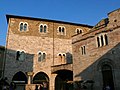


Archaeological site, Bevagna (PG)
42°56′25″ N, 12°36′34″ E
No photo on Wikimedia Commons yet
At a glance
- Type
- Archaeological site
- Coordinates
- 42°56′25″ N, 12°36′34″ E
History and description
Bevagna is a town and comune in the central part of the Italian province of Perugia (Umbria), in the flood plain of the Topino river.
Bevagna is 25 km (16 mi) south-east of Perugia, 8 km (5.0 mi) west of Foligno, 7 km (4.3 mi) north-north-west of Montefalco, 16 km (9.9 mi) south of Assisi and 15 km (9.3 mi) north-west of Trevi.
Bevagna is one of I Borghi più belli d'Italia ("The most beautiful villages of Italy").
History
Bevagna, known in antiquity as Mevania, was an important Umbrian city on the Via Flaminia, between Carsulae and Fulginium. The ancient settlement lay on the bank of the river Timia in an open and fertile valley stretching from the vicinity of Spoleto to the Tiber, separating the main Apennine chain from the ranges that extend toward Todi and Amelia. Classical authors including Columella, Silius Italicus and Lucan refer to the fertility of this region.
Before the Roman conquest, Mevania was a significant centre; in 308 BC Umbrian forces were stationed here when the consul Fabius advanced against them. In the Roman imperial period the city continued to flourish: Strabo mentions it among the strongest Umbrian cities, and Pliny records that it was enclosed by brick walls. The Antonine Itinerary and the Itinerary of Vicarello list Mevania as a mansio (station) on the Via Flaminia. Pliny also notes that the territory, the Mevanias ager, produced a particular prized wine called Irtia. Inscriptions indicate that the city belonged to the tribus Aemilia and that its municipal magistracies included quattuorviri.
The Clitunno was regarded as a major feature of the ancient city: it is described as extremely abundant in water and navigable with boats in two tiers. Near the confluence of the Topino with the Clitunno there was a kind of harbor, also mentioned in the Acts of Saint Vincent the Martyr, the patron of Bevagna, in connection with his attempted drowning at the harbour of Mevania.
In the 6th century the city suffered serious damage during barbarian incursions.
After the 11th century Bevagna became a free municipality with a self-governing system headed by consuls. In 1249 Pope Innocent IV granted the community the right to choose its chief magistrate. In November of the same year, in the context of Frederick II's claim to the Duchy of Spoleto, Bevagna was besieged by the imperial vicar Thomas I of Aquino, Count of Acerra, and the city was badly damaged.
The city later rose again through the efforts attributed to the Blessed Giacomo of Bevagna, who rallied the dispersed inhabitants and encouraged the rebuilding of the walls on a more modest scale, sufficient to protect the families who had returned. …
Religion
The church of San Michele Arcangelo was the city's first cathedral and later became a collegiate church, which was abolished by Frederick II in 1248 and restored only in 1620 at the will of Pope Paul V.
Over the centuries the building underwent numerous alterations. In the 15th century its roof was restored, and in the 17th century both the interior and the façade were adapted to Baroque taste. During that phase a new rose window was opened by demolishing the original and part of the corbel table with its small arches; the interiors of both the church and the crypt were entirely covered with stuccoes and with vaulting in camorcanna. The bell tower, built at the end of the 12th century, was modified in its upper part using reused elements from the preceding bell tower. Between 1951 and 1957 the church was returned to its earlier forms through the removal of Baroque interventions and the reconstruction of missing parts.
Its current layout is basilican, with a raised presbytery and aisles separated by columns carrying transverse arches with recessed archivolts, resting on capitals that were abraded during the Baroque works. The façade, dated to the first years of the 13th century, is built of small travertine blocks. Three portals open at ground level, with the central portal richly decorated; above, the façade is divided into five parts by four shaped lesenes, the two on the right continuing into the bell tower. Between the lesenes are three triple-light windows, and above them runs a band of blind arches resting on corbels carved as human and animal heads. Four projecting protomes emerge from the lesenes, two animal and one in the form of a crowned male head.
The central portal reuses Roman moldings, partly reworked, as jambs. At the springing of the arch are sculpted figures including, on the left, the winged bust of Saint Michael with a spear in one hand and an open book in the other, with a dragon attempting to bite the spear; beneath is an inscription stating that Rodulfus and Binellus made these works. On the other side is an angel holding a processional cross and a scroll. The crypt is composed of twelve bays defined by six slender columns. …
Text from Wikipedia, the free encyclopedia, under CC BY-SA 4.0. Full article: «Mevania».
Getting there
SpelloTrain, nearest
6.9 km as the crow flies
Mevania
Aeroporto Internazionale dell'Umbria - Perugia "San Francesco d'Assisi"19.4 km
Distances are as the crow flies, not walking or driving.
Loading map…
The town
 Things to see in Bevagna4,797 inhabitants, 210 m above sea level. 12 historic places in the town.PhotoHagai Agmon-Snir حچاي اچمون-سنير חגי אגמון-שניר, CC BY-SA 4.012 places
Nearby
See on the mapDo you know this place?
We are missing the opening hours and photos. The data comes from open projects: if you add it there, it appears here at the next update.
More archaeological sites in Umbria


Frequently asked questions
Where is Mevania?
Mevania is in Bevagna, in the province of Perugia (Umbria), Italy. GPS coordinates: 42.94028, 12.60944.
What else is there to see near Mevania?
Nearby you’ll find: Bevagna (700 m away), Museo Civico, Bevagna (800 m away), Palazzo dei Consoli (900 m away).
Sources and licences
Text. Wikipedia, the free encyclopedia (CC BY-SA 4.0).
Data. Wikidata (CC0); opening hours and contacts OpenStreetMap (ODbL).
Updated 28 October 2026. All sources and licences