


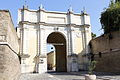


Photo: Petar Milošević, CC BY-SA 4.0 · Wikimedia Commons
Archaeological site
Mausoleum of Galla Placidia
Mausoleum in Ravenna, Italy
Ravenna (RA), Emilia-Romagna
At a glance
- Type
- Archaeological site
- Styles
- Byzantine architecture, Early Christian architecture
- Protection
- Part of UNESCO World Heritage Site
- UNESCO World Heritage
- Early Christian Monuments of Ravenna
- Coordinates
- 44°25′16″ N, 12°11′49″ E
- Address
- via G. Argentario 22 ‒ Ravenna (RA)
History and description
The Mausoleum of Galla Placidia is a Late Antique Roman building in Ravenna, Italy, built between 425 and 450. It was added to the World Heritage List together with seven other structures in Ravenna in 1996. Despite its common name, the empress Galla Placidia (d. 450) was not buried in the building, a misconception dating from the thirteenth century; she died in Rome and was buried there, probably alongside Honorius in the Mausoleum of Honorius at Old Saint Peter's Basilica.
History
The "mausoleum" of Galla Placidia, built 425–450, is a cruciform chapel or oratory that originally adjoined the narthex of the Church of the Holy Cross (Santa Croce) in Ravenna, which was built in 417 as the church for the imperial palace. It was probably dedicated to Saint Lawrence.
Aelia Galla Placidia, the likely patron of the building's construction, was the daughter of Theodosius I and Galla, the daughter of Valentinian I. Raised by Serena, wife of Stilicho, she was made nobilissima in her youth and granted a palace by her father in Constantinople. She received an advanced education both secular and religious, as is evident from her letters. She married Athaulf, King of the Visigoths in 414 in Spain after moving to the West, though he soon died and she married the patricius Constantius (later Constantius III) in 417. Their children were Justa Grata Honoria and Valentinian III. Constantius III was elevated as co-emperor of the West in 421 by Honorius, who lacked an heir, and Galla Placidia was made augusta; Constantius died the same year and Galla Placidia fled to Constantinople. When Honorius died in 423, the primicerius notariorum Joannes succeeded as augustus in the West; thereafter Theodosius II, augustus in the East, moved to install Galla Placidia's son Valentinian as emperor in the West instead, appointing him caesar.
The building dates from after 425; in that year the six-year old Valentinian III took office as augustus in 425 and Galla Placidia's title as augusta was again secured – she ruled as regent for her son for twelve years. Her political influence waned with the growing maturity of her son and the rise to prominence of the patricius Flavius Aëtius in the 430s, but she remained powerful until she died in 450. She was an active patron of religious institutions, building churches at Ravenna, Rome, and Jerusalem. She contributed to the refurbishment of Saint Paul's outside-the-walls (San Paolo fuori le Mura), as recorded in an inscription there. …
Architecture and decoration
The mausoleum is laid out in a cruciform floor plan, with a central dome on pendentives and barrel vaults over the four transepts. The exterior of the dome is enclosed in a square tower that rises above the gabled lateral wings. The brick surface is set with narrow mortar joints and decorated with blind arcades. Light enters through modern alabaster window panels.
The iconographic themes developed in the decorations represent the victory of eternal life over death.
The interior of the mausoleum is covered with rich mosaics. The inside contains two famous mosaic lunettes, and the rest of the interior is filled with mosaics of Christian and Apocalyptic symbols.
Mosaics composed of glass tesserae cover the interior walls of the vault, the lunettes and the cupola; the adornments are of high quality. Above the entrance portal is a mosaic depicting Christ as the Good Shepherd among his flock. The barrel-vaults of the four arms of the cruciform chapel bear vegetal mosaics consisting of acanthus and vine scrolls. In the western arm's lunette a mosaic represents deer approaching a spring, perhaps a reference to Psalm 42, whose incipit is "As the hart panteth after the water brooks, so panteth my soul after thee, O God." In the southern transept's lunette is a mosaic depicting a male saint carrying a cross accompanied by a burning gridiron and an opened cabinet containing the four canonical Gospels, identified by the names of the Four Evangelists in Latin. Unidentified figures of white-robed martyrs decorate the lunettes of the east and west transepts. The interior of the dome at the centre is decorated as a starry sky, with a regular mosaic of golden stars on a dark blue background, with a gold cross represented at the apex of the dome and the four symbols of the Evangelists (or the "living creatures" of Revelation 4:7) at the corner pendentives. The four lunettes below the dome, between the arches springing from the four central piers and the arches of the pendentives above them, have mosaics each depicting two Apostles with their right arms raised in acclamation likely directed at the male saint in the southern transept's mosaic. …
Text from Wikipedia, the free encyclopedia, under CC BY-SA 4.0. Full article: «Mausoleum of Galla Placidia».
Photos
Getting there
RavennaTrain, nearest
900 m as the crow flies
Mausoleum of Galla Placidiavia G. Argentario 22 ‒ Ravenna (RA)
Aeroporto Gastone Novelli6.8 km
Distances are as the crow flies, not walking or driving.
Loading map…
Nearby
See on the mapMore archaeological sites in Emilia-Romagna

- Free 1st Sunday


- Free 1st Sunday


Frequently asked questions
Where is Mausoleum of Galla Placidia?
Mausoleum of Galla Placidia is in Ravenna, in the province of Ravenna (Emilia-Romagna), Italy. Address: via G. Argentario 22 ‒ Ravenna (RA). GPS coordinates: 44.42102, 12.19708.
What else is there to see near Mausoleum of Galla Placidia?
Nearby you’ll find: National Museum of Ravenna (100 m away), Walls of Ravenna (200 m away), Museo Byron (200 m away).
Sources and licences
Text. Wikipedia, the free encyclopedia (CC BY-SA 4.0).
Data. Wikidata (CC0); opening hours and contacts OpenStreetMap (ODbL).
Photos. Wikimedia Commons, author and licence on every image.
Credits for the 2 photos
- Mausoleum of Galla Placidia in Ravenna — Petar Milošević, CC BY-SA 4.0
- Ravenna - Mausoleo di Galla Placidia - 2026-09-25 11-59-47 001 — Barbara_Bertini, CC BY-SA 4.0
Updated 28 October 2026. All sources and licences