


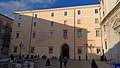


Photo: Francorov, CC BY-SA 3.0 · Wikimedia Commons
Abbey / Monastery, 13th century
Certosa di Trisulti
Monastery in Collepardo, Italy
Collepardo (FR), Lazio
At a glance
- Type
- Abbey / Monastery
- Period
- Middle Ages, 13th century
- Style
- Gothic architecture
- Dedicated to
- Bartholomew the Apostle
- Area
- 1,500 m²
- Protection
- Italian national heritage
- Coordinates
- 41°46′47″ N, 13°23′49″ E
- Address
- via Trisulti, 8 - Collepardo
History and description
Trisulti Charterhouse (Italian: Certosa di Trisulti) is a former Carthusian monastery or charterhouse, now owned by the Cistercians, in Collepardo, province of Frosinone, central Italy. It is located on the slopes of Monte Rotonaria, a peak of the Monti Ernici, at 825 meters above sea level. It was consecrated in 1211, becoming a national monument in 1873.
History
A first Benedictine abbey was founded in the site in 996 by Saint Dominic Abbot; some remains can be seen today not far from the current building. The latter was erected starting from 1204, on a more accessible location, by order of Pope Innocent III, who assigned it to the Carthusians. The abbey church, dedicated to Saint Bartholomew, was consecrated in 1211.
The name Trisulti could derive from Latin tres saltibus, meaning "at the three jumps": this was the name of a castle of the baronial Colonna family which commanded the three passes ("jumps") leading to Abruzzo, Rome and Latium.
The complex was enlarged and modified several times in the following centuries. The current appearance dates from an essentially Baroque restoration.
In 1947 the monastery was taken over by the Cistercian Congregation of Casamari Abbey and continues as a Cistercian monastery.
In 2018 the former White House Chief Strategist, Steve Bannon, announced plans to establish a "gladiator school" for aspiring right-wing politicians in the charterhouse. The Dignitatis Humanae Institute, founded by a European associate of Bannon's named Benjamin Harnwell, was evicted from the charterhouse by the Italian government after it was alleged that rent was not paid and Harnwell had obtained the lease fraudulently. In 2024, an Italian court ruled that the lease had been obtained correctly and all funds had been paid.
Description
The abbey is surrounded by a massive line of walls. The entrance has a bust of Saint Bartholomew by Jacopo Lo Duca, a pupil of Michelangelo Buonarroti; this leads to a central square where there is a Romanesque-Gothic guesthouse, commonly known as the "Palace of Innocent III" (including a portico, a terrace and a library of 36,000 volumes), and the church of San Bartolomeo (St. Bartholomew).
Church of San Bartolomeo
The church had originally been a tall narrow Gothic-style building, but was largely rebuilt as a Baroque one. The façade (1798) was designed by Paolo Posi. The interior, like other Carthusian churches, is divided by an iconostasis which sheltered the cloistered monks. The canvases depicting St John the Baptist and St Michael Archangel are copies replacing stolen originals. The finely carved door by Giuseppe Kofler is flanked by glass coffins of two martyrs.
There are two wooden choirs; dating from 1564 and 1688, they were both created by Carthusian masters.
The concave ceiling was frescoed with the Glory of Paradise (1683) by Giuseppe Caci. The main altarpiece depicts an Enthroned Madonna and Child with St Bartholomew and St Bruno by Vincenzo Manenti. On the walls are 19th century canvases depicting scenes from the bible with ovals depicting blessed and holy Carthusian monks by Filippo Balbi. There are also altarpieces by Giacomo Manco.
The complex also includes an 18th-century pharmacy, on two levels; it is decorated by trompe-l'œil frescoes and Grotteschi and contemporary furniture. The garden facing the pharmacy was once a botanic garden. The rooms have genre-themed frescoes by Filippo Balbi.
Text from Wikipedia, the free encyclopedia, under CC BY-SA 4.0. Full article: «Certosa di Trisulti».
Timeline
- 13th centuryBuilt
Events and people from Wikidata (CC0).
Photos
Getting there
Morrea-Castronovo-RendinaraTrain, nearest
11.0 km as the crow flies
Certosa di Trisultivia Trisulti, 8 - Collepardo
Distances are as the crow flies, not walking or driving.
Loading map…
Nearby
See on the mapMore abbeys and monasteries in Lazio


- Free 1st Sunday


Frequently asked questions
Where is Certosa di Trisulti?
Certosa di Trisulti is in Collepardo, in the province of Frosinone (Lazio), Italy. Address: via Trisulti, 8 - Collepardo. GPS coordinates: 41.77974, 13.39688.
Can I visit Certosa di Trisulti for free?
Yes: entry is free on the first Sunday of every month, under the Italian “Domenica al museo” scheme.
How old is Certosa di Trisulti?
Wikidata dates it to the 13th century.
What else is there to see near Certosa di Trisulti?
Nearby you’ll find: Grotte di Collepardo (3.5 km away), Convento dei Cappuccini (6.8 km away), Badia di S. Sebastiano (7.3 km away).
Sources and licences
Text. Wikipedia, the free encyclopedia (CC BY-SA 4.0).
Data. Wikidata (CC0); opening hours and contacts OpenStreetMap (ODbL).
Photos. Wikimedia Commons, author and licence on every image.
Credits for the 9 photos
- Certosa di Trisulti — Francorov, CC BY-SA 3.0
- Certosa di Trisulti - panoramio — pietro scerrato, CC BY 3.0
- Certosa di Trisulti 2017 — Marica Massaro, CC BY-SA 4.0
- Collepardo - Certosa di Trisulti - 2025-09-19 20-52-34 001 — Serdiego, CC BY-SA 4.0
- Collepardo, Certosa di Trisulti 001 — Mattis, CC BY-SA 4.0
- La Certosa di Trisulti - panoramio — pietro scerrato, CC BY 3.0
- La certosa di Trisulti 2017 — Marica Massaro, CC BY-SA 4.0
- Piazzetta Certosa Trisulti — Simoni Valerio, Public domain
- L'Abbazia di Trisulti vista dal retro - panoramio — pietro scerrato, CC BY 3.0
Updated 28 October 2026. All sources and licences