


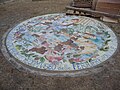

Archaeological site, Monasterace (RC)
38°26′42″ N, 16°34′41″ E
No photo on Wikimedia Commons yet
At a glance
- Type
- Archaeological site
- Coordinates
- 38°26′42″ N, 16°34′41″ E
History and description
Caulonia or Caulon (Ancient Greek: Καυλωνία, romanized: Kaulōnía; also spelled Kaulonia or Kaulon) was an ancient city on the shore of the Ionian Sea near Monasterace, Italy.
At some point after the destruction of the city by Rome in 200 BC, the inhabitants moved to a location further inland where they founded Stilida which developed into the modern town Stilo.
Since 1863 AD the name Caulonia has also been used by the town 15km away formerly known as Castelvetere. The city changed its name to Caulonia in honour of the ancient city, which was mistakenly believed to have been located in its territory.
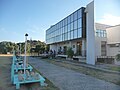
Some of the artefacts which have been excavated at the site can now be seen in the Monasterace Archaeological Museum.
History
Archeological evidence shows that it was founded early in the second half of the seventh century BC. Both Strabo and Pausanias mention that the city was founded by Achaean Greek colonists. Pausanias also gives the name of the oecist, or founder, as Typhon of Aegium. Others sources such as Pseudo-Scymnus claim that it was founded by Croton. A. J. Graham does not consider these two options to be mutually exclusive because the oecist and settlers could have been invited by Croton.
It had been thought that Caulonia was ruled by Kroton for some time but the fact that Caulonia minted its own coins in the 6th century BC suggests that it was independent. Also, the claim of Kroton over such a long stretch of coast close to its rival Locri would have been risky. According to Thucydides Caulonia supplied Athens with timber for ships during the Peloponnesian War (431–404 BC). The store of timber at Caulonia was attacked and burned by forces from Syracuse.
In 389 BC the city was conquered by Dionysius I of Syracuse at the Battle of the Elleporus, who transplanted its citizens to Syracuse and gave them citizenship and an exemption from taxes for five years. He then levelled the city to the ground and gave its territory to his ally Locri.
It was refounded by Dionysius II of Syracuse several decades later and he probably gave control over the city to Locri.
The city was razed two more times: it was destroyed during the Pyrrhic War (280–275 BC) and taken by the Campanians, who formed the largest contingent of allies in the army of Rome. In 200 BC the town was completely destroyed by the Romans, when it sided with Hannibal during the Punic Wars. It was probably around this time that the ancient site of Caulonia, directly on the Ionian coast, was abandoned in favour of a more protected site inland. About 200 years later when the city is mentioned by Strabo, it is described by him as "situated before a valley" and deserted.
Archaeology
The first archaeological excavations were conducted between 1911 and 1913 by Paolo Orsi.
In 1969 a mosaic depicting a dragon was discovered in what is now called the "House of the Dragon". It was first exhibited in the Museo Nazionale della Magna Grecia, but was restored and transferred to the Monasterace Archeological Museum in 2012.
In 2012 a mosaic floor of 25 m2 dating to late 4th century BC was discovered in what is thought to have been a thermal bathhouse. It is one of the largest mosaics from the Hellenistic period found in Southern Italy. The mosaic is divided into nine polychrome squares and another space with a polychrome rosette at the entrance of the room. It depicts a dragon in its centre, comparable to the mosaic discovered in 1969.
In 2013 a bronze tablet from the 5th century BC was discovered. The tablet has a dedication of eighteen lines written in the Achaean alphabet, the longest Achaean inscription ever discovered in Magna Graecia.
Text from Wikipedia, the free encyclopedia, under CC BY-SA 4.0. Full article: «Caulon».
Getting there
Monasterace-StiloTrain, nearest
900 m as the crow flies
Caulon
Distances are as the crow flies, not walking or driving.
Loading map…
The town
 Things to see in Monasterace3,303 inhabitants, 138 m above sea level. 11 historic places in the town.PhotoMarcuscalabresus, CC BY-SA 3.011 places
Nearby
See on the mapDo you know this place?
We are missing the opening hours and photos. The data comes from open projects: if you add it there, it appears here at the next update.
More archaeological sites in Calabria


Frequently asked questions
Where is Caulon?
Caulon is in Monasterace, in the province of Reggio Calabria (Calabria), Italy. GPS coordinates: 38.44500, 16.57800.
What else is there to see near Caulon?
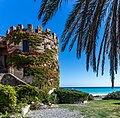
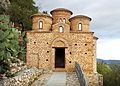
Nearby you’ll find: Museo archeologico di Monasterace (600 m away), Torre Sant'Antonio (8.8 km away), Cattolica di Stilo (10.3 km away).
Sources and licences
Text. Wikipedia, the free encyclopedia (CC BY-SA 4.0).
Data. Wikidata (CC0); opening hours and contacts OpenStreetMap (ODbL).
Updated 28 October 2026. All sources and licences