


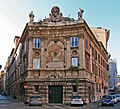

Photo: Livioandronico2013, CC BY-SA 4.0 · Wikimedia Commons
Castle, 139
Castle of the Holy Angel
Castle and museum in Rome, formerly the imperial mausoleum of the emperor Hadrian and subsequent Roman emperors
- Within the UNESCO World Heritage Site “Historic Centre of Rome, the Properties of the Holy See in that City Enjoying Extraterritorial Rights and San Paolo Fuori le Mura”
- Free on the first Sunday
At a glance
History and description
Castel Sant'Angelo, also known as Mausoleum of Hadrian (Italian: Mausoleo di Adriano), is a towering rotunda (cylindrical building) in Parco Adriano, Rome, Italy. It was initially commissioned by the Roman Emperor Hadrian as a mausoleum for himself and his family. The popes later used the building as a fortress and castle dedicated to Saint Michael the Archangel, and it is now a museum. The structure was once the tallest building in Rome.
Hadrian's tomb
The tomb of the Roman emperor Hadrian, also called Hadrian's mole, was erected on the right bank (or northern edge) of the Tiber, between 134 and 139 AD. Originally the mausoleum was a decorated cylinder, with a garden top and golden quadriga. Hadrian's ashes were placed here a year after his death in Baiae in 138, together with those of his wife Sabina, and his first adopted son, Lucius Aelius, who died in 138. Following this, the remains of succeeding emperors were also put here, the last recorded deposition being Caracalla in 217. The urns containing these ashes were probably placed in what is now known as the Treasury Room, deep within the building. Hadrian also built the Pons Aelius facing straight onto the mausoleum – it still provides a scenic approach from the center of Rome and the left bank of the Tiber, and is renowned for the Baroque additions of statues of angels holding aloft instruments of the Passion of Christ.
Decline
Much of the tomb contents and decorations have been lost since the building's conversion to a military fortress in 401 and its subsequent inclusion in the Aurelian Walls by Flavius Honorius Augustus. The urns and ashes were scattered by Visigoth looters during Alaric's sacking of Rome in 410, and the original decorative bronze and stone statuary were thrown down upon the attacking Goths when they besieged Rome in 537, as recounted by Procopius. An unusual survivor, however, is the capstone of a funerary urn (probably that of Hadrian), which made its way to Saint Peter's Basilica, covered the tomb of Otto II and later was incorporated into a massive Renaissance baptistery. The use of spolia from the tomb in the post-Roman period was noted in the 16th century – Giorgio Vasari writes:
...in order to build churches for the use of the Christians, not only were the most honoured temples of the idols [pagan Roman gods] destroyed, but in order to ennoble and decorate Saint Peter's with more ornaments than it then possessed, they took away the stone columns from the tomb of Hadrian, now the castle of Sant'Angelo, as well as many other things which we now see in ruins.
Legend holds that the Archangel Michael appeared atop the mausoleum, sheathing his sword as a sign of the end of the plague of 590, thus lending the castle its present name. A less charitable yet more apt elaboration of the legend, given the militant disposition of this archangel, was heard by the 15th-century traveler who saw an angel statue on the castle roof. He recounts that during a prolonged season of the plague, Pope Gregory I heard that the populace, even Christians, had begun revering a pagan idol at the church of Santa Agata in Suburra. A vision urged the pope to lead a procession to the church. Upon arriving, the idol miraculously fell apart with a clap of thunder. Returning to St Peter's by the Aelian Bridge, the pope had another vision of an angel atop the castle, wiping the blood from his sword on his mantle, and then sheathing it. While the pope interpreted this as a sign that God was appeased, this did not prevent Gregory from destroying more sites of pagan worship in Rome.
Papal fortress, residence and prison
The popes converted the structure into a castle, beginning in the 14th century; Pope Nicholas III connected the castle to St Peter's Basilica by a covered fortified corridor called the Passetto di Borgo. The fortress was the refuge of Pope Clement VII from the siege of Charles V's Landsknechte during the Sack of Rome (1527); the fortress was also the place in which Benvenuto Cellini, while incarcerated due to charges of embezzlement, murder and sodomy, describes strolling the ramparts and shooting enemy soldiers.
Leo X built a chapel with a Madonna by Raffaello da Montelupo. In 1536, Montelupo also created a marble statue of Saint Michael holding his sword after the 590 plague (as described above) to surmount the Castel. Later Paul III built a rich apartment, to ensure that in any future siege the pope had an appropriate place to stay.
Montelupo's statue was replaced by a bronze statue of the same subject, executed by the Flemish sculptor Peter Anton von Verschaffelt, in 1753. Verschaffelt's is still in place and Montelupo's can be seen in an open court in the interior of the Castle.
The Papal State also used Sant'Angelo as a prison; Giordano Bruno, for example, was imprisoned there for six years. Other prisoners were the sculptor and goldsmith Benvenuto Cellini and the magician and charlatan Cagliostro. Executions were performed in the small inner courtyard. As a prison, it was also the setting for the third act of Giacomo Puccini's 1900 opera Tosca; the eponymous heroine leaps to her death from the Castel's ramparts.
During earlier times, the prison had another remarkable function. Cornelis de Bruijn mentioned that when Pope Clement X died in 1676, all prisoners with heavy sentences were transported to St. Angelo. Then, as soon as the papal seat became vacant, the local city council would release all prisoners from Rome's prisons except those that were locked in St. Angelo. This chain of events was, according to Cornelis, a custom every time the pope died.
Museum
Decommissioned in 1901, the castle is now a museum: the Museo Nazionale di Castel Sant'Angelo. It received 1,234,443 visitors in 2016.
There is an ongoing project to connect Castel sant'Angelo to the St. Peter's Basilica via a fully pedestrian path, by creating an underground tunnel under the Piazza Pia Place.
Text from Wikipedia, the free encyclopedia, under CC BY-SA 4.0. Full article: «Castle of the Holy Angel».
Timeline
- 123 ADStart of construction
- 139 ADBuilt
- 1906Opened
Events and people from Wikidata (CC0).
Photos
Getting there
Roma San PietroTrain, nearest
1.3 km as the crow flies
Castle of the Holy AngelLungotevere Castello, 50
Aeroporto di Roma-Ciampino15.6 km
Distances are as the crow flies, not walking or driving.
Loading map…
Nearby
See on the mapMore castles in Lazio


Frequently asked questions
Where is Castle of the Holy Angel?
Castle of the Holy Angel is in Rome, in the province of Roma (Lazio), Italy. Address: Lungotevere Castello, 50. GPS coordinates: 41.90304, 12.46631.
What are the opening hours of Castle of the Holy Angel?
According to OpenStreetMap the opening hours are: Every day: 9:00–19:30. Always check the official website before your visit.
How much does it cost to visit Castle of the Holy Angel?
There is an admission charge, but entry is free on the first Sunday of the month (Domenica al museo). Up-to-date prices are on the official website.
Is Castle of the Holy Angel wheelchair accessible?
According to OpenStreetMap data, the site is wheelchair accessible.
How old is Castle of the Holy Angel?
Wikidata dates it to 139.
What else is there to see near Castle of the Holy Angel?
Nearby you’ll find: Museo nazionale di Castel Sant'Angelo (0 m away), Ponte Sant'Angelo (100 m away), Porta Aurelia-Sancti Petri (200 m away).
Sources and licences
Text. Wikipedia, the free encyclopedia (CC BY-SA 4.0).
Data. Wikidata (CC0); opening hours and contacts OpenStreetMap (ODbL).
Photos. Wikimedia Commons, author and licence on every image.
Credits for the 9 photos
- Castel Sant'Angelo at Night — Livioandronico2013, CC BY-SA 4.0
- 1991-04-XX Italien Rom Fluss Tiber d — Lothar Weber, CC BY-SA 4.0
- 1991-04-XX Italien Rom Fluss Tiber f — Lothar Weber, CC BY-SA 4.0
- 1991-04-XX Italien Rom Fluss Tiber g — Lothar Weber, CC BY-SA 4.0
- 2016 - Castel Sant'Angelo 03 — Jordiferrer, CC BY-SA 4.0
- 2016 Views from the dome of Saint Peter's Basilica 05 — Jordiferrer, CC BY-SA 4.0
- 2024-10-12 Rome, Castel Sant'Angelo — Alexkom000, CC BY 4.0
- Aerial view from airplane in 2026.29 — CAPTAIN RAJU, CC0
- Andělský hrad — Tomáš Novotný, CC BY-SA 4.0
Updated 28 October 2026. All sources and licences