


Photo: CC BY-SA 3.0 · Wikimedia Commons
At a glance
- Type
- Castle
- Protection
- Cultural heritage monument in South Tyrol
- Coordinates
- 46°29′22″ N, 11°23′52″ E
History and description
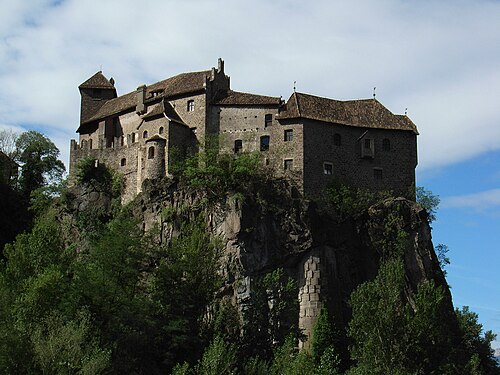
Karneid Castle (Italian: Cornedo all'Isarco) is a castle in northern Italy situated in the comune (municipality) of Karneid in the province of South Tyrol in the Italian region Trentino-Alto Adige/Südtirol, located about 4 km east of the city of Bolzano (Bozen).
Historical background
A 20th century analysis of the castle by the historian Martin Bitschnau suggests it was constructed on the site of an earlier smaller building in the early 13th CE by unknown vassals of the Prince-Bishopric of Brixen, an imperial estate of the Holy Roman Empire.
The fortress stands perched dramatically on an inaccessible cliff face above the confluence of the Eggental and the Eisack rivers, on the historically resonant ancient border between the kingdoms of the Lombards and the Bavarii. The name 'Karneid' derives from the Latin "cornus" meaning “horn”.
Chronology
1230-40
The Keep
The heart of the castle, with a floor plan of 7.4 x 6.8m and walls of 2.1m thickness throughout. The limited internal dimensions indicate that this tower is not intended to be inhabited for long periods. Its function is as a watchtower and visible expression of judicial power. The entrance to the tower is 8m above ground in order to impede access in case of war. From the windowless basement a wooden trap door descends into the dungeon. Small windows and loopholes on two floors form architectural and defence elements typical of the period.
The Hall
Until about 1200, the home of a nobleman or feudal lord in this part of the world was a residence in the local town or village. A castle tended to be solely a fortified place of refuge, usually just a tower surrounded by a wall. The construction of castles at higher vantage points with a residential building or great hall was an innovation brought about by the increasing desire of ruling families in the 13th century to project power and wealth as part of the so-called Vertikalverschiebung or vertical shift. The two-story hall in Karneid on the northern corner of the keep speaks for the wealth and status of its owner. Inwardly sloping roofs are designed so that rainwater can flow over gutters into a cistern carved out of the rock in the middle of a central courtyard. An inner wall connects the keep and hall to the east and west.
The Curtain Wall
Surrounding the hall, keep and inner wall is the curtain wall. There is a gate in the south east corner of the wall, opposite the keep. Access to the gate is by a wooden bridge over a man-made ditch sealing off the east side of the terrain. A wooden battlement runs along the inside of the curtain wall for defence purposes.
1246
The first documented reference to 'Corneit', referring to a certain 'paumannum de Corneit' and his spouse Yrmengarde.
1250-75
The Outer Ward …
The legend of the ghost riders of Karneid
Many years ago a dreadful plague raged in the Tyrol. From his castle high on the cliffs, the lord of Karneid surveyed the devastation in the valleys below. Fearing for the safety of his wife, his children and his followers, he made a solemn vow that if God spared the castle from disease he and his followers would perform a pilgrimage to the church of Maria Weissenstein to give thanks to the Virgin Mary.
In the weeks that followed the plague gradually retreated and all those residing in Karneid escaped unharmed. There was much celebration and the pilgrimage was soon forgotten as people returned gratefully to their everyday routines.
But the terror of the Black Death soon returned to the valley and this time struck the castle, carrying off its inhabitants one by one. The knight's entire clan, his wife and his children perished. He himself was the last to pass, a year to the day after he had made his vow.
Every year on the night of the anniversary of their Lord's death, when the grapes have ripened on the vines in the valley, the cursed inhabitants of Karneid rise from their graves to fulfill their promise and perform their pilgrimage to Weissenstein. Many a pious pilgrim seeking shelter late at night has seen the Knight and his family dressed in black, slowly riding their skeletal horses up the mountain, doomed to fulfill their vow for all eternity.
Extract from John L. Stoddard's Lectures, Supplementary Volume III: South Tyrōl, Around Lake Garda, The Dolomites (1903)
"A remarkable gateway to the Dolomites is the majestic gorge, directly opposite Botzen, known as the Eggen Thal. This suffers nothing by comparism with the other portals. Indeed, to its extraordinary vestibule may be awarded the primacy of the picturesque. A mighty strip of porphyry, forty miles in length, thirteen in breadth and several thousand feet in height stretches along the western border of the Dolomites and its huge, purplish walls form a conspicuous feature in the landscapes near Meran and Botzen. One section of its blood-red cliffs, just east of the latter city, is perforated by a deep gash, several miles in length, from which emerges a tumultuous torrent. This gash is called the Eggen Thal. Into its sombre shadow winds a carriage road constructed at great cost and with enormous difficulty, which gradually ascends the cañon, passing beneath vast, overhanging precipices, crossing repeatedly the tortuous stream by means of massive bridges and even taking refuge within tunnels, at points where some concession to the opposition of the raging tunnels becomes essential. It is a solemn entrance, especially when one has some acquaintance with the Dolomite peaks which lie beyond, and knows what weird and awful shapes they can assume. On this account, the Eggen Thal is probably the most appropriate avenue of approach to those mysterious mountains. It is a corridor of time, that leads us from old igneous rocks, forged in the earths fiery furnace when our globe was young, to coral reefs, on which the ocean waves once broke in glittering spray, but which now sparkle in the frosty air, ten thousand feet above their early home. At times one looks up almost timidly between these jaws of ruddy porphyry toward the narrow streak of blue, so far away. It seems like a celestial river, whose noiselessness, limpidity and calm present a great contrast to the maddened stream beside us, as our deal of heaven differs from the storms and sorrows of this earthly life." …
Text from Wikipedia, the free encyclopedia, under CC BY-SA 4.0. Full article: «Karneid Castle».
Photos
Getting there
Bolzano - BozenTrain, nearest
3.1 km as the crow flies
Karneid Castle
Aeroporto di Bolzano-Dolomiti - Flughafen Bozen-Dolomiten6.5 km
Distances are as the crow flies, not walking or driving.
Loading map…
Nearby
See on the mapMore castles in Trentino-South Tyrol



Frequently asked questions
Where is Karneid Castle?
Karneid Castle is in Karneid, in the province of Bolzano (Trentino-South Tyrol), Italy. GPS coordinates: 46.48946, 11.39783.
What else is there to see near Karneid Castle?
Nearby you’ll find: Castel Campegno (600 m away), Museo della scuola (1.9 km away), Villa Bittner (2.6 km away).
Sources and licences
Text. Wikipedia, the free encyclopedia (CC BY-SA 4.0).
Data. Wikidata (CC0); opening hours and contacts OpenStreetMap (ODbL).
Photos. Wikimedia Commons, author and licence on every image.
Credits for the 9 photos
- Schloss Karneid — CC BY-SA 3.0
- Castel Cornedo 01 — Syrio, CC BY-SA 4.0
- Flickr - …trialsanderrors - Karneid Castle, Eggental, Tyrol, Austro-Hungary, ca. 1895 — …trialsanderrors, CC BY 2.0
- Burg Karneid bei Bozen-Bolzano — Bartleby08, CC BY 4.0
- Eggenthal (i.e., Eggental), Karneid, Tyrol, Austro-Hungary-LCCN2002711019 — Photochrom Print Collection, Public domain
- Schloss Karneid mit der neuen breiten Eggentalstraße. (BildID 15419373) — K.u.k. Kriegspressequartier, Lichtbildstelle - Wien, Public domain
- Schloss Karneid und Bozen — Plentn, CC BY-SA 4.0
- Schloss Karneid with view of the city Bolzano not retouched — This Photo was taken by Wolfgang Moroder. Feel free to use my photos, but please mention me as the author and send me a message. This image is not in the public domain. Please respect the copyright…, CC BY-SA 3.0
- Schloss Karneid with view of the city Bolzano — This Photo was taken by Wolfgang Moroder. Feel free to use my photos, but please mention me as the author and send me a message. This image is not in the public domain. Please respect the copyright…, CC BY-SA 3.0
Updated 28 October 2026. All sources and licences