





Photo: Chrieative ( talk ), Public domain · Wikimedia Commons
Archaeological site
Roman shipyard of Stifone
Archaeological site in Umbria, Italy
At a glance
- Type
- Archaeological site
- Coordinates
- 42°29′52″ N, 12°29′33″ E
History and description
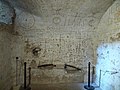
The Roman shipyard of Stifone is an archaeological find of Roman origin recently discovered in Umbria, in the municipality of Narni, inside an artificial channel adjacent the Nera River, about 900 metres down-river from the village of Stifone. Its position is just behind the remains of the river port of the ancient city of Narni.
The shipyard in the local historiography
Even before the discovery, following some popular tales handed down through the centuries, it is indicative to note how the local historiography had already mentioned the ancient presence of a similar structure. The former mayor of Narni, Rutilio Robusti, asserted:
"The origin of the word Stifone comes from the Greek and it has been used to indicate a place where timber boats and rafts were built to be sent towards Rome"
(Rutilio Robusti, Narni, guida della città e dintorni, 1924)
That contribution has been taken up by other authors, as Italo Ciaurro and Guerriero Bolli, both of whom have mentioned the origin of the toponym, the second writing of a shipyard of Stifone although he was thinking of the Byzantine period. Without any evidence to support the theory, the story of an ancient shipyard was never fully investigated, leaving only a general idea based on a few quotes. With Robusti's contribution, the normal thinking was that the site had perhaps been used for the construction of river rafts for the transportation of people and goods. Once the ruins were actually discovered, it was realized that due to the scale of the works and effort that had gone into building it, it may have been something more. The possibility that it had a connection to the Punic Wars shouldn't be excluded; for this reason, the volunteers who have been working to expand the knowledge of the site are hoping for more attention from archaeologists and public administrations. Being a unique and valuable find, it is important that it be dated as accurately as possible. The potential knowledge that may be gleaned from the site should not be underestimated.
The ancient navigability of the Nera River
The ancient navigability of the Nera River, as a natural way to send farm produce towards Rome, following the Tiber River in Orte, is confirmed by the classic authors Strabo and Tacitus. The Greek geographer refers about "not big boats"; the Latin historian instead describes in detail the journey of the consul Gnaeus Calpurnius Piso and his wife Plancina who, in the 19, returning to Rome from the provinces of Syria, decided to leave the Via Flaminia and taking a ship at Narni.
« Starting from Narni, to avoid suspects or because who fears is uncertain in his plans, he followed the waterway of Nera River and then of Tiber. So he increased the popular grudge because, once landed with the ship at Cesari’s grave, in broad daylight and with riverside full of people, they advanced cheerful in face, him among a crowd of clients and Plancina with her following of women» (Tacitus, Annales, Book III, 9)
However, the navigability of the Nera River is related only with the last part of its waterway, included between Stifone and the confluence of Nera with the Tiber. The narrow gorges below Narni, in fact, make impossible this practice.
The position of the river port and its rediscovery
The geographical coordinates of the ancient river port of Narni were revealed in the 16th century by the Jesuit Fulvio Cardoli, who saw in person its traces. Below his contribute:
"About one thousand steps beyond Taizzano, there was time once a port along the Nera River, as demonstrated by some traces"
(F. Cardoli, Ex notis Fulvij Carduli S.J. presbyteri Narniensis de Civitatis Narniae, Origine et antiquatibus).
The river port was found in the same position in the year 1879, when an informer of the marquis Giovanni Eroli noticed the remains of two big pilasters used to fasten the boats.
With the construction of some dams up stream, and the consequent rise of the river level, the port was tacitly believed as submerged. The remains of it, contrary to popular belief, were however in the same place described by the Jesuit, although hidden among the bushy vegetation. Only in the year 1992 was the port mentioned again in local historiography, when the archaeologist Roberto Nini wrote of the area. Some years later, the river port was visited by the superintendent for the regional archaeological heritage, Daniela Monacchi, but the close presence of an ancient shipyard was not noticed, due to a body of stagnant water which has obstructed the passage.
The finding of the shipyard
Meanwhile, someone had decided to patrol the channel which hosts the remains of the shipyard, in particular a group of people from the close village of Nera Montoro who knew the old popular story regarding the presence of a similar structure. After perceiving its destination, the local artist Alvaro Caponi has tried to reconstruct the hypothetical functioning producing some sketches, but despite its importance, the discovery has remained without any development. This till the beginning of the new century, when a young free-lance journalist, Christian Armadori, taken to the place by the entrant archaeologist Claudio Maturi with the prospect of an article, has been stunned by the find insomuch as undertaking an appropriate research. Then, in the year 2006, a group of volunteers has established the cultural association Porto di Narni Approdo d'Europa with the aim to put the archaeological site under the attention of the local government, and few time later also the major of Narni, Stefano Bigaroni, has gone to the area in order to check the plausibility of the discovery.
Text from Wikipedia, the free encyclopedia, under CC BY-SA 4.0. Full article: «Roman shipyard of Stifone».
Getting there
Nera MontoroTrain, nearest
1.3 km as the crow flies
Roman shipyard of Stifone
Distances are as the crow flies, not walking or driving.
Loading map…
Nearby
See on the mapMore archaeological sites in Umbria


Frequently asked questions
Where is Roman shipyard of Stifone?
Roman shipyard of Stifone is in Narni, in the province of Terni (Umbria), Italy. GPS coordinates: 42.49773, 12.49247.
What else is there to see near Roman shipyard of Stifone?
Nearby you’ll find: Sant'Angelo in Massa (1.1 km away), Rocca di Albornoz (2.9 km away), Eroli Museum (3 km away).
Sources and licences
Text. Wikipedia, the free encyclopedia (CC BY-SA 4.0).
Data. Wikidata (CC0); opening hours and contacts OpenStreetMap (ODbL).
Photos. Wikimedia Commons, author and licence on every image.
Credits for the 1 photos
- Sezione nave — Chrieative ( talk ), Public domain
Updated 28 October 2026. All sources and licences