


- Free 1st Sunday
Photo: Grueslayer, CC BY-SA 4.0 · Wikimedia Commons
Museum, 1294
Franciscan church in Florence, Italy
The Basilica di Santa Croce (Italian for 'Basilica of the Holy Cross') is a minor basilica and the principal Franciscan church of Florence, Italy. It is situated on the Piazza di Santa Croce, about 800 metres (2,600 ft) southeast of the Duomo, on what was once marshland beyond the city walls. Being the burial place of notable Italians, including those from the Italian Renaissance such as Michelangelo, Galileo, and Machiavelli, as well as the poet Foscolo, political philosopher Gentile and the composer Rossini, it is also known as the Temple of the Italian Glories (Tempio dell'Itale Glorie).
The basilica is the largest Franciscan church in the world. Its most notable features are its sixteen chapels, many of them decorated with frescoes by Giotto and his pupils, and its tombs and cenotaphs. Legend says that Santa Croce was founded by St Francis himself. The construction of the current church, which replaced an older building, was begun on 12 May 1294, possibly by Arnolfo di Cambio, and paid for by some of the city's wealthiest families. It was consecrated in 1442 by Pope Eugene IV. The building's design reflects the austere approach of the Franciscans. The floorplan is an Egyptian or Tau cross (a symbol of St Francis), 115 metres in length with a nave and two aisles separated by lines of octagonal columns. To the south of the church was a convent, some buildings of which remain.
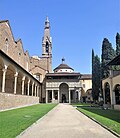
The Primo Chiostro, the main cloister, houses the Cappella dei Pazzi, built as the chapter house, completed in the 1470s. Filippo Brunelleschi (who had designed and executed the dome of the Duomo) was involved in its design which has remained rigorously simple and unadorned.
In 1560, the choir screen was removed as part of changes arising from the Counter-Reformation and the interior of this area was rebuilt by Giorgio Vasari. As a result, there was damage to the church's decoration and most of the altars previously located on the screen were lost. The Bardi Chapel which contained a cycle of frescoes of the life of St Francis was plastered over, at the behest of Cosimo I, and Vasari placed some new altars against the walls, causing considerable damage to the frescoes.
The bell tower was built in 1842, replacing an earlier one damaged by lightning. The neo-Gothic marble façade dates from 1857 to 1863. The Jewish architect Niccolò Matas from Ancona designed the church's façade, working a prominent Star of David into the composition. Matas had wanted to be buried with his peers but because he was Jewish, he was buried under the threshold and honoured with an inscription.
In 1866, the complex became public property, as a part of government suppression of most religious houses, following the wars that gained Italian independence and unity. …
Donatello: Cavalcanti Annunciation on the south wall; crucifix in the lefthand Cappella Bardi di Vernio; St Louis of Toulouse in the refectory (originally made for Orsanmichele)
Agnolo Gaddi: fresco cycle of The Legend of the True Cross in the apse with stained glass windows designed by him (1385–1387); fresco decoration of the Cappella Castellani with scenes of the lives of SS Anthony the Great, John the Baptist, John the Evangelist and Nicholas (1385)
Taddeo Gaddi: frescoes in the Baroncelli Chapel; Crucifixion in the sacristy; Arbor vitae with the Last Supper in the refectory (c. 1330–1340 or 1360), considered his best work
Giotto: frescoes in Cappella Peruzzi and righthand Cappella Bardi; possibly Coronation of the Virgin, altarpiece in the Baroncelli Chapel, also attributed to Taddeo Gaddi
Giovanni da Milano: frescoes in Cappella Rinuccini) with Scenes of the Life of the Virgin and the Magdalen
Maso di Banco: frescoes in Cappella Bardi di Vernio) depicting Scenes from the life of St. Sylvester (1335–1338)
Henry Moore: statue of a warrior in the Primo Chiostro
Andrea Orcagna: frescoes largely disappeared during Vasari's remodelling, but some fragments remain in the refectory
Once present in the church's Medici Chapel, but now split between the Florentine Galleries and the Bagatti Valsecchi Museum in Milan, is a polyptych by Lorenzo di Niccolò, whilst the Novitiate Altarpiece by Filippo Lippi and a predella by Pesellino was painted for the church's Novitiate Chapel.
The basilica became popular with Florentines as a place of worship and patronage and it became customary for greatly honoured Florentines to be buried or commemorated there. Some were in chapels "owned" by wealthy families such as the Bardi and Peruzzi. As time progressed, space was also granted to notable Italians from elsewhere. For 500 years monuments were erected in the church including those to:
Leon Battista Alberti (15th-century architect and artistic theorist)
Giovan Vincenzo Alberti (Florentine senator and minister to first two Lorraine Grand-Dukes)
Leonardo Bruni (15th-century chancellor of the Republic, scholar and historian) by Bernardo Rossellino
Carlo Marsuppini (15th-century chancellor of the Republic of Florence) by Desiderio da Settignano
Michelangelo Buonarroti by Giorgio Vasari with sculptures by Valerio Cioli, Iovanni Bandini, and Battista Lorenzi.
Text from Wikipedia, the free encyclopedia, under CC BY-SA 4.0. Full article: «Basilica of Santa Croce».
Events and people from Wikidata (CC0).
Distances are as the crow flies, not walking or driving.


Basilica of Santa Croce is in Florence, in the province of Firenze (Tuscany), Italy. Address: Piazza Santa Croce 16. GPS coordinates: 43.76845, 11.26274.
Wikidata dates it to 1294.
Nearby you’ll find: Cappella de' Pazzi (100 m away), Convento di Santa Elisabetta del Capitolo (100 m away), Palazzo Gargiolli (100 m away).
Text. Wikipedia, the free encyclopedia (CC BY-SA 4.0).
Data. Wikidata (CC0); opening hours and contacts OpenStreetMap (ODbL).
Photos. Wikimedia Commons, author and licence on every image.
Updated 28 October 2026. All sources and licences