

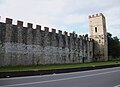


Photo: Gianni Careddu, CC BY-SA 4.0 · Wikimedia Commons
Archaeological site, 1st century
Baths of Nero
Archaeological site in Italy
At a glance
- Type
- Archaeological site
- Period
- Antiquity, 1st century
- Commissioned by
- Lucius Venuleius Montanus
- Protection
- Italian national heritage
- Coordinates
- 43°43′20″ N, 10°24′07″ E
History and description
The Baths of Nero (Italian - Bagni di Nerone) are an archaeological site near the Porta a Lucca in Pisa, then the Roman city of Colonia Pisana. Now below street level, they are the only Roman remains still standing in the city and form a thermae complex.
History
They were given the misnomer 'of Nero' in the medieval period, when they were believed to have been part of a palace - the earliest level actually dates to the final decades of the 1st century, during the reign of Domitian, as suggested by the use of the opus vittatum mixtum building technique with alternating layers of brick and tuff blocks. It was rebuilt during the 2nd century, as evidenced by an inscription (CIL XI, 1433, now held in National Museum of San Matteo) which cites the Veruleii Aproniani family, well-known for owning extensive grounds and ceramics factories. In particular Lucius Venuleius Apronianus Priscus financed the rebuilding. He was a patronus of Roman Pisa and consul of Attidium (a Roman city near present-day Fabriano), who held a number of offices in the Antonine period. As was typical of public figures in the Roman world, he funded several building projects: in 92 he built the Caldaccoli Aqueduct and also funded a building in Corliano.
The best-preserved part of the complex is the laconicum (hot room), composed of an octagonal room with an apse, with a dome-shaped perforated roof, which has been partially restored. There are also the remains of some of the walls of the palaestra of the apodyterium and two walls from the tepidarium. Marble remains and some decorative sculptures have also been found. Its water was supplied by the nearby river Auser and from the Caldaccoli aqueduct.
They were re-discovered and restored in the 16th and 17th centuries by command of Cosimo III, excavated in 1881 by Clemente Lupi, fenced off in 1938 (after the demolition of some neighbouring houses) and finally fully restored in 1947. A covering dome was installed but this was worn out by the weather by 2007, when it was replaced.
Text from Wikipedia, the free encyclopedia, under CC BY-SA 4.0. Full article: «Baths of Nero».
Timeline
- 1st centuryBuilt
Events and people from Wikidata (CC0).
Photos
Getting there
Pisa San RossoreTrain, nearest
1.1 km as the crow flies
Baths of Nero
Aeroporto internazionale Galileo Galilei4.2 km
Distances are as the crow flies, not walking or driving.
Loading map…
Nearby
See on the mapMore archaeological sites in Tuscany


- Free 1st Sunday
Frequently asked questions
Where is Baths of Nero?
Baths of Nero is in Pisa, in the province of Pisa (Tuscany), Italy. GPS coordinates: 43.72229, 10.40195.
How old is Baths of Nero?
Wikidata dates it to the 1st century.
What else is there to see near Baths of Nero?
Nearby you’ll find: Porta a Lucca (0 m away), City walls of Pisa (0 m away), Porta del Parlascio (100 m away).
Sources and licences
Text. Wikipedia, the free encyclopedia (CC BY-SA 4.0).
Data. Wikidata (CC0); opening hours and contacts OpenStreetMap (ODbL).
Photos. Wikimedia Commons, author and licence on every image.
Credits for the 9 photos
- Pisa, Bagni di Nerone (01) — Gianni Careddu, CC BY-SA 4.0
- Bagni di Nerone (Pisa) 01 — John Samuel, CC BY-SA 4.0
- Bagni di nerone 01 — sailko, CC BY 2.5
- Bagni di nerone 04 targhe — sailko, CC BY 2.5
- Bagni di nerone 05 nicchia interna — sailko, CC BY 2.5
- Pisa - Bagni di Nerone e San Torpè — Luca Aless, CC BY-SA 4.0
- Pisa, Bagni di Nerone (02) — Gianni Careddu, CC BY-SA 4.0
- Pisa, römische Thermen, Bagno di Nerone (01) — Bayreuth2009, CC BY 3.0
- Terme "di Nerone" - panoramio — Carlo Pelagalli, CC BY-SA 3.0
Updated 28 October 2026. All sources and licences