


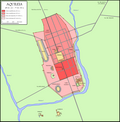


Photo: Zavijavah, CC BY-SA 3.0 · Wikimedia Commons
Archaeological site
Aquileia
Ancient Roman city now Aquileia, Province of Udine, Friuli–Venezia Giulia, Italy
Aquileia (UD), Friuli Venezia Giulia
- Within the UNESCO World Heritage Site “Archaeological Area and the Patriarchal Basilica of Aquileia”
At a glance
- Type
- Archaeological site
- Coordinates
- 45°46′24″ N, 13°21′59″ E
History and description
Aquileia was an ancient town in northeastern Italy, located near the head of the Adriatic Sea. Founded in 181 BC as a Roman military colony, it was originally established to secure the eastern borders of Italy against neighboring tribes such as the Carni and Histri. The city subsequently grew into an important frontier military city. Its strategic location made it an hub for trade and military operations, particularly for Roman expansion toward the Danube. In classical antiquity, Aquileia was a major Roman city with an estimated population close to 100,000 in the 2nd century AD.
Aquileia was one of the first cities in which Christianity could be practised unhindered; the Patriarch of Aquileia was the second most important person of the Western Church after the bishop of Rome. In the 4th century, the construction of the Patriarchal Basilica under Bishop Theodore marked the city as an important religious center. However, the city's decline began after being sacked by Attila the Hun in 452 AD. Aquileia remained a religious center, though its military significance waned. Over time, the patriarchal seat moved to Cividale del Friuli for greater security.
Overview
In 452 AD, it was destroyed by the hordes of Attila's Huns.
Aquileia, which is closest to the gulf of the Adriatic Sea was founded by the Romans, fortified against the barbarians from the interior. One goes up with ships to the city by ascending along the course of the Natiso for about 60 stadia. it served as an emporium to those Illyrian peoples living along the Istro. They come to be supplied with products from the sea, such as wine, which they put into wooden barrels by loading it onto wagons, and also oil, while the people of the area come to buy slaves, cattle and leather. Aquileia lies across the border from the Veneti. The border is marked by a river that flows down from the Alps and through which, with a navigation of 1,200 stadia, one goes up to the city of Noreia.
This is how Herodian describes it at the time of his 238 siege by the troops of Maximinus Thrax:
Before these events occurred, Aquileia was a very large city with a very large stable population. Located on the sea, it had all the Illyrian provinces behind it. Aquileia was used as a port of entry to Italy. The city had, thus, made it possible for goods to be transported from the interior by land or rivers, to be exchanged with merchant ships. [Goods] were, in addition, transported from the sea to the mainland as needed, when goods were not produced locally, due to the cold climate, but sent up to the mountainous areas. Since agriculture in the hinterland had many people employed in wine production, they exported large quantities of wine to markets that could not grow vines there. The large number of people living permanently in Aquileia consisted not only of native residents, but also of foreigners and traders. At this time the city was even more crowded than usual. All the people from the surrounding area had left the small towns or villages and fled [to the big city]. They placed their hopes of safety in the large city and its defensive walls. These ancient walls, however, had mostly collapsed. Under Roman rule the cities of Italy did not, normally, need walls or weapons. They had substituted lasting peace for war and had also earned the right to participate in Roman rule.
Republican period (181-31 BC).
Aquileia was founded in 181 B.C. near the Natissa River as a colony under Latin law, by Lucius Manlius Acidinus, Publius Scipio Nasica and Gaius Flaminius, sent by the senate to bar the way to the neighboring Carni and Histrian peoples who threatened the eastern borders of Italy. It was established in the territory of the Carni:
In the same year 181 BC the colony of Aquileia was deducted in the territory of the Gauls. 3 000 infantrymen received 50 iugera each, the centurions 100, the horsemen 140. The triumvirs who founded the colony were Publius Scipio Nasica, Gaius Flaminius, and Lucius Manlius Acidinus.
The first settlers were 3,000 veterans, followed by their respective families from Samnium, a total of about 20,000 people, who were followed by groups of Veneti; later, in 169 B.C., another 1,500 families were added, while eastern communities, such as Egyptians, Jews and Syrians, also settled in the city.
It was ruled initially by duumvirs and later by quattuorviri with its own senate. The city first grew as a military outpost in preparation for future campaigns against Histri and Carni, later as "headquarters" for eventual Roman expansion toward the Danube. …
Early imperial period (30 B.C.-285 A.D.)
At the time of Augustus, after an initial campaign led by Publius Sillius Nerva in 16 B.C. following an invasion of Pannonians in Istria and the subsequent Roman conquest of territories as far as Pula and Raša, in 15 B.C, his stepson Tiberius, together with his brother Drusus, led a military campaign against the populations of Rhaetians, settled between Noricum and Gaul, and Vindelici. The two, in an attempt to encircle the enemy by attacking him on two fronts without leaving him any escape routes, planned a large "pincer movement," which they put into practice also with the help of their lieutenants: Tiberius moved from Helvetia, while his younger brother moved from Aquileia and reached Tridentum, dividing the army into two columns. A first column traveled along the Adige and Isarco valleys (at whose confluence he built the Pons Drusi, near present-day Bolzano), ascending as far as the Inn; the second went along what was to become under Emperor Claudius the Via Claudia Augusta (traced therefore by his father Drusus) and which, through the Vinschgau valley and the Reschen pass, also reached the Inn river. Tiberius, advancing from the west, defeated the Vindelici, reuniting near Lake Constance with his brother Drusus, who, in the meantime, had defeated and subdued the peoples of the Breuni and Genauni. These successes enabled Augustus to subdue the peoples of the Alpine region as far as the Danube and earned him renewed imperatorial acclaim. A few years later, beginning in 14 B.C, Aquileia again turned out to be instrumental in the subjugation of the whole of Illyricum and Pannonia, under the commands first of Marcus Vinicius, then of Augustus' son-in-law and brotherly friend Agrippa, then of his stepson Tiberius. Aquileia again continued to be an important military center during the Dalmatian-Pannonian revolt of 6-9, forming the last bulwark against the possible threat of an invasion by these peoples, who could thus have reached Rome itself in only ten days. It was clear, however, that Aquileia had lost its former function as "headquarters," which was now attributed by Tiberius to Siscia on the Sava River, in a more advanced position. From this point on, Aquileia ceased to play a decisive military role any longer, maintaining instead an important economic and social function in the rear, now that all military forces had been moved to Pannonia and Dalmatia. …
Late imperial period (286-452)
Maximian, once he became Augustus of the West, preferred to use two capitals: Aquileia (which Ausonius calls the ninth city of the Empire), farther east, as a river-sea port on the Adriatic Sea and a military hinterland, given its proximity to the limes of the Claustra Alpium Iuliarum; Mediolanum, on the other hand, farther west, was positioned to guard the passes north of the great Alpine lakes. In these two locations he therefore had large imperial structures and palaces erected, leaving mainly the care of the defense of the Rhine limes to Constantius.
In 312, during the civil war, Constantine I, now suspicious of Maxentius, assembled a large army and moved across the Alps into Italy, and after defeating Maxentius's armies twice in a row, near Turin and Brescia, laid siege to and occupied, first Verona and then Aquileia, subduing the whole of northern Italy. Shortly thereafter he marched on Rome, where he finally defeated Maxentius' army just north of the Eternal City in the decisive Battle of the Milvian Bridge, on October 28, 312. With the death of Maxentius, all of Italy came under Constantine's control, while the Praetorian Guard and the Castra Praetoria were suppressed.
Throughout the continuation of the fourth century, imperial presences in Aquileia intensified, and many bloody clashes resolved fratricidal contentions such as the one between Constantine II and Constans I in 340; or between Constantius II and Magnentius in 351-352; or episodes of usurpation: Theodosius I defeated Magnus Maximus there (in 388); Valentinian III killed Joannes there in the Hippodrome (in 425). …
Text from Wikipedia, the free encyclopedia, under CC BY-SA 4.0. Full article: «Aquileia».
Photos
Getting there
Cervignano - Aquileia - GradoTrain, nearest
5.9 km as the crow flies
Aquileia
Port8.8 km
Trieste Airport9.8 km
Distances are as the crow flies, not walking or driving.
Loading map…
Nearby
See on the mapMore archaeological sites in Friuli Venezia Giulia


Frequently asked questions
Where is Aquileia?
Aquileia is in Aquileia, in the province of Udine (Friuli Venezia Giulia), Italy. GPS coordinates: 45.77329, 13.36651.
What else is there to see near Aquileia?
Nearby you’ll find: Ancient Roman forum (0 m away), House of Titus Macer (300 m away), Circo romano di Aquileia (400 m away).
Sources and licences
Text. Wikipedia, the free encyclopedia (CC BY-SA 4.0).
Data. Wikidata (CC0); opening hours and contacts OpenStreetMap (ODbL).
Photos. Wikimedia Commons, author and licence on every image.
Credits for the 2 photos
- Porto fluviale di Aquileia — Zavijavah, CC BY-SA 3.0
- Port fluvial d'Aquileia — Yves canaff, CC BY-SA 4.0
Updated 28 October 2026. All sources and licences