




- Free 1st Sunday
Photo: PaestumPaestum, CC BY 4.0 · Wikimedia Commons
Alba Fucens was an ancient Italic town located at 1,000 m (3,300 ft) elevation at the base of Monte Velino, approximately 6.5 km (4.0 mi) north of Avezzano, Abruzzo, central Italy. Its ruins can be found in the comune of Massa d'Albe.
The city is largely visible after excavation and is probably the most important ancient site in Abruzzo.
It was originally a town of the Aequi, though on the frontier of the Marsi, but was occupied by a Latin colony in the late fourth century BC.
Following the defeat of the Aequi in the closing phase of the Second Samnite Wars.With the intention of securing control of the Apennine corridor and facilitating Roman access toward the Adriatic while tightening their grip on Samnium, the Romans initially offered the Aequi civitas sine suffragio, a form of citizenship without voting rights. Following the Aequian rejection of this settlement, Rome conquered the Aequi and subsequently established two Latin colonies (Alba Fucens in 303 BC and Carsioli shortly thereafter between 302 and 298 BC).
The initial colonial body, consisting of approximately 6,000 settlers, built a wall in the years immediately following their settlement. The colonial foundation was met with hostility by the surrounding Aequian population. In the year following its establishment, the Aequi launched an unsuccessful assault on the colony, apparently unwilling to accept the implantation of a fortified Latin citadel within their former lands.
Alba Fucens lay on a hill just to the north of the Via Valeria, which was prolonged beyond Tibur probably at this very period. In the Second Punic War Alba at first remained faithful and in 211 BC sent a contingent of 2,000 men to help Rome, but afterwards refused to send contingents and was punished.
After this it became a regular place of detention for important state prisoners such as Syphax of Numidia, Perseus of Macedonia, and Bituitus, king of the Arverni.
It was attacked by the allies in the Social War, but remained faithful to Rome; and its strong position rendered it a place of some importance in the civil wars. In the struggle between Sulla and Marius, the city sided with the latter and at the end of the conflict Sulla, to punish it and at the same time satisfy the requests of one of his lieutenants, Metellus Pius, distributed part of the territory of Alba Fucens to the latter's veterans.
In the conflict between Caesar and Pompey, it hosted a garrison of six cohorts of Lucius Domitius Ahenobarbus (consul 54 BC) then surrendered to the legions of Caesar. …
The city streets and many buildings built on a Hippodamian orthogonal plan are clearly exposed. On the northern side is a large terrace surrounded by a portico attached to an exedra.
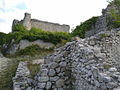
The city walls of about 3 km circumference are well preserved and constructed of polygonal masonry of uncertain date; the blocks are carefully jointed, and the faces smoothed. The arrangement of the gates is clearly traceable; as a rule they come at the end of a long, straight stretch of wall, and are placed so as to leave the right side of any attacking force exposed. On the north is, for a length of about 150 m, a triple line of defences of later date (possibly added by the Roman colonists), as both the city wall proper, and the double wall thrown out in front of it are partly constructed of concrete, and faced with finer polygonal masonry.
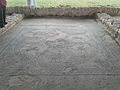
The forum (142 x 44 m) was overlooked by the basilica built (end of the 2nd century BC to first decades of the following century), the macellum (market) from the same era and the baths of the late Republican age, but enlarged in the imperial era. The baths were decorated with precious mosaics depicting marine scenes and subjects.
The well-preserved amphitheatre (96 x 79 m) from the reign of Tiberius was built by the Prefect of the Praetorium Nevius Sutorius Macro, born in Alba. There are numerous houses belonging to the local patricians including a domus. On the side of the Pettorino hill are the remains of the Roman theatre's cavea.
Remains of the 10 km long Roman aqueduct, built as early as the 1st century BC, are visible especially of the siphon-bridge in the locality of Arci, 1.5 km NE of the town. Its source was the Sant'Eugenia spring beyond the pass of Fonte Capo la Maina near the hamlet of Santa Jona. The last 3 km was unusually built using a pressured pipeline as an inverted siphon across a valley. At Arci is the venter of the inverted siphon, an embankment 12 m wide and over 130 m long increasing in height with the valley depth and at the deepest point was a bridge with arches carrying the pipes to reduce the depth of the siphon and hence the water pressure and associated leakage. …
Discovered in 1949 after excavations carried out by the Belgian University of Louvain, the project led to a series of publications of the site.
The statue of Venus and other finds are at the National Museum of the Abruzzi at Chieti.
Since 2007 new excavations have been led by Brussels University, and amongst the most spectacular finds were a painted calendar and fasti.
Text from Wikipedia, the free encyclopedia, under CC BY-SA 4.0. Full article: «Alba Fucens».
Distances are as the crow flies, not walking or driving.


Alba Fucens is in Massa d'Albe, in the province of L'Aquila (Abruzzo), Italy. GPS coordinates: 42.07906, 13.41147.
Yes: entry is free on the first Sunday of every month, under the Italian “Domenica al museo” scheme.
Wikidata dates it to 303 BC.
Nearby you’ll find: Roman theater of Alba Fucens (100 m away), San Pietro (200 m away), Amphitheatre of Alba Fucens (200 m away).
Text. Wikipedia, the free encyclopedia (CC BY-SA 4.0).
Data. Wikidata (CC0); opening hours and contacts OpenStreetMap (ODbL).
Photos. Wikimedia Commons, author and licence on every image.
Updated 28 October 2026. All sources and licences