




- UNESCO
- Free 1st Sunday
Photo: personnel, GFDL · Wikimedia Commons
Abbey / Monastery, 1510
Church building in Parma, Italy
Parma (PR), Emilia-Romagna
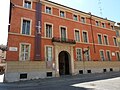
San Giovanni Evangelista is a Mannerist-style, Roman Catholic church located on Piazzale San Giovanni, located just behind the apse of the Parma Cathedral, in the historic center of Parma, northern Italy. The buildings surrounding the piazza were also part of a former Benedictine convent. The church is notable for its Correggio frescoes.
Construction of the abbey and church were begun in the 10th century under the patronage of then Bishop Sigefredus over a pre-existing oratory dedicated to Saint Colombanus. In 1477 the whole complex was damaged by a fire. The abbey basilica was rebuilt from around 1498 to 1510, according to a design by Bernardino Zaccagni. The abbey was suppressed in 1810, although the monks were able to return in 1817.
The marble façade of the church opens onto the Piazzale San Giovanni. The facade was designed by Simone Moschino of Orvieto in proto-Baroque, or Mannerist, style in 1604, and completed in 1607, as cited in the plaque below the tympanum. They tympanum has an eagle, symbol of St John the evangelist. It is decked with statues in niches or rooflines, and brackets and frames that have little architectural explanation. Above the lateral doors are two circular windows, while the upper story has a circular window with a square glass pane in front.
The bell tower on the right side, perhaps designed by Giovanni Battista Magnani, was completed in 1613. With a height of 75 meters, it is the tallest in Parma.
The interior layout has a Latin cross plan, with a nave and two aisles covered with cross vaults, and a dome at the crossing. The structure is similar to the nearby cathedral's. The grooved piers are Renaissance elements of classical inspiration.
The design included since the beginning a thoroughly painted decoration of the interior, and a contract had been signed with the young Correggio, who had already worked in another Benedictine monastery, in the Camera della Badessa of San Paolo. Correggio added a painted frieze which runs for the whole internal perimeter. It is long strip with monochrome paintings (with few red details) on a dark blue background, including also some tondoes with portraits of Benedictine popes, cardinals and monks. The main feature is a series of puttos in actions symbolizing the importance of the Christian Mass and sacrifice. The grotesque decorations on the semi-piers and the vault decoration (with candelabra, puttos and symbols of St. John the Evangelist) were contributed (c. 1520) by Correggio's pupils, in particular Michelangelo Anselmi.
The ceiling of the left crossing was painted by Anselmi with a St. Benedict Enthroned and Four Saints (1521), while the walls show terracotta sculptures by Antonio Begarelli (St. John the Evangelist and Madonna with Child and St. John, c. 1543). In the arch of the right chapel of the presbytery are additional frescoes by Bedoli. …
The twelve side chapels were frescoes by local artists (including Angelo Michele Colonna) in the late 16th century and early 17th century.
The first chapel on the left has an arch frescoed by Parmigianino, with St Agatha and the Executioner and Saints Stephen and Lawrence. These are monumental figures influenced by Pordenone's frescoes in the Cathedral of Cremona.
Another Saints Stephen and Lawrence and a Saint Vitalis with the Horse, both by Parmigianino, are in the following chapel.
The altarpiece in the Zancheri Chapel, Mystical Marriage of St. Catherine of Alexandria (1536) is by Bedoli. Attributed to Parmigianino, but today considered by Anselmi, is a fresco cycle. Anselmi also painted a Christ Carrying the Cross (c. 1522) in the sixth left chapel.
Works in the right chapels include an Cristoforo Caselli's Adoration of the Magi (1449, third chapel), Bedoli's altarpiece of Madonna with Child and St. James (c. 1543–1545, fourth chapel), and a Nativity by Jacopo Francia.
Around 1524, Correggio also painted two canvasses for the Del Bono Chapel, now at the Galleria nazionale di Parma: the Lamentation for Dead Christ and the Martyrdom of Four Saints. There are 18th century copies of Correggio's canvasses in the Del Bono Chapel, whose arch has maintained frescoes executed by his pupils under his design (Conversion of St Paul and Saints Andrew and Peter).
The Benedectine monastery is on the left of the church entrance. It is a large complex with a chapter-house, a refectory, and three cloisters. The first, St. John Cloister (1537), has Ionic columns; the second, the Chapter Cloister (1500), has decorations by Correggio and the third, known as the Cloister of St. Benedict, has early 16th-century frescoes.
The associated library has manuscript and codexes testifying the amanuensis activity of the local monks. The manuscripts arrived here from the monastery of Santa Giustina in Padua without decorations, and here were decorated by Damiano da Moile, Francino da Moile and, starting from 1492, da Michele da Genova.
The monastery has also an ancient grocery, documented since 1201. Its dependences include the Abbey of Santa Maria della Neve at Torrechiara.
Text from Wikipedia, the free encyclopedia, under CC BY-SA 4.0. Full article: «San Giovanni Evangelista».
Events and people from Wikidata (CC0).
Distances are as the crow flies, not walking or driving.


San Giovanni Evangelista is in Parma, in the province of Parma (Emilia-Romagna), Italy. Address: borgo Pipa 1/a. GPS coordinates: 44.80293, 10.33219.
Wikidata dates it to 1510.
Nearby you’ll find: Antica spezieria di San Giovanni (0 m away), Seminario Maggiore (Parma) (100 m away), Palazzo Dalla Rosa Prati (200 m away).
Text. Wikipedia, the free encyclopedia (CC BY-SA 4.0).
Data. Wikidata (CC0); opening hours and contacts OpenStreetMap (ODbL).
Photos. Wikimedia Commons, author and licence on every image.
Updated 28 October 2026. All sources and licences