

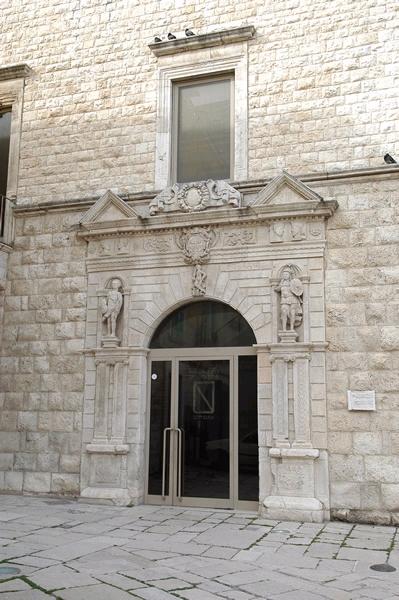
Photo The original uploader was Michele Zaccaria at Italian Wikipedia., CC BY-SA 2.0
Bari · Puglia (Apulia)
Things to see in Molfetta
In Molfetta the atlas lists 20 historic places: 8 museums, 7 historic villas and palaces, 2 fortresses and towers, 2 archaeological sites and 1 lighthouse.
For most of these places we don’t have verified opening hours yet: always check the official website before you go.
Don’t miss: Basilica of Our Lady of the Martyrs, church building in Molfetta, Italy.
- 20historic places
- 57,329inhabitants
- 8 maltitude
The town
Molfetta is a town in the province of Bari in the Italian region of Apulia (Puglia). The city has always had a strong bond with the sea and with the other cities of the Mediterranean.
Molfetta is a town of almost 60,000 inhabitants.
Over time, many peoples passed from Molfetta, from the Byzantines to the Lombards, from the Saracens to the Swabians. Frederick II of Swabia named Molfetta "royal city". During the period of the Crusades, Molfetta acquired notoriety as a renowned stop during the journey to the Holy Land.
Text from Wikivoyage, CC BY-SA, abridged · Wikivoyage
20 places
Museums 8


Villas and palaces 7


Fortresses and towers 2


Archaeological sites 2
Lighthouses 1


Getting there
It is about 25 km north-west of Bari.
By plane: The nearest airport is Bari Palese.
By car: From the A14 motorway, exit at Molfetta and turn left onto Provincial Road 112.
From the SS 16 Adriatica, take the Molfetta Nord, Molfetta Centro or Molfetta Sud exit.
By train: Molfetta station. It is on the Lecce-Bologna Adriatic line, where the regional trains from Bari and Barletta stop.
Text from Wikivoyage, CC BY-SA, abridged · Wikivoyage
What to see, according to Wikivoyage
The Pulo of Molfetta. A characteristic karstic collapse sinkhole created by the collapse of the vault and the dividing walls of one or more caves and tunnels formed starting from distant geological times and forming part of a complex karst system consisting of the confluence and intersection of several karst wells which originated precisely in that place from a series of geological coincidences. Archaeological Civic Museum of Pulo (Museo civico archeologico del Pulo). Housed a restored building from the early 19th century, it exhibits various finds from various archaeological excavations, carried out since 1997 in the Neolithic village of the Azzollini Fund and in the nearby Pulo. The collection includes a selection of ceramics, lithic industries and fragments of the huts, dating back to the Neolithic and the Bronze Age, accompanied by captions, images and reconstructions. There are also some ceramic containers of the local 18th-century factories, which refer to the period in which the sinkhole was used as a saltpetre quarry. Cathedral of San Corrado (Duomo di San Corrado).
Text from Wikivoyage, CC BY-SA, abridged · Wikivoyage · Underlined names link to our own pages.