

Photo Pxhere, CC0
Como · Lombardy
Things to see in Como
In Como the atlas lists 58 historic places: 26 historic villas and palaces, 9 museums, 7 fortresses and towers, 6 abbeys and monasteries, 6 archaeological sites, 2 castles and 2 historic theatres.
Of these, 6 list opening hours.
Don’t miss: Como Civic Art Gallery (1989), museum in Como, Italy.
By date of construction, the most common period is the Modern era (62% of dated places) and the Middle Ages (23% of dated places).
- 58historic places
- 83,184inhabitants
- 201 maltitude
The town
Como is a city at the southern end of Lake Como in Lombardy, Northwest Italy. It has a population of 84,000 (2015). The border with Switzerland is at the northwestern end of the city.
Como has always been an area of intense activity, as it has been a crossing point between Central Europe and the Mediterranean over the centuries. Built by the Romans at the end of the Piedmont road, it was an important communication point between Rome and its northern territories. Until the end of the 1980s, Como was famed for its silk.
Como was the birthplace of the Roman scientists Pliny the Elder and Pliny the Younger, as well as Alessandro Volta, 18th-century inventor of the battery and the man who gave his name to the unit of electrical force – the volt.
Text from Wikivoyage, CC BY-SA, abridged · Wikivoyage
58 places
Villas and palaces 26


Show all 26 places
 Villa del Grumello
 Casa Pedraglio
 Villa Gallia
 Villa Saporiti
 Posta Design Hotel
 Villa Dossi Pisani
 Broletto
 Villa Geno
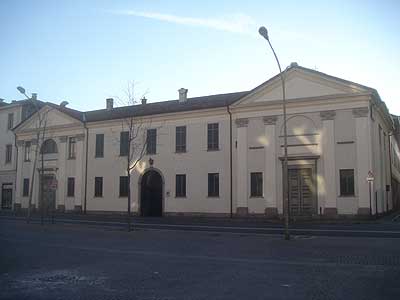 Centro socio-pastorale Cardinal Ferrari
 Giosuè Carducci institute
 Villa Parravicini Revel
 Palazzo Cernezzi
 Palazzo delle Poste
 Lambertenghi palace
 Villa Gallietta
 Vista Palazzo Lake of Como
 Palazzo della Banca Commerciale
 Villa Sforni Villa Dozzio Palazzo Saibene (Villa Gallietta)
Museums 9


Fortresses and towers 7


Abbeys and monasteries 6


Archaeological sites 6


Historic theatres 2


Getting there
By car: The E35 motorway (toll is €1.60 for the A9 stretch, €1.10 for the A4 section, about 1.50 for the E35 section west of Milan) runs past Como from Milan, and goes on to Switzerland. There are many exits to Como; avoid Como South, choose the next ones (signed Como Nord and Monte Olimpino) for the city, and the last exit (signed ultima uscita per l'Italia) before Switzerland for Cernobbio, Bellagio and towns on the western lake shore.
To reach Como coming from most of Italy, it is necessary to pass through the great motorway junction of Milan. At viale Certosa follow the directions for Como / Varese / Autostrada dei Laghi and then take the A9 Lainate-Como-Chiasso.
From Switzerland, Como can be reached via the A2 Basel - Chiasso motorway.
By train: Como has good train connections with Italy and Switzerland (which is just next to the town). It has two main stations: Como San Giovanni and Como Lago - both used to get into the town. Tickets can be bought at ticket machines in stations - be prepared to use these instead of going to a ticket office, as not many can be found open. Trains are run by different companies, including SBB (Swiss Federal Railways) and Trenitalia (owned by the Italian state).
Como San Giovanni. San Giovanni is just outside the edge of the old town, and has connections on to Zurich in Switzerland to the north, Lecco to the east, and Milan to the south.
Text from Wikivoyage, CC BY-SA, abridged · Wikivoyage
What to see, according to Wikivoyage
Faro Voltiano (Volta Lighthouse) (first take a funicular up to Brunate and then walk up 36 min to San Maurizio). Boasting some of the best views on the lake, this very high building will allow you to look down on the lake some 2000 feet below. Cattedrale di Santa Maria Assunta (Como Cathedral). Note the statues of Pliny the Elder and Younger at the sides of the main entrance! Basilica di Sant'Abbondio. A Romanesque basilica built in 11th century; inside some 13th-century frescos. The basilica was built on the site of an early Christian basilica of the 5th century, dedicated to the holy apostles Peter and Paul. Between 1050 and 1095, the Benedictines rebuilt the church in Romanesque style. In the 16th century the basilica underwent profound renovations, assuming a classical look, while the construction of the grandiose cloister was also started. In 1834 the buildings, now in a serious state of decay, were partly demolished and rebuilt. From 1863, the basilica was restored its Romanesque appearance; during the works the foundations of the early Christian building and those of the external narthex, which had been demolished during the 16th century, were also found.
Text from Wikivoyage, CC BY-SA, abridged · Wikivoyage · Underlined names link to our own pages.