


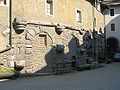


Photo: Geobia, CC BY-SA 3.0 · Wikimedia Commons
Archaeological site
Roman Theatre of Aosta
Ancient Roman theatre or odeon in Aosta, Italy
Aosta (AO), Aosta Valley
At a glance
- Type
- Archaeological site
- Protection
- Italian national heritage
- Coordinates
- 45°44′18″ N, 7°19′20″ E
- Address
- Via Porta Pretoria 8, 11100 Aosta
History and description
The Roman Theatre is an ancient building in Aosta, north-western Italy.
It was built in the late reign of Augustus, some decades after the foundation of the city (25 BC), as testified by the presence of pre-existing structures in the area. There was also an amphitheatre, built during the reign of Claudius, located nearby.
It was restored in 2009. Since 2011, theatre is used for music shows and theatrical performs. The theatre was shuttered in 2022 for further restorations costing nearly 5 million euros. It reopened in July 2026.
Description
The theatre occupies three blocks annexed to the ancient city walls, along the Roman main road (the decumanus maximus, next to the Porta Prætoria. The structure occupied an area of 81 by 64 metres (266 by 210 ft), and could contain up to 3,500/4,000 spectators.
What remains today include the southern façade, standing at 22 metres (72 ft). The cavea was enclosed in a rectangular-shaped wall including the remaining southern part. This was reinforced by buttresses each 5.5 metres (18 ft) from the other, and included by four orders of arcades which lightened its structure. It has been supposed that the theatre once had an upper cover, in the same way of the Theatre of Pompey in Rome.
The orchestra had a diameter of 10 metres (33 ft). The scene, of which only the foundations remain, was decorated by Corinthian columns and statues and was covered with marble slabs.
A marketplace surrounded by storehouses on three sides with a temple in the centre with two on the open (south) side, as well as a thermae, also have been discovered.
Text from Wikipedia, the free encyclopedia, under CC BY-SA 4.0. Full article: «Roman Theatre of Aosta».
Photos
Getting there
Aosta / AosteTrain, nearest
500 m as the crow flies
Roman Theatre of AostaVia Porta Pretoria 8, 11100 Aosta
Aeroporto regionale della Valle d'Aosta / Aéroport régional de la Vallée d'Aoste3.6 km
Distances are as the crow flies, not walking or driving.
Loading map…
Nearby
See on the mapMore archaeological sites in Aosta Valley


Frequently asked questions
Where is Roman Theatre of Aosta?
Roman Theatre of Aosta is in Aosta (Aosta Valley), Italy. Address: Via Porta Pretoria 8, 11100 Aosta. GPS coordinates: 45.73841, 7.32230.
What are the opening hours of Roman Theatre of Aosta?
According to OpenStreetMap the opening hours are: April to September · every day: 9:00–19:00; October to March · every day: 10:00–13:00, 14:00–17:00. Always check the official website before your visit.
What else is there to see near Roman Theatre of Aosta?
Nearby you’ll find: Tour Fromage (100 m away), Casa Tollen (100 m away), Torre dei Signori di Porta S. Orso (100 m away).
Sources and licences
Text. Wikipedia, the free encyclopedia (CC BY-SA 4.0).
Data. Wikidata (CC0); opening hours and contacts OpenStreetMap (ODbL).
Photos. Wikimedia Commons, author and licence on every image.
Credits for the 9 photos
- 2104AostaTeatroRomano — Geobia, CC BY-SA 3.0
- Antico Teatro Romano di Aosta — Alexis Courthoud, CC BY-SA 4.0
- Aosta - Teatro romano di Aosta - 2024-09-06 18-11-41 001 — Termauri, CC BY-SA 4.0
- Aosta - Teatro romano di Aosta - 2024-09-06 18-12-10 001 — Termauri, CC BY-SA 4.0
- Aosta - Teatro romano — Robcor782, CC BY-SA 4.0
- Aosta – Teatro Romano — Zzzx, CC BY-SA 4.0
- Aosta antico teatro romano — Trapezaki, CC BY-SA 4.0
- Aosta teatro romano 01 — Panic0, CC BY-SA 3.0
- Aosta, il Teatro Romano — Enrico Robetto, CC BY-SA 4.0
Updated 28 October 2026. All sources and licences