



Photo: Photo: Andreas Praefcke, CC BY 3.0 · Wikimedia Commons
Historic theatre, 1886
Teatro Coccia
Opera house and theatre in Novara, Italy
At a glance
- Type
- Historic theatre
- Period
- Modern era, 1886
- Coordinates
- 45°26′44″ N, 8°37′06″ E
History and description
Teatro Coccia is the main opera house in Novara (as well as one of the major traditional Italian theatres), and is also the most important "historical" theatre in Piedmont. It faces along via Fratelli Rosselli, and delimits piazza dei Martiri to the west and piazza Giacomo Puccini to the east.
History
Back in the day, Novara did not have a permanent theatre, and operas took place in private venues, such as noblemen's rooms and courts. The preferred venue was Casa Petazzi, equipped with a gallery and boxes. Count Luigi Maria Torinelli, together with the newly formed Società dei Palchettisti (English: Society of Box Holders), provided the funds for a new theatre. The new theater was called Teatro Civico, also known as Teatro Nuovo. Construction works started in 1777. The opera house was completed in two years, being inaugurated in 1779 (with Medonte re d'Epiro by Giuseppe Sarti) on a project of Cosimo Morelli. The Galliari brothers completed the decorations on the interior, as well as the stage curtain. On the latter, they depicted Hercules, the mythological founder of the city. The boxes were covered in blue silk, and they held carved seats in rich brocade. Luigi Canonica restructured the Civico/Nuovo in 1830. Between 1853 and 1855 the Teatro Sociale, a second theatre, opened in Novara. A fierce competition between the Teatro Sociale, hosting minor companies and promoting young talents, and the Teatro Civico/Nuovo, later renamed Teatro Antico, ensued. When Carlo Coccia died in 1873, the Antico's name was changed again, in Teatro Coccia.
The municipal council of Novara acquired both theatres in 1880, willing to replace them with a new opera house, since the Teatro Nuovo's capacity was considered inadequate to the demands of the day, as a result, in 1886 the Teatro Nuovo was demolished. At that time, in fact, the city saw a notable demographic growth and an affirmation of the bourgeoisie, increasingly turning to the world of culture, where the interest in theatrical performances was not limited only to the noble and prestigious families of Novara but involved the rest of the citizenship. Already around 1860 the Novara architect Alessandro Antonelli had proposed the merger of the Teatro Nuovo with the Teatro Sociale, to unify the various types of shows in a single building, but the majestic project was judged too expensive and disproportionate to the demands and financial resources of the city. …
Architecture
In 1886 work began on the new Coccia; a lot of material from the previous theatre was used, which was almost completely demolished.
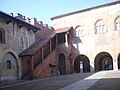
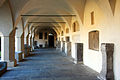
The new complex occupied an area four times larger and was oriented differently than the old theatre, with the entrance on the current via Fratelli Rosselli instead of today's largo Puccini. The external perimeter was surrounded by a porch in pink Baveno granite, with Doric style columns, and by a single floor with huge windows (alternating, also, with Ionic style columns).
Even today the grandeur of the horseshoe-shaped room is striking, surrounded by three orders of large boxes, the first gallery and the loggione, all decorated in the Renaissance style, with a series of Corinthian cast-iron columns surmounted by a sculpture depicting a swan. The capacity of the hall was 1500 seats, with a maximum of 1800 people; the latest restoration works, however, have reduced the capacity, bringing the number of seats to 918. The proscenium is 14 metres long, the depth is 23 metres, while the scenic tower of the grating is 22.5 metres high. There is also another hall for shows, called "Piccolo Coccia", with a capacity of 200 seats. The last restoration, completed in 1993, has brought back the original colours of the room (velvets in antique pink, ivory and gold decorations), after the changes that took place in the 20s/30s of the last century, which had replaced the upholstery with the red colour, and made total gilding of the parapets of the boxes.
Great debuts and artistic activity
The inauguration of the new Coccia Theater took place on the evening of 22 December 1888, with the opera Les Huguenots by Giacomo Meyerbeer, directed by the great virtuoso conductor Arturo Toscanini. Probably due to the complexity of the music, the inaugural opera was not well received. The Maestro Toscanini would direct in the Novara temple also Aida and La forza del destino by Giuseppe Verdi, as part of the inaugural season of the theater, conducted by Toscanini. On 21 December 1893, the second version of Giacomo Puccini's Manon Lescaut was performed for the first time at the Coccia. At the turn of 1895 and 1896, Maestro Antonino Palminteri directed respectively Tannhäuser by Richard Wagner and Loreley by Alfredo Catalani. In December 1900 Antonino Palminteri returned to Coccia to conduct Tosca and the success was so resounding that La Stampa expressed itself as follows: "The Tosca at the Coccia. As for the [...] splendid performance, the orchestra conducted by Palminteri, which he played with such confidence that it certainly did not reveal it was a first performance. And credit for this goes to maestro Palminteri who was able to give impetus, color and effectiveness [...] and therefore Puccini's music was well enjoyed." Giacomo Puccini sent to Maestro Antonino Palminteri a telegram reading: "Giacomo Puccini gratefully rejoices with the Egr. M° Palminteri and with the performers for the success obtained in Novara [...] Greetings and best wishes, G.Puccini." …
Text from Wikipedia, the free encyclopedia, under CC BY-SA 4.0. Full article: «Teatro Coccia».
Timeline
- 1886Built
Events and people from Wikidata (CC0).
Photos
Getting there
NovaraTrain, nearest
800 m as the crow flies
Teatro Coccia
Aeroporto internazionale Milano Malpensa "Silvio Berlusconi"22.1 km
Distances are as the crow flies, not walking or driving.
Loading map…
Nearby
See on the mapMore historic theatres in Piedmont


Frequently asked questions
Where is Teatro Coccia?
Teatro Coccia is in Novara, in the province of Novara (Piedmont), Italy. GPS coordinates: 45.44553, 8.61820.
How old is Teatro Coccia?
Wikidata dates it to 1886.
What else is there to see near Teatro Coccia?
Nearby you’ll find: Visconti-Sforza Castle (100 m away), Galleria d'Arte Moderna Paolo e Adele Giannoni (200 m away), Musei della canonica del duomo di Novara (200 m away).
Sources and licences
Text. Wikipedia, the free encyclopedia (CC BY-SA 4.0).
Data. Wikidata (CC0); opening hours and contacts OpenStreetMap (ODbL).
Photos. Wikimedia Commons, author and licence on every image.
Credits for the 6 photos
- Teatro Coccia Novara 2 — Photo: Andreas Praefcke, CC BY 3.0
- Mario Finotti - Les Ballets Trockadero - Teatro Coccia - Novara — Mario Finotti, CC BY 4.0
- Novara-Teatro Coccia-DSCF0925 — Twice25 & Rinina25, CC BY 2.5
- Teatro Coccia Novara 3 — Photo: Andreas Praefcke, CC BY 3.0
- Teatro nuovo di Novara xilografia — incisore anonimo, Public domain
- Paolo Coletta — Lazy001, CC BY-SA 4.0
Updated 28 October 2026. All sources and licences