


Photo: Parsifall, CC BY-SA 4.0 · Wikimedia Commons
At a glance
- Type
- Museum
- Period
- Early modern period, 1695
- Style
- Italian Baroque architecture
- Architect
- Francesco Croce
- Protection
- Italian national heritage
- Coordinates
- 45°27′35″ N, 9°12′19″ E
- Address
- Viale Regina Margherita
History and description
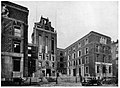
The Rotonda della Besana (also known as Rotonda di Via Besana or Complesso di San Michele ai Nuovi Sepolcri, and originally as Foppone della Ca' Granda) is a late baroque building complex and former cemetery in Milan, Italy, built between 1695 and 1732 and located close to the city center. The complex comprises a lobate hectagonal colonnade portico enclosing a garden and the deconsacrated church of San Michele ai Sepolcri ("Saint Michael by the Sepulchers"). The portico was designed by architects Francesco Croce and Carlo Raffaello Raffagno, while the church was designed by Attilio Arrigoni. Although originally a cemetery, over time the Rotonda has been adapted for a number of other uses; today, it is a leisure area and a venue for cultural events.
The complex covers an overall area of 7,100 m2 and owes its current name to its location, at number 15 of Via Enrico Besana.
History
The building was originally established to serve as a foppone (i.e., a cemetery for the poor) for the Ospedale Maggiore (also known as the Ca' Granda, "Big House"), and hosted about 150,000 burials, placed in a complex system of catacombs (the catacombs are no longer accessible). In 1787, under Austrian rule, cemeteries were moved outside the city walls, and the Rotonda cemetery was thus dismissed. Under Napoleonic rule, plans were made to redesign the Rotonda into a famedio (i.e., a honorific burial place) along the lines of the Panthéon in Paris, but these plans were later dismissed. The Rotonda was thus adapted for a number of other uses, including as a stable and a barn. In the 19th century it was returned to the Ospedale Maggiore, which used it as a cronicario (a shelter for the chronically sick) and a laundry building. The Ospedale eventually donated the structure to the Comune di Milano, in 1939. The Comune restored the complex and adapted it to serve as a green area and as a venue for cultural and social events.
Text from Wikipedia, the free encyclopedia, under CC BY-SA 4.0. Full article: «Rotonda della Besana».
Timeline
- 1695Founded
Events and people from Wikidata (CC0).
Photos
Getting there
Milano DateoTrain, nearest
1.3 km as the crow flies
Rotonda della BesanaViale Regina Margherita
Aeroporto di Milano-Linate5.4 km
Distances are as the crow flies, not walking or driving.
Loading map…
Nearby
See on the mapMore museums in Lombardy

- Free 1st Sunday


Frequently asked questions
Where is Rotonda della Besana?
Rotonda della Besana is in Milan, in the province of Milano (Lombardy), Italy. Address: Viale Regina Margherita. GPS coordinates: 45.45976, 9.20514.
How old is Rotonda della Besana?
Wikidata dates it to 1695.
What else is there to see near Rotonda della Besana?
Nearby you’ll find: Palazzo della Camera del Lavoro (300 m away), Porta Vittoria (300 m away), Società Umanitaria (300 m away).
Sources and licences
Text. Wikipedia, the free encyclopedia (CC BY-SA 4.0).
Data. Wikidata (CC0); opening hours and contacts OpenStreetMap (ODbL).
Photos. Wikimedia Commons, author and licence on every image.
Credits for the 8 photos
- Besana, Milano 01 — Parsifall, CC BY-SA 4.0
- 2016-10-31 Salvetti Milano Rotonda Besana 1 — Salvetti.photography, CC BY-SA 4.0
- 2016-11-04 Salvetti Milano Rotonda Besana 3 — Salvetti.photography, CC BY-SA 4.0
- Inside of the Rotonda della Besana 01 — Paolo fashionstreet, CC BY-SA 4.0
- L'interno della Rotonda della Besana — Maurizio Giuliano, CC BY-SA 4.0
- Le colonne della Rotonda della Besana — AlinaTrilok, CC BY-SA 4.0
- Milano - Rotonda della Besana - 2023-09-30 23-44-12 001 — Luca.salvetti, CC BY-SA 4.0
- Milano - Rotonda della Besana - 2024-09-27 12-11-58 001 — Scaroz, CC BY-SA 4.0
Updated 28 October 2026. All sources and licences