


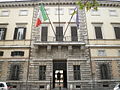


Photo: Sailko, CC BY-SA 3.0 · Wikimedia Commons
Fortress / Tower
Porta Santo Spirito
Gate of the Leonine walls in Rome, Italy
- Within the UNESCO World Heritage Site “Historic Centre of Rome, the Properties of the Holy See in that City Enjoying Extraterritorial Rights and San Paolo Fuori le Mura”
At a glance
- Type
- Fortress / Tower
- Coordinates
- 41°54′01″ N, 12°27′42″ E
History and description
Porta Santo Spirito is one of the gates of the Leonine walls in Rome (Italy). It rises on the back side of the Hospital of the same name, in Via dei Penitenzieri, close to the crossing with Piazza della Rovere.
History
It is one of the most ancient gates in the wall surrounding the Vatican, as it is contemporary to the building of the walls of Pope Leo IV, around 850.
Although it was the only direct connection between St. Peter's Basilica and the area of Trastevere (through Porta Settimiana), as well as the access to Via Aurelia nova, it was opened at first as a secondary passage.
Its former name was Posterula Saxonum (Postern of the Saxons). In effect, in 727 King Ine of Wessex, after having abdicated, moved to Rome, where he founded a Schola Saxonum (whose purpose was to provide a Catholic instruction to English clergy and nobles), together with a church and a graveyard. Saxon presence in the area is attested until the end of 12th century, when King Lohn Lackland assigned the complex of the Schola to the building of the Church of Santa Maria in Saxia (now Church of Santo Spirito in Sassia) and of the still existing Hospital, whose foundations were settled in 794. On that occasion Pope Innocent III also modified the name of the gate, giving it the present one.
The structure withstood several restorations and enlargements. A remarkable one was probably carried out at the beginning of the 15th century, maybe by Pope Gregory XII, given that the gate is called Porta Nuova (Italian for "New Gate") in a document dated 1409. At the beginning of the following century, Pope Alexander VI substantially modified this gate, together with other ones, as well as the surrounding wall; finally, about forty years later, Pope Paul III also made some interventions, using the advice and services of such engineers as Michelangelo and Antonio da Sangallo the Younger. A new fear of raids by Saracen pirates, as well as the modern poliorcetic techniques suggesting a massive use of artilleries, persuaded Paul III to modernize the walls, giving them significant defensive characteristics. …
Text from Wikipedia, the free encyclopedia, under CC BY-SA 4.0. Full article: «Porta Santo Spirito».
Photos
Getting there
Roma San PietroTrain, nearest
800 m as the crow flies
Porta Santo Spirito
Aeroporto di Roma-Ciampino15.6 km
Distances are as the crow flies, not walking or driving.
Loading map…
Nearby
See on the mapMore fortresses and towers in Lazio


- UNESCO


Frequently asked questions
Where is Porta Santo Spirito?
Porta Santo Spirito is in Rome, in the province of Roma (Lazio), Italy. GPS coordinates: 41.90031, 12.46161.
What else is there to see near Porta Santo Spirito?
Nearby you’ll find: Villa Barberini al Gianicolo (100 m away), Museo storico nazionale dell'arte sanitaria (200 m away), Palazzo Serristori (200 m away).
Sources and licences
Text. Wikipedia, the free encyclopedia (CC BY-SA 4.0).
Data. Wikidata (CC0); opening hours and contacts OpenStreetMap (ODbL).
Photos. Wikimedia Commons, author and licence on every image.
Credits for the 4 photos
- Roma, Porta Santo Spirito — Sailko, CC BY-SA 3.0
- Porta del Bastione detta di S. Spirito alla Lungara — Unknown Unknown, CC BY-SA 4.0
- Porte Santo Spirito - Rome (IT62) - 2021-08-25 - 1 — Chabe01, CC BY-SA 4.0
- Palazzo Corsini (77564080) — Giuseppe Vasi, Public domain
Updated 28 October 2026. All sources and licences